
Beyond Randomness: Driving MANET Mobility with Social Network Theory
An Efficient Social Network-Mobility Model for MANETs
This paper introduces an efficient Social Network-Mobility model for Mobile Ad Hoc Networks (MANETs) by replacing synthetic random movements with a framework based on Social Network Theory. By quantifying social relationships into a "Social Factor" (), the model generates realistic node distributions and link durations, outperforming the traditional Random Way-Point (RWP) model in capturing pedestrian patterns.
TL;DR
The movement of nodes in a Mobile Ad Hoc Network (MANET) is rarely random; it's driven by human intent. This paper presents a mobility model that replaces the chaotic "drunkard's walk" of the Random Way-Point (RWP) model with a mathematically rigorous framework based on social interactions. By calculating a Social Factor (), the authors predict where nodes go and how long they stay there, achieving far more realistic simulation results for campus and battlefield scenarios.
The Flaw in the "Random" Status Quo
For years, MANET research has relied on synthetic models like Random Way-Point (RWP). In RWP, nodes pick a destination, move there, and pause for a random duration. While mathematically tractable, it ignores a fundamental truth: humans move to socialise.
The authors argue that existing models lack:
- Time-Location Dependence: People visit specific places at specific times.
- Community Behavior: Group dynamics influence individual speed and direction.
- Realistic Pause Times: Staying at a location isn't a dice roll; it's a function of your relationship with the people there.
Methodology: The Geometry of Social Interaction
The core innovation lies in converting social "desire" into a physical vector. The paper builds this through several layers of abstraction:
1. The Social Factor ()
Instead of arbitrary connectivity, the model uses an Interaction Matrix (). The interaction between node and is weighted by their history. A critical contribution here is the Connection Threshold (CT), which isn't a fixed number but a dynamic function of Link Duration (LD) and Frequency of Connectivity (FC).
2. Intelligent Pause Time (PT)
While RWP uses a uniform distribution for pauses, this model defines Pause Time as a product of the Social Factor, Group Attraction (GA), and Previous Average Connectivity (PAC).
Formula Insight: If a group has a high attraction force and you have a history of connecting with them, your "Pause Time" increases. This mimics real-world scenarios like a student staying longer in a cafeteria when surrounded by friends.
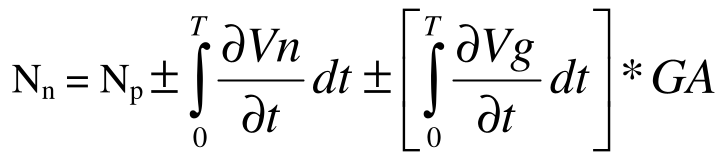
3. Group Velocity Dynamics
The node’s new position is not just its own velocity , but also includes an integral of the Group Velocity scaled by the Group Attraction.
Experimental Analysis: Campus vs. Battlefield
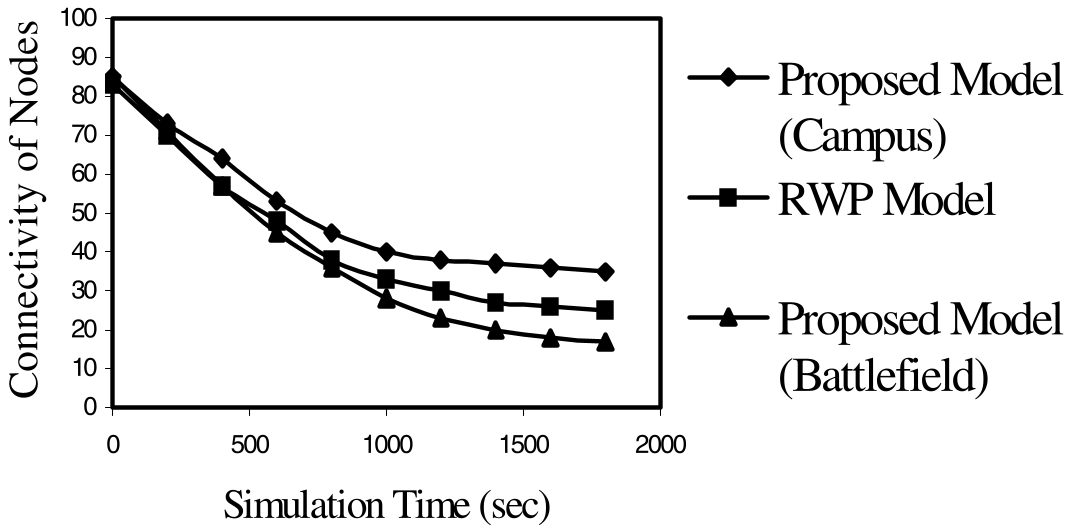
The authors simulated 100 nodes within a 250m transmission range of a Group Center. They compared the Node Distribution Pattern of their social model against the RWP model across two distinct social "grades": a campus environment and a battlefield.
Key Findings:
- RWP showed a uniform, context-blind distribution.
- The Proposed Model demonstrated "clumping" and movement patterns specific to the community type.
- Stability: The Social Factor () eventually reaches a steady state, allowing for predictable network topology analysis.
Critical Insight & Conclusion
The true value of this paper is the bridge it builds between Sociology and Wireless Engineering. By proving that pause times follow a specific user-oriented distribution rather than a random one, the authors challenge the foundation of many MANET routing protocols.
Takeaway: If you are designing an Ad Hoc network for human users (soldiers, students, or rescue workers), your simulation is only as good as your mobility model. Moving from "Random" to "Social" is not just a refinement—it's a requirement for accuracy.
Limitations: The current model does not yet account for physical obstacles (walls, terrain) which would further constrain social paths. The authors have noted this as their next frontier for research.