
O-M2D: Efficiently Unveiling the Strategic "Multi-Members" of Social Networks
Efficient unveiling of multi-members in a social network
The paper introduces O-M2D, an efficient algorithm for identifying "multi-members"—strategic actors belonging to multiple communities—within social networks modeled as hypergraphs. By bridging hypergraph theory and data mining, the authors equate multi-member detection to finding minimal transversals with maximal community recovery, achieving significant speedups over previous SOTA methods like MtMiner.
TL;DR
Identifying the "bridge" actors who connect disparate social communities is a computationally expensive task, traditionally requiring exhaustive relationship data. This paper introduces O-M2D, a hypergraph-based algorithm that identifies these "multi-members" (actors belonging to multiple groups) with unprecedented efficiency. By jumping directly to the optimal search depth using data mining heuristics, O-M2D solves high-cardinality problems where previous State-of-the-Art (SOTA) tools simply crashed.
Problem & Motivation: Beyond the Adjacency Matrix
Most social network analysis (SNA) assumes we have an adjacency matrix—a complete map of who knows whom. However, in modern platforms like del.icio.us (social tagging) or corporate skill databases, we often only see group membership:
- Community A: Users who tagged "Python".
- Community B: Users who tagged "Data Science".
The goal is to find the smallest set of people who "cover" all these communities. These actors are the influencers, mediators, and ambassadors. From a mathematical perspective, if communities are hyperedges in a hypergraph, these actors form a minimal transversal. The bottleneck? Finding minimal transversals is an NP-Hard problem, and classic algorithms like Berge's or MtMiner suffer from "exponential explosion" in memory and time as they climb the search tree.
Methodology: The "Essential" Shortcut
The authors propose a breakthrough by connecting hypergraph theory to Pattern Mining. They define a Minimal Transversal Multi-Member (Tmm) through three strict conditions:
- Transversality: Must have at least one member in every community.
- Minimal Cardinality: The set must be as small as possible (Level ).
- Maximal Recovery: Among minimal sets, favor those whose members belong to larger/more significant communities.
The core innovation is the O-M2D (Optimized M2D) algorithm. Unlike traditional breadth-first searches that examine every possible combination at Level 1, then Level 2, and so on, O-M2D uses a heuristic called GetMinTransversality. This allows the algorithm to "jump" directly to the target depth, bypassing billions of useless candidate evaluations.
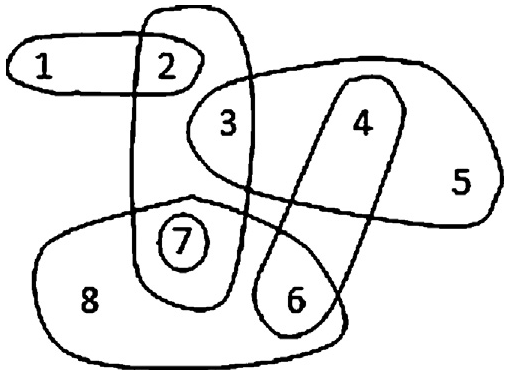 Fig 1: A hypergraph representation where vertices 1-8 are actors and hyperedges are overlapping communities.
Experiments & Results: Crushing the Baselines
The authors tested O-M2D against several heavyweights, including MtMiner, DUAL, and KS.
1. Superior Scalability
In the "Worst Case" synthetic datasets (designed to exhaust memory), O-M2D handled up to 73 hyperedges while DUAL and MtMiner failed after just 11-12. This is because O-M2D doesn't store the intermediate states of every level.
2. Real-World Performance
On folksonomy data (MovieLens & del.icio.us), O-M2D consistently clocked the fastest times.
- Del4 Dataset: While MtMiner and DUAL timed out or crashed, O-M2D reached the 21st level of the search space in roughly 365 seconds.
- Memory Greediness: O-M2D consumed orders of magnitude less RAM because it only computes the "Essentiality" condition for the target level.
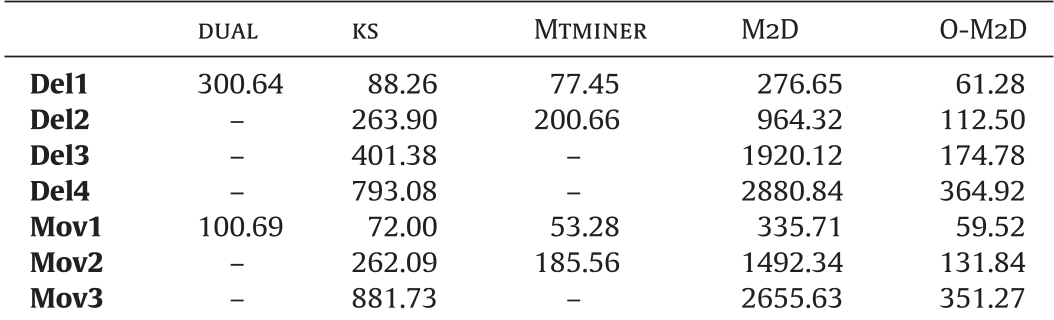 Table 6: Execution time comparison showing O-M2D's dominance in high-complexity datasets (Del3, Del4, Mov3).
Critical Analysis & Conclusion
The beauty of this work lies in its Inductive Bias: it recognizes that we don't need the entire set of minimal transversals—we only need the most efficient ones. By focusing on the "Essential Itemset" property, the authors effectively pruned the search space before even entering it.
Takeaway: If you are building a recommendation engine or an influencer marketing tool, don't just look for "degree centrality." Use hypergraph transversals to find the multi-members who truly bridge the silos of your network.
Limitations: While O-M2D is fast, the GetMinTransversality heuristic's accuracy on extremely non-uniform hypergraphs could be further explored. Future work should look at "redundancy-aware" transversals to handle duplicate community signals.