
AKT: Reinforcing Social Networks through Tie Strength and Engagement
Efficiently Reinforcing Social Networks over User Engagement and Tie Strength
The paper introduces the Anchored k-Truss problem, a novel optimization task aimed at reinforcing social networks by anchoring a limited budget of key users to prevent network unraveling. It utilizes the k-truss model to simultaneously account for user engagement (degree) and tie strength (triangles), proposing the AKT algorithm to efficiently find optimal anchors in large-scale graphs.
TL;DR
The death of social networks (like Friendster) often starts with a "cascade of departure." This paper introduces the Anchored k-Truss problem, a mathematical framework to identify which users a platform should incentivize to keep the most people active. By focusing on k-truss (triangles) rather than just k-core (degree), the authors ensure that preserved communities have not just many connections, but strong ones.
Background: Why Degree is Not Enough
For years, the "k-core" model was the gold standard for measuring user engagement. If every user has at least friends, the community is stable. However, k-core treats every edge the same. In reality, a connection supported by mutual friends (a triangle) is much stronger than a bridge between two strangers.
The k-truss model captures this by requiring every edge to participate in at least triangles. This paper argues that to stop a network from collapsing, we must reinforce these "strong ties."
The Problem: Computational Complexity
Finding the best users to "anchor" (give incentives so they never leave) is NP-hard for . Furthermore, the problem is non-submodular, meaning that the benefit of anchoring two users together might be greater than the sum of their individual benefits. This makes optimization extremely difficult.
Methodology: The "Edge Layer" Insight
The core contribution of this work is the AKT (Anchored k-Truss) algorithm. Instead of a "brute-force" recomputation of the k-truss for every possible anchor, the authors use a clever data structure called Edge Layers ().
1. The Edge Layer Structure
Edges are peeled away in layers based on their "support" (number of triangles). The algorithm only considers vertices incident to edges that almost made it into the k-truss as candidate anchors.
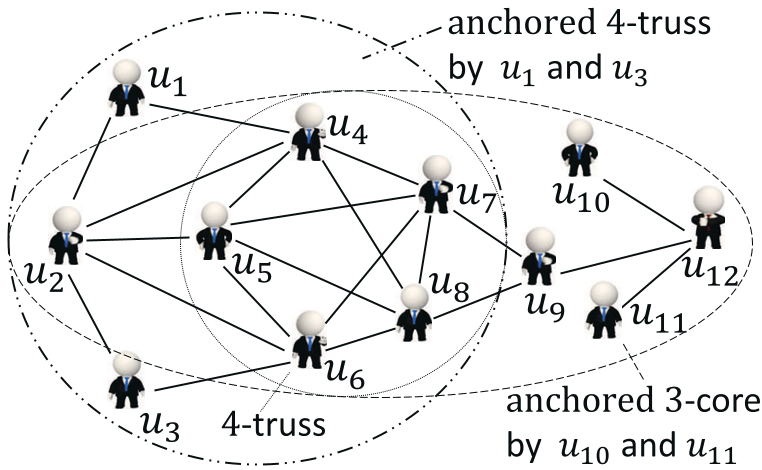 Fig 1: A motivation example showing how anchoring users and saves and expands the stable 4-truss.
2. Triangle Hold Paths
The algorithm defines "Triangle Holds." If an edge is anchored, it provides support to its neighboring edges in a triangle. This effect cascades. AKT uses a layer-by-layer search to track this "contagion of stability" efficiently.
Experimental Validation
The authors tested AKT on massive datasets, including Orkut (117M edges) and LiveJournal.
- Effectiveness: Compared to simple heuristics like "anchor the highest degree nodes," AKT identified users that preserved up to 5x more followers.
- Efficiency: While naive greedy algorithms fail on large graphs, AKT's pruning techniques (Theorem 5 & 6) reduce the search space by over 90% in most cases.
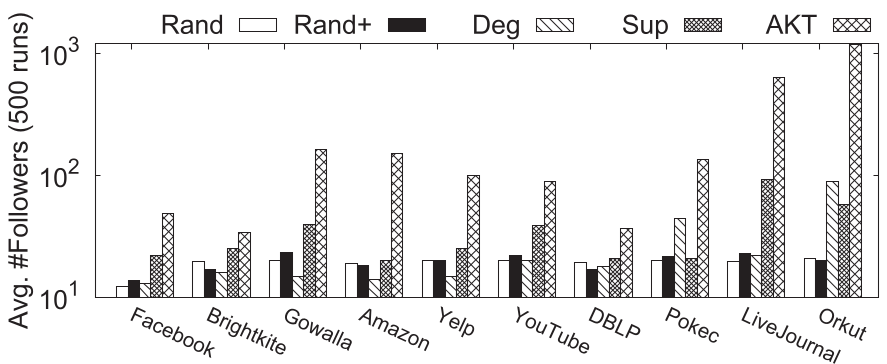 Fig 2: Comparison of follower gains across various datasets. AKT consistently identifies the most influential anchors for retention.
Depth Insight: k-Core vs. k-Truss
The paper's case study on Yelp is particularly revealing. While the k-core model often anchors "stars" with many loose connections, the k-truss model anchors "community pillars"—users who sit at the center of tightly-knit, cohesive clusters. Protecting a pillar saves the whole cluster; protecting a star might only save the star itself.
Conclusion & Future Outlook
The Anchored k-Truss model is a significant step forward in network science. It moves us from a "quantity" view of social connections to a "quality" view.
Limitations: The current model assumes an unweighted graph. In the future, incorporating edge weights (e.g., actual interaction frequency) could make the "tie strength" metric even more robust. Furthermore, extending this to Directed Graphs (distinguishing between cycle and flow triangles) opens new doors for analyzing information flow in platforms like Twitter or TikTok.