
Beyond the Silos: Mapping the Intellectual Prestige of Public Administration via Ego-Network Analysis
Using ego-network analyses to examine journal citations: a comparative study of public administration, political science, and business management
2021-11-08
Summary
Problem
Method
Results
Takeaways
Abstract
This study uses ego-network analysis to investigate the degrees of isolation, insularity, and prestige of journals in Public Administration (PA) relative to Political Science (PS) and Business Management (BM). By analyzing citation data from 2005 to 2015, it reveals that while top PA journals were historically isolated, major titles like PAR and JPART are achieving increased recognition and prestige across neighboring disciplines.
## TL;DR
Is Public Administration an academic island? This study utilizes **Ego-Network Analysis** and longitudinal citation data (2005–2015) to prove that while the field has been historically "isolated," its flagship journals (*PAR* and *JPART*) are rapidly gaining prestige and breaking into the citation networks of Political Science and Business Management.
## The Motivation: An Intellectual Identity Crisis
For decades, Public Administration (PA) scholars have agonized over their field's "standing." Heavyweights like Dwight Waldo and Herbert Simon debated whether PA was a branch of political theory or an empirical management science. This tension led to a persistent concern: PA was a "net importer" of ideas—citing everyone else but rarely being cited in return.
The authors argue that previous studies used "flat" metrics. To truly understand a field's health, we need to look at its **Ego-Network**—the specific constellation of connections (citations) surrounding a journal—and distinguish between:
1. **Insularity**: Do we only cite ourselves? (Out-degree)
2. **Isolation**: Does no one else cite us? (In-degree)
3. **Prestige**: Is the ratio of being cited vs. citing others favorable?
## Methodology: The Social Network of Science
The researchers didn't just count citations; they measured the *diversity* of those citations using the **Index of Qualitative Variation (IQV)**.
* **The "Ego"**: The focal journal.
* **The "Alters"**: The journals it interacts with.
By normalizing these scores, they could compare a small field like PA with "giants" like Business Management without the data being skewed by sheer volume.
## Key Insights: Decoding the Prestige Gap
### 1. The Isolation is Thawing
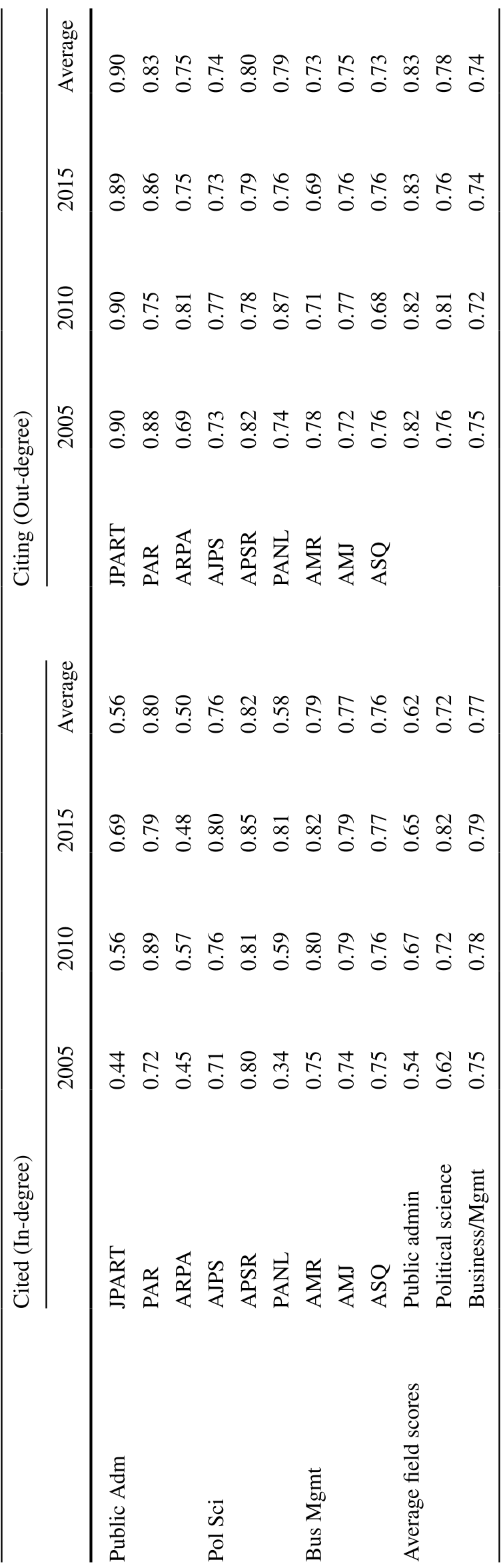
The study found that PA journals are generally more isolated than their peers. However, the trend is positive. *JPART* saw its in-degree IQV jump from **0.44 (2005)** to **0.69 (2015)**. This means its reach into other fields is expanding.
### 2. The Prestige Ratio: A Reality Check
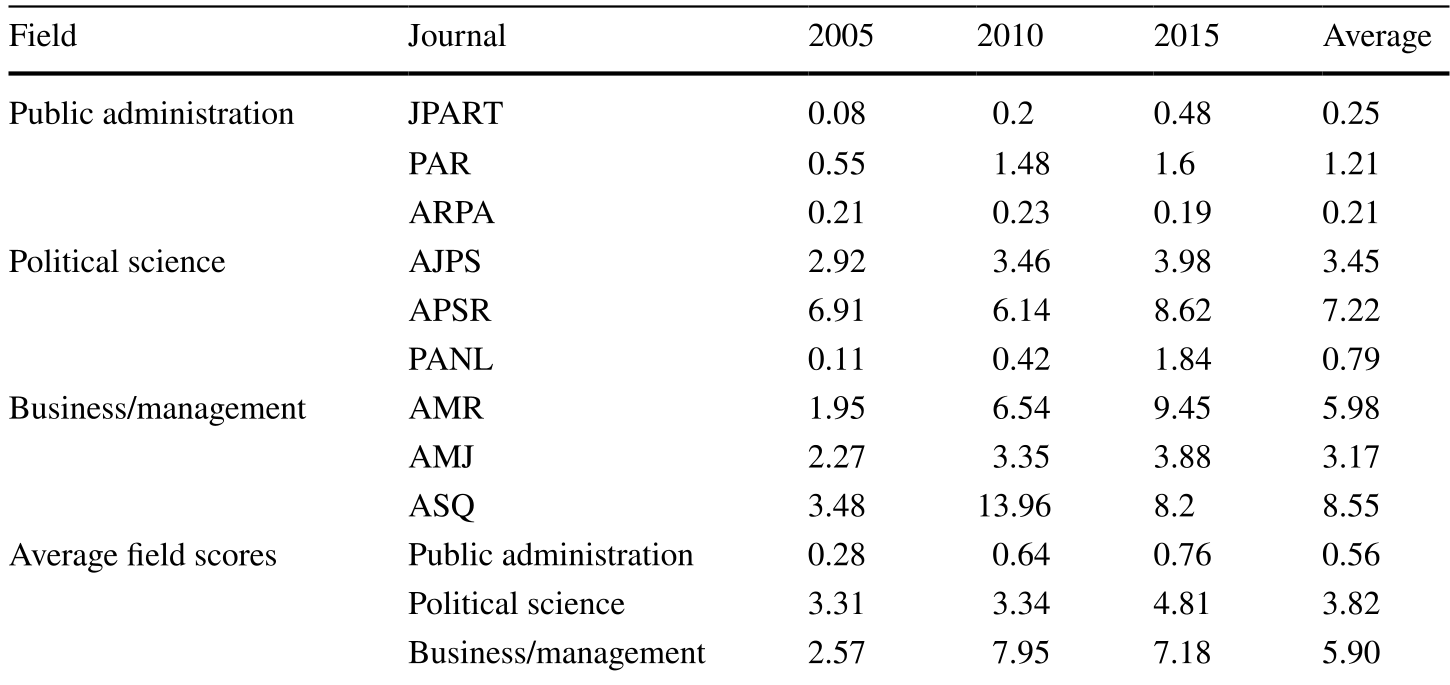
The most telling metric is the ratio of **Incoming ties** to **Outgoing ties**. A ratio > 1 means the journal is a "creditor" of knowledge.
* **Business Management**: Averaged a massive **5.90**.
* **Political Science**: Averaged **3.82**.
* **Public Administration**: Averaged **0.56**.
While the average is low, *PAR* (1.6) has successfully broken the barrier, meaning it is now recognized by other fields more than it acknowledges them.
## Critical Analysis: Why the Gap?
The authors suggest the "Intellectual Crisis" of PA—a lack of a single core theory—is a double-edged sword. It makes PA scholars **not insular** (they are very open to outside ideas, as shown by JPART’s high out-degree scores), but it makes other fields **reluctant to cite PA** because the field lacks a clear "exportable" theoretical brand.
### Limitations
* **The "WoS" Universe**: The study relies on Web of Science, which can be exclusive of non-English and practitioner-led works.
* **Top-Heavy Data**: By focusing only on the "Top 3" journals, we might miss the interdisciplinary "ferment" happening in mid-tier or specialized journals.
## Conclusion: A Promising Horizon
The data suggests that Public Administration is no longer "ships passing in the night" with Management and Political Science. The upward trend in prestige for *PAR* and *JPART* indicates that the rigorous, empirical turn in PA research over the last two decades is finally paying off in the broader marketplace of ideas.
**Takeaway for Researchers**: If you want to increase the prestige of your field, don't just borrow—specialize. When a field develops unique insights that others *must* use, the network shifts in its favor.