
Ego Network Models: Bridging Anthropology and the Future Internet
Ego network models for Future Internet social networking environments q
The paper presents a unifying framework for generating synthetic ego networks that realistically model human social structures for Future Internet environments. It introduces a constructive algorithm based on anthropological "Dunbar's number" theories and an analytical model that correlates ego network layers with the statistical properties of node contact processes in Mobile Social Networks (MSNs) and Social Pervasive Networks (SPNs).
TL;DR
Human social networks are not flat; they are organized into concentric circles of intimacy. This paper leverages "Dunbar’s Number" to create a constructive algorithm and analytical model for synthetic ego networks. By mapping social intimacy to contact frequency, the authors explain why aggregate human contact patterns exhibit heavy tails and provide a roadmap for designing more efficient Mobile Social Networks (MSNs).
The "Dunbar" Intuition: Why Social Structure Matters
In the world of opportunistic networking (think "store-carry-and-forward"), we often treat node meetings as stochastic events. However, humans don't move or meet randomly. We have a "time budget" for social interaction, and our brains have a cognitive limit on how many relationships we can maintain.
The authors identify a critical gap: networking researchers often use power-law distributions for Inter-Contact Times (ICT) without understanding the social architecture that generates them. By looking at Ego Networks (networks centered around a single 'ego'), we can model the Future Internet as a reflection of physical human behavior.
Methodology: From Intimacy to Inter-Contact Times
1. The Layered Ego Network
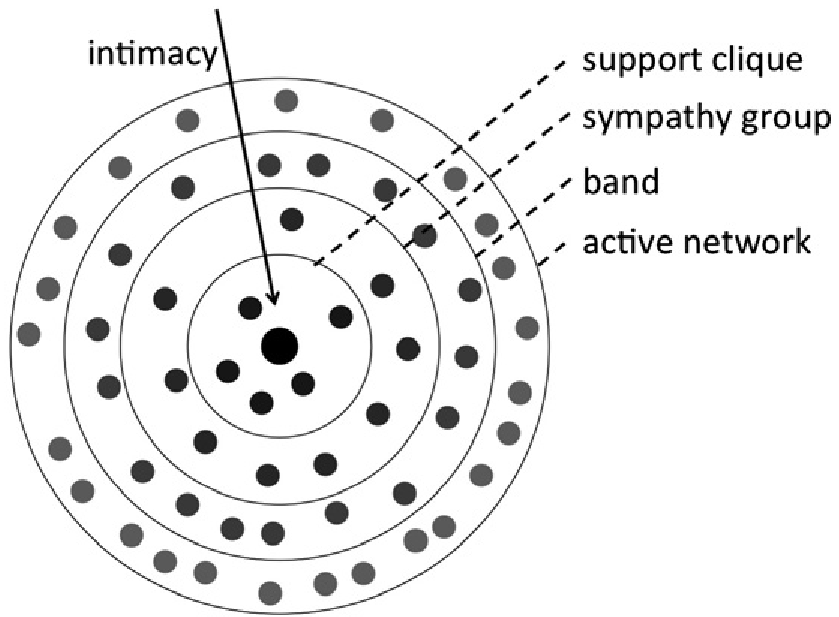
The core of the methodology is the hierarchical structure of acquaintanceship. An ego network typically consists of:
- Support Clique (~5 people): The inner-most circle of high intimacy.
- Sympathy Group (~12-15 people): Regular, close contacts.
- Active Network (~150 people): The "Dunbar's Number" limit of stable social relationships.
2. The Constructive Algorithm
The authors propose an algorithm that:
- Assigns a Time Budget to the Ego.
- Samples layer sizes based on Gamma distributions.
- Distributes intimacy (Emotional Closeness) and maps it to specific time costs, differentiating between Kin (family) and Friends. Kin bonds are "cheaper" to maintain at lower intimacy levels.
3. The Contact Process Model
The breakthrough here is the mapping of social layers to Contact Rates (). By partitioning a Gamma distribution of contact rates across the social layers, the authors show that the outer-most layers (the most numerous but least frequent contacts) dominate the tail of the aggregate contact distribution.
Experimental Results and SOTA Comparison
The model was validated against 251 real-world ego networks and various opportunistic networking traces.
| Layer | Min | Max | Avg (Synthetic) | Ref Value (Dunbar) |
|---|---|---|---|---|
| Active Network | 3 | 585 | 133.33 | 132.5 |
| Sympathy Group | 0 | 77 | 14.05 | 14.3 |
| Support Clique | 0 | 45 | 4.62 | 4.6 |
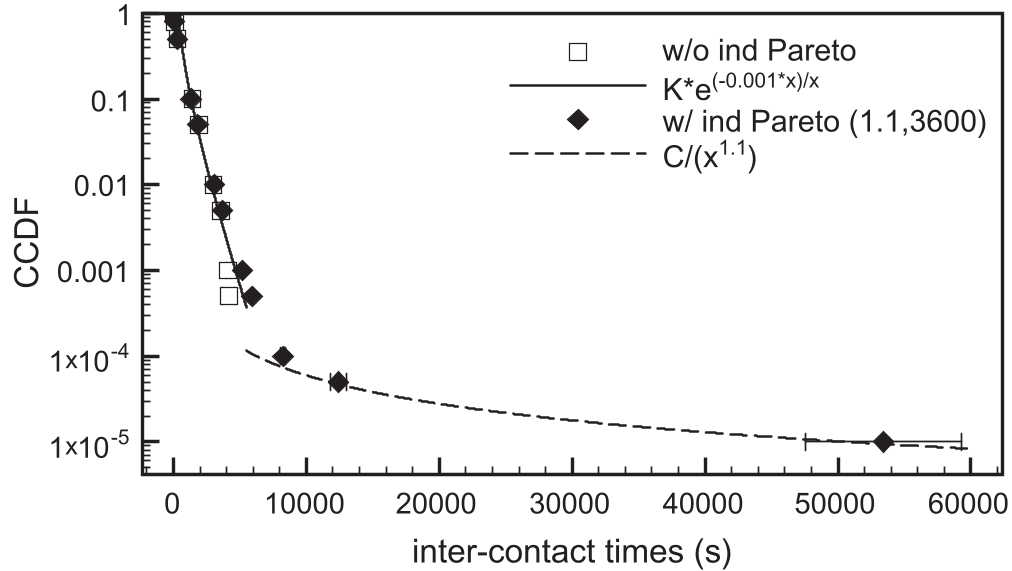
The results confirm that the synthetic ego networks successfully mimic both the structural properties (layer size and composition) and the temporal properties (aggregate ICT power-law behavior) of real human interactions.
Critical Insights: The "Single Pair" Hazard
A fascinating theoretical takeaway is the authors' analysis of power-law distributions. They prove that even a single pair of nodes with a power-law ICT distribution can cause a forwarding protocol to experience infinite expected delay. This highlights the necessity of accurate individual-pair modeling rather than just relying on "aggregate" network statistics which can mask dangerous heterogeneity.
Conclusion & Perspective
This paper represents a significant step towards "Socially Aware Networking." Instead of treating the "Cyber" and "Physical" worlds as separate entities, the authors treat technology as a mediator that inherits the invariant properties of human sociality.
Future Outlook: As we move toward 6G and pervasive computing, these models will be vital for designing "Trusted P2P" systems where communication channels are activated along lines of existing social trust, naturally inheriting the security and reliability of human bonds.