
Digital Shadows of the Social Brain: Validating Dunbar’s Number on Facebook
Analysis of Ego Network Structure in Online Social Networks
This paper investigates the structural organization of Online Social Networks (OSNs) through the lens of the "Ego Network" model. By analyzing a massive Facebook dataset of 3 million users and 23 million interactions, the authors validate that digital social structures mirror the hierarchical "Dunbar's Circles" found in offline environments, characterized by four layers and a scaling factor of approximately three.
TL;DR
Does the internet actually change how we socialize? While platforms like Facebook allow us to "friend" thousands, a deep dive into interaction data reveals a sobering truth: our digital social lives are almost identical to our physical ones. This study proves that Facebook users organize their friends into four distinct circles of intimacy, adhering to the same cognitive limits discovered by anthropologists decades ago—including the famous Dunbar's Number.
Problem & Motivation: The Myth of Infinite Connection
Since the inception of Online Social Networks (OSNs), there has been a debate: do these tools expand our social capacity? Anthropologist Robin Dunbar famously argued that human brain size (the neocortex) limits us to maintaining around 150 active relationships.
The authors identified a major gap in OSN research. While most studies looked at the "Global Graph" (how everyone is connected to everyone), very few looked at the Ego Network (how one person manages their specific ties). The authors set out to determine if the "cost" of maintaining a digital tie is low enough to break the hierarchical structure of traditional human social groups.
Methodology: Mapping Intimacy via Interaction
Intimacy is hard to measure directly. Following anthropological standards, the authors used contact frequency as a proxy for social closeness.
- Dataset: 3 million Facebook users from a 2008 regional crawl.
- Interaction Frequency: They didn't just look at "Friendship" (which can be passive), but at Wall posts and photo comments across four time windows (1 month to "all-time").
- Clustering: To find the "circles," they used a 1D k-means algorithm. This allowed the data to tell them how many layers naturally exist. They also used DBSCAN to ensure "noise" (random, one-off interactions) didn't skew the results.
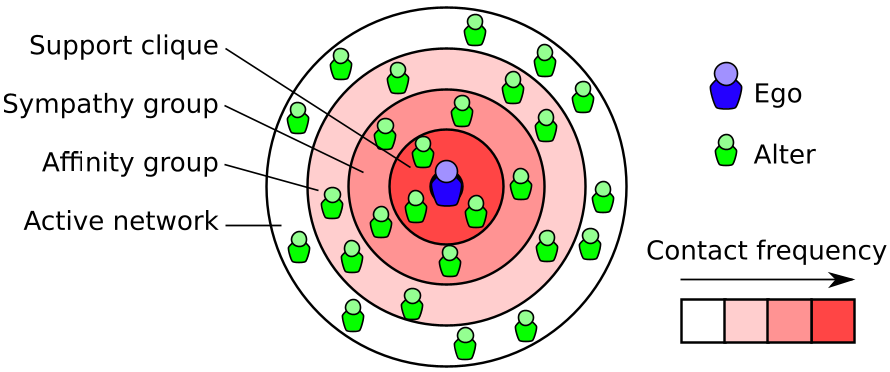 Figure 1: The hierarchical model of ego networks, featuring concentric circles of increasing size and decreasing intimacy.
The Core Findings: 4 Layers, 1 Constant
The analysis yielded "strikingly similar" results to offline social networks:
- The Layer Count: The optimal number of clusters for most users was 4.
- The Scaling Factor: In offline networks, each successive circle is roughly 3x larger than the previous one (5, 15, 50, 150). On Facebook, the authors found a scaling factor of 3.12.
- Dunbar's Number: By accounting for the fact that they only had a 43% sample of the network, the authors estimated an active network size of 128.16—sitting right in the pocket of the 150-person Dunbar limit.
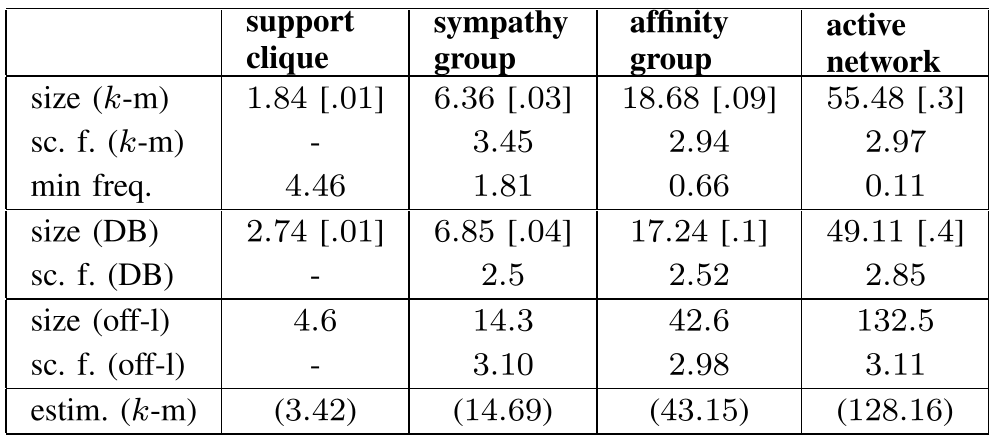 Table 1: Comparison of Circle Sizes. Note how the "estim. (k-m)" row closely aligns with the "size (off-l)" findings from classic anthropology.
Critical Insight: The "Support Clique" is Universal
One fascinating takeaway is that even "low-activity" users on Facebook (those with fewer total friends) still prioritize a small "Support Clique" of ~5 people. The authors found that while outer circles (acquaintances) might shrink if you aren't a "power user," the inner-most circle of high-frequency contact remains remarkably stable. This suggests that certain tiers of our social network are biologically mandatory for emotional support, regardless of how much we use the technology.
Conclusion & Perspective
This paper serves as a powerful reminder of biological determinism in the age of AI and hyper-connectivity. It suggests that while we can build tools to contact anyone, we cannot build a brain that cares about everyone.
Limitations: The data is from 2008. In 2026, with the rise of algorithmic feeds (TikTok style) and "Parasocial" relationships, one might wonder if the active network has actually shrunk as we spend more time interacting with content rather than ego-to-alter social ties.
Future Work: Investigating whether "Passive Consumption" (scrolling without commenting) follows these same hierarchical rules could be the next frontier in understanding the cyber-physical social evolution.