
EHR Model: Why Social Sharing Trumps Self-Tracking in Health Tech Adoption
EHR: a Sensing Technology Readiness Model for Lifestyle Changes
The paper introduces the EHR (e-Health Readiness) model, a framework designed to predict user adoption of pervasive sensing technologies for lifestyle changes. Validated via a large-scale psychometric study (N=541), the model proves that overall readiness is driven by three key functional pillars: self-reflection, social sharing, and personalized recommendations.
TL;DR
Sensing technology for health is moving from the lab to the street, but why do some people embrace it while others resist? This paper presents the EHR (e-Health Readiness) model, revealing that our willingness to use health sensors isn't just about "being healthy"—it's deeply tied to our desire to share data with loved ones and our baseline satisfaction with technology. Surprisingly, social features are more persuasive for adoption than the act of self-monitoring itself.
The "Lay User" Gap
Most health tech research focuses on patients (managing chronic illness) or athletes (optimizing performance). However, the vast majority of potential users are "laypersons"—people who are currently healthy but at risk due to modern lifestyles (stress, inactivity).
The authors argue that we cannot treat a busy office worker the same as a hospital patient. There are unique psychological barriers:
- Fear of Monitoring: The creepy factor of being "watched" by a device.
- Technology Overload: The feeling that adding another "smart" device actually degrades quality of life.
- Social Hesitation: The tension between wanting support and fearing over-sharing.
Methodology: Mapping the Human Factor
To decode these barriers, the researchers built a four-tier hierarchical model and tested it on 541 participants using Structural Equation Modeling (SEM). This allowed them to see not just if factors were related, but the strength of the causal links.
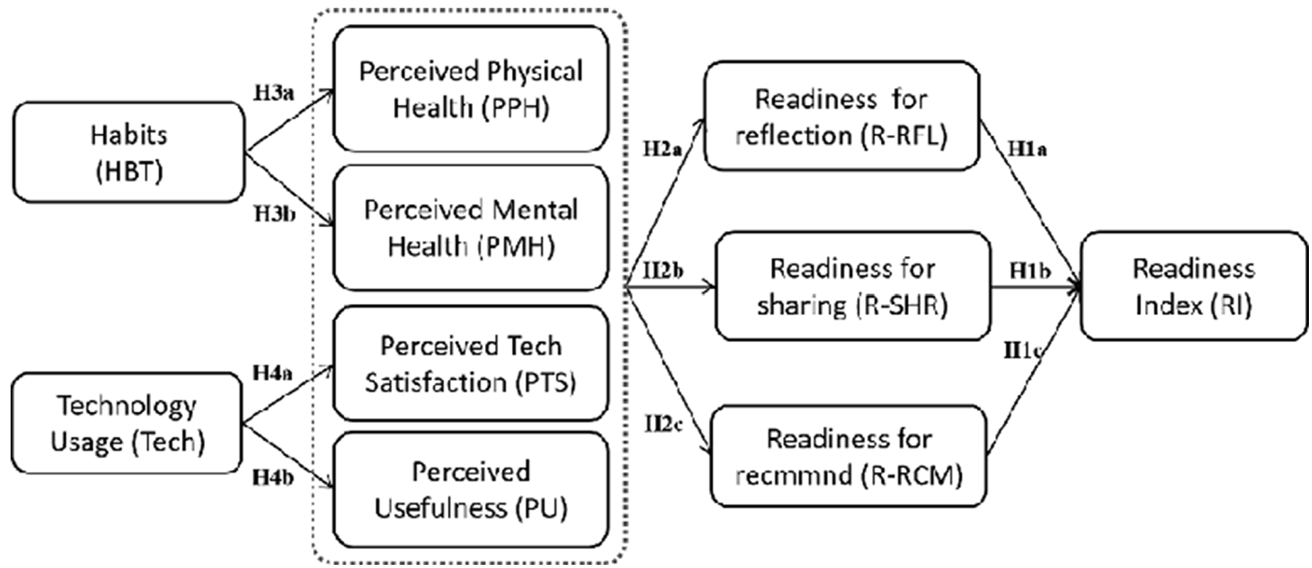
The model breaks down into:
- Habits: Your actual daily behavior (How much do you sleep? How well do you eat?).
- Perceptions: Your subjective view of your health and tech.
- Specific Readiness: Willingness to engage in three core functions: Self-Reflection, Sharing, and Recommendations.
- Overall Readiness: Your global intention to adopt the tech.
Key Insights: It’s More Social Than We Thought
The study's results challenged the common assumption that "reflection" (seeing your own data) is the primary driver for health tech.
1. Sharing is the "Silver Bullet"
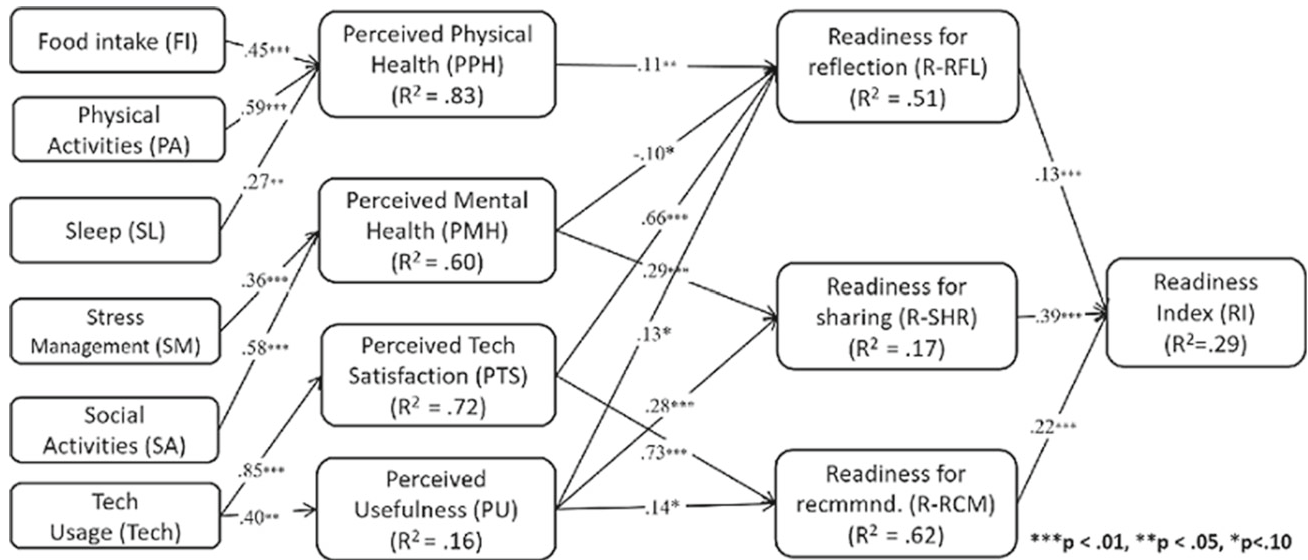
The path from Readiness for Sharing to Overall Readiness was the strongest (). People are much more likely to adopt a sensing tool if they perceive it as a bridge to their family and friends rather than just a private mirror.
2. The Mental Health Paradox
The study found a fascinating split:
- Users with lower perceived mental health were more willing to monitor themselves (seeking answers).
- However, they were less willing to share data.
- Design Implication: Apps for mental wellness should focus on private self-reflection first, only introducing social features as the user's perceived mental health improves.
3. Technology Satisfaction is a Gatekeeper
If a user finds technology frustrating generally, they are highly unlikely to accept "recommendations" from a machine (). For health tech to reach the masses, it must feel less like a "computer" and more like a seamless part of the environment.
Design Implications for the Future
Based on the EHR model, the authors suggest several pivots for developers:
- Move Beyond the Dashboard: Provide actionable social sharing and reliable, low-embarrassment recommendations.
- Focus on Reliability: Qualitative feedback showed that "skepticism about machine authority" is a major hurdle. If a sensor recommends a behavior, it needs to cite its "source" (e.g., medical experts vs. generic algorithms).
- Simplicity is Health: To capture the "tech-frustrated" segment, sensors must be unobtrusive, aesthetic, and require zero configuration.
Critical Analysis & Conclusion
The EHR model is a significant step toward a "Human-Centered" view of preventative health. By moving the focus from data accuracy to user readiness, it provides a roadmap for the next generation of wearables.
Limitations: The study sample leaned heavily toward younger users in India and the US. Future research will need to validate if "Readiness for Sharing" remains the top driver for elderly populations, who may have higher privacy concerns or different social structures.
Final Takeaway: If you want someone to wear a heart monitor, don't just tell them it will save their life—tell them it will let their grandchildren know they are okay.