
Eigenspace Analysis: Unmasking Hidden Threats in Social Networks
Eigenspace analysis for threat detection in social networks
The paper presents a statistical framework for detecting small, anomalous threat subgraphs within large, noisy social networks using the spectral properties of the modularity matrix. By analyzing eigenvector norms and applying temporal integration (matched filtering), the authors achieve SOTA-level detection performance for realistic, non-dense threat signatures in both static and dynamic R-MAT backgrounds.
TL;DR
This research from MIT Lincoln Laboratory addresses the "needle in a haystack" problem of social network analysis: finding a small group of coordinated actors (threats) hidden within a massive, noisy background. By shifting from standard PCA to an analysis of Modularity Matrix Eigenspaces and employing Temporal Matched Filtering, the authors prove that even sparse threat networks can be detected with high accuracy if their temporal evolution is known.
Problem & Motivation: The Limits of Traditional Vision
In the context of law enforcement and intelligence, a "threat" isn't always a dense, obvious clique. It might be a sparse chain of communications (like the Jakarta embassy bombing plan) that mirrors the "standard" behavior of a social network.
The core challenge is two-fold:
- Non-Euclidean Geometry: Standard signal processing assumes data points in a coordinate system. Graphs (nodes and edges) don't play by these rules.
- Background Dominance: In real-world "Power Law" networks (modeled here by R-MAT), the most significant eigenvectors often capture global clustering patterns, completely drowning out the local signal of a 20-person threat cell.
Methodology: Modularity and the Insight
The authors' weapon of choice is the Modularity Matrix :
This matrix represents the difference between the actual network connections () and what we would expect from a random null model ().
The Norm Trick
Normally, researchers look at the largest eigenvalues. However, a small threat might not affect the global scale. Instead, the authors look at the norm of the eigenvectors. Because eigenvectors are unit-normalized ( norm = 1), an eigenvector that is "aligned" with only a few specific nodes (the threat) will have a much smaller norm than one spread across the whole graph.
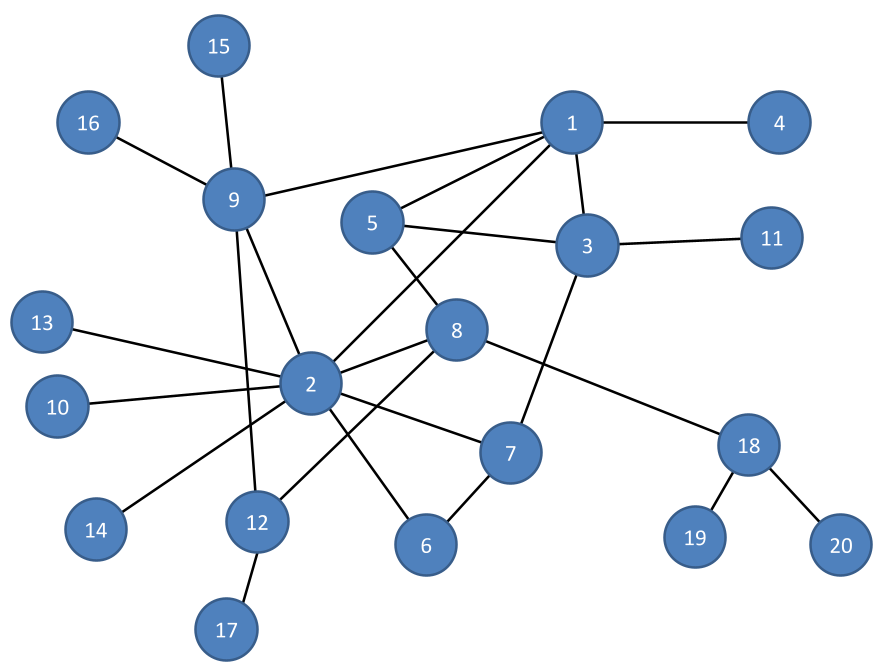 In the figure above, the threat vertices (red) are completely overlapping with the background noise in standard PC1/PC2 space, rendering traditional PCA-based detection useless.
Dynamic Detection: Temporal Matched Filtering
The paper's most significant contribution is the extension into dynamic graphs. A threat might be invisible in a single snapshot, but its growth pattern is unique.
The authors treat the modularity matrices at different time steps as a signal stream and apply a filter :
By designing to emphasize threat-like evolution (e.g., a "sinusoidal" rise and fall of communication) and de-emphasize background noise, they achieve "Temporal Integration Gain."
Experiments & Results
The researchers tested this against a simulated CT-SNAIR threat (20 nodes, 25 edges).
- Static Results: Detection failed (stayed near chance/50% EER) when the threat was randomly placed. However, if the threat was placed in the "null space" of the background's strongest components, analysis became effective.
- Dynamic Results: This is where the method shined. By using a 32-sample window, the Equal Error Rate (EER) dropped to <3%.
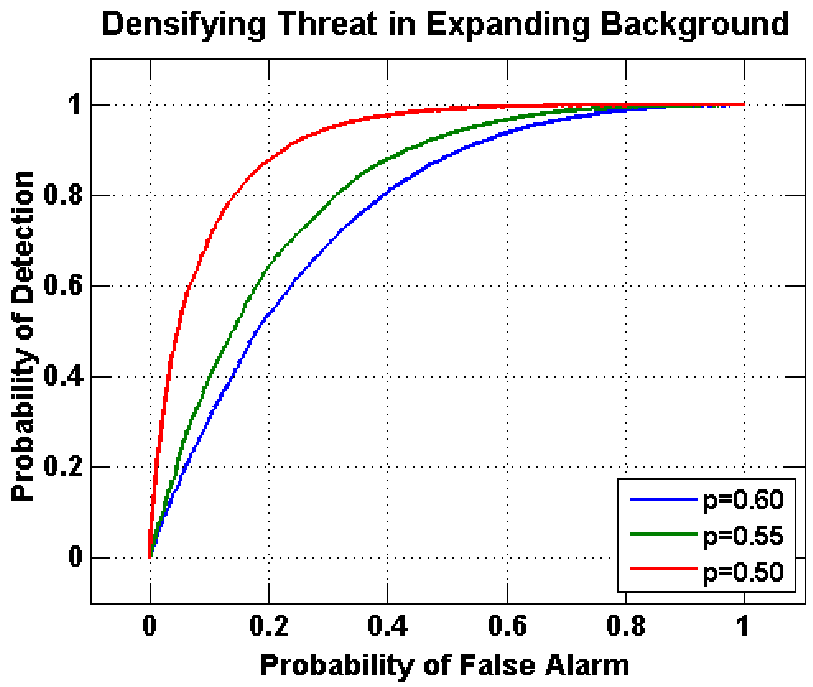 Figure (c) shows that for sinusoidal growth models, the integrated signal power is so high that detection is nearly perfect across various background noise levels ().
Critical Analysis & Conclusion
Takeaway
The paper shifts the focus from static topology to dynamic behavior. It argues that we shouldn't just ask "Does this group look suspicious?" but rather "Is this group becoming suspicious in a way we recognize?"
Limitations
The "Expanding" background model (where edges are added but never removed) caused the Chi-squared test to fail, resulting in 50% EER. This suggests the current symmetry-based statistics struggle with backgrounds that have non-stationary structural shifts.
Future Work
The authors suggest that cued detection (starting with one known suspicious individual) could further refine these spectral tools. By focusing on eigenvectors strongly associated with a specific "seed" node, we can uncover the rest of the threat cell even in high-noise environments.