
eLearning & Social Software: From Passive Consumption to Collaborative Creation in Higher Education
eLearning: A social software in higher education learning
2011-05-23
Summary
Problem
Method
Results
Takeaways
Abstract
This paper investigates the integration of Web 2.0 and Social Software (Blogs, Wikis, Facebook) into higher education as a means to transform traditional passive learning into an interactive, participative social process. Based on a survey at the Polytechnic of Rijeka, it evaluates student engagement and the shifting role of digital learning contents in academic settings.
## TL;DR
While modern students are "digital natives," their use of Web 2.0 tools in education remains largely passive. This paper explores how Social Software—including Wikis, Blogs, and Social Networks—can break the cycle of traditional memorization-based learning, provided that higher education institutions facilitate a shift toward student-led content creation.
## The Motivation: Why Traditional eLearning is Failing
The authors argue that traditional education fosters "submissiveness and passiveness." Static textbooks are being replaced by the internet, yet the pedagogical approach often remains rooted in the past. The core problem is that simply moving a lecture online doesn't change the power dynamic; the teacher remains the "sage on the stage" while the student remains a consumer.
The **Insight** of this paper is that Web 2.0 isn't just a technical upgrade—it's a psychological one. By using tools that students already use for socialization (Facebook, YouTube, Skype), educators can tap into existing habits to foster *experiential learning*.
## Methodology: The Web 2.0 Learning Frame
The researchers define a new framework for knowledge creation that moves away from fixed curricula. Key elements include:
* **Dynamic Curriculum**: Small, interdisciplinary modules that combine formal and informal learning.
* **Student Support**: Moving from "instructor-only" help to peer-to-peer virtual communities.
* **Content Generation**: Shifting the effort of synthesis from the teacher to the student (e.g., student-written Wikipedia articles).

*(Figure Note: This framework highlights the transition from centralized control to distributed, communicative knowledge sharing.)*
## Experimental Analysis: The Polytechnic of Rijeka Case Study
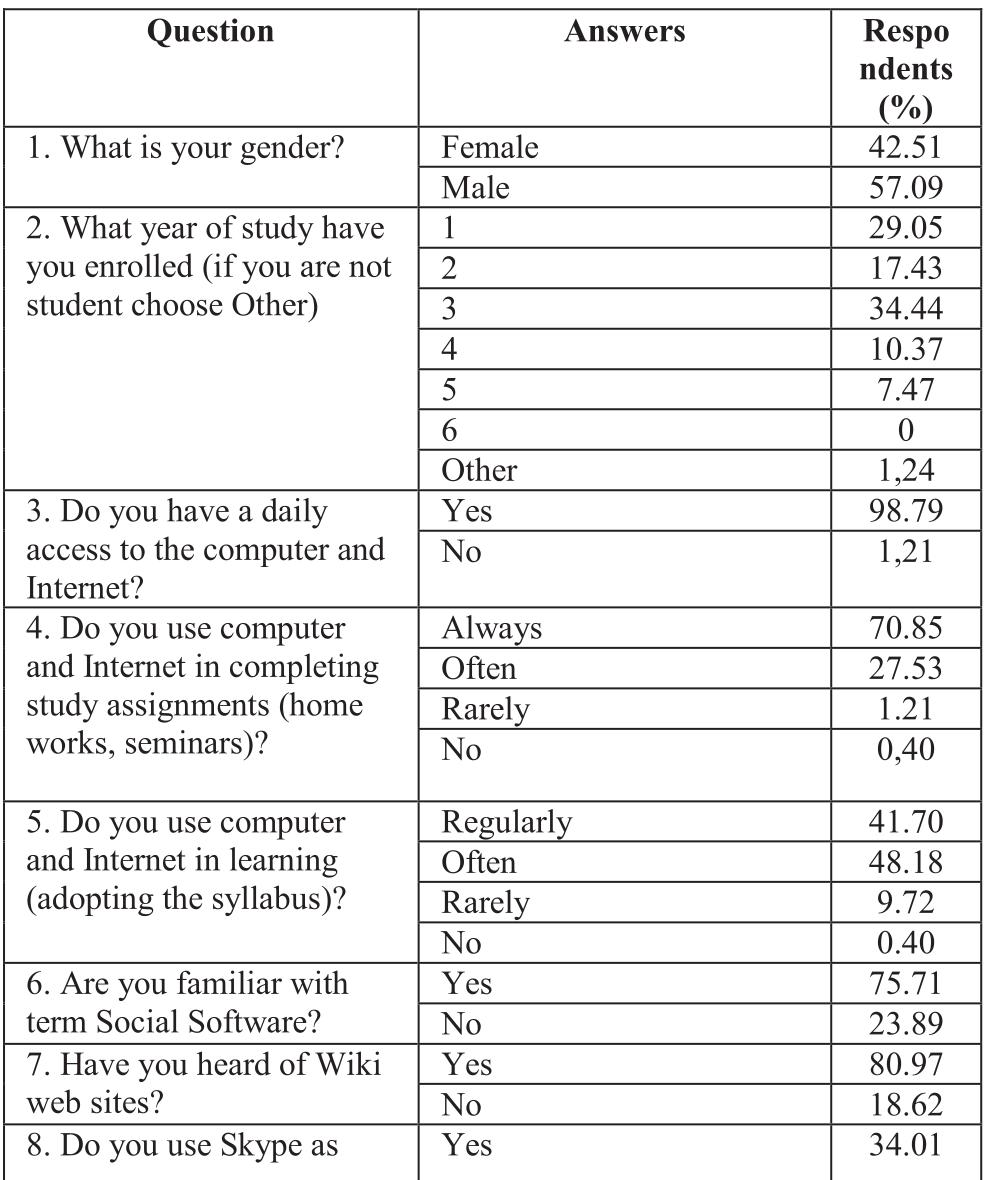
The paper presents data from a 2011 survey at the Polytechnic of Rijeka. While the data is a decade old, it highlights a persistent "Digital Literacy Gap."
### Key Findings:
1. **High Access, Low Interaction**: 98.8% of students have daily internet access, yet **85.4%** have never contributed to a Wiki.
2. **Trust Issues**: 45% of students doubt the authenticity of social software content, yet 65% admit it helps them significantly in their work.
3. **The Rise of Informal Tools**: Tools like YouTube (used for video classes) and GoogleDocs emerged as high-frequency "helper" tools.
## Critical Insights: The "Active Learner" Paradox
The most striking result is the contradiction in student attitudes. While 57.5% of students support social software as a primary teaching tool, very few possess the drive to contribute to it autonomously. This suggests that the barrier isn't *access* to technology, but *instructional design*.
**Ablation of Traditional Methods**: The study suggests that social software should not "replace" libraries or teachers but act as a "supplemental catalyst." Only 10.5% of students wanted to learn *solely* via social software, indicating that the human element of guidance remains crucial.
## Conclusion & Future Outlook
The paper concludes that Social Software is essential to making higher education "fresher" and more relevant to new generations. However, the move to Web 2.0 (and now toward AI-integrated learning) requires a fundamental shift in how we define "learning content."
**Takeaway**: Future research should focus on how to bridge the gap between "knowing a tool exists" and "knowing how to use that tool for critical knowledge synthesis." As we move into an era of AI-generated content, the "participative social process" described here becomes even more vital for verifying accuracy and maintaining human critical judgment.
### Limitations
* The sample size was limited to a specific region (Croatia).
* The technology landscape has shifted significantly since 2011 (the decline of Facebook in favor of newer platforms).