
Twitter as a Political Microscope: Analyzing the 2017 French Primaries
Elections and the Twitter Community: The Case of Right-Wing and Left-Wing Primaries for the 2017 French Presidential Election
This study employs Social Network Analysis (SNA) to examine the Twitter landscape during the 2017 French Presidential primary elections. By constructing mention and hashtag graphs, the authors identify key influencers, media roles, and the prevalence of social bots across the left and right political wings.
TL;DR
Can Twitter activity actually mirror the ballot box? In "Elections and the Twitter community," researchers Karina Sokolova and Charles Perez dive into the 2017 French Presidential primaries. By analyzing over 590,000 tweets, they demonstrate that social media isn't just a vacuum of opinions—it's a structured network where mention graphs correlate strongly with voting ranks, and traditional media acts as the vital bridge between polarized ideological camps.
The Motivation: Beyond Simple Opinion Polls
Traditional polling often misses the intensity and structure of political engagement. The authors recognized that during the high-stakes 10 days leading up to an election, Twitter becomes a dense ecosystem of candidates, citizens, and media. The fundamental question was: Do the structural properties of these online networks—who mentions whom and which hashtags co-occur—reveal the underlying health and direction of a political movement?
Methodology: Mining the Mention and Hashtag Ecosystem
The researchers didn't just count tweets; they mapped the "connective tissue" of the conversation using two primary tools:
- Mention Graphs: Where nodes are users and edges represent interactions. This reveals the "In-degree" (popularity/influence) and "Out-degree" (activity level).
- Hashtag Co-occurrence Graphs: This maps how topics are linked. For instance, how #Direct and #RadioLondres (a tag used to bypass legal blackouts on early result reporting) clustered around specific wings.
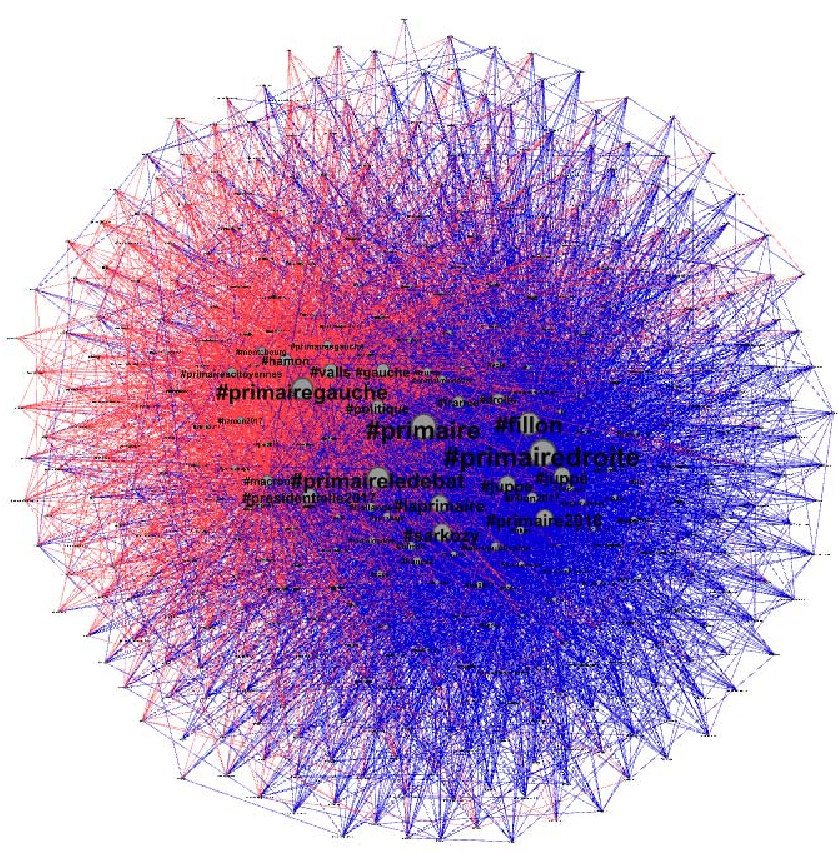
The Macro View: Combined Hashtag Dynamics
The study visualized a "Giant Component" where the left and right wings, though distinct, were tethered by official debate hashtags.
Key Findings: Twitter Activity vs. Reality
One of the most striking results was the Kendall rank correlation. For the left-wing primary, the correlation between Twitter volume rank and actual voting rank was a staggering 0.81.
| Candidate (Right-wing) | Vote Rank | Tweet Rank | Gap |
|---|---|---|---|
| François Fillon | 1 | 3 | +2 |
| Alain Juppé | 2 | 2 | 0 |
| Nicolas Sarkozy | 3 | 1 | -2 |
Note: While winners were always highly discussed, they weren't always the #1 trending topic, often because controversial figures (like Sarkozy) generate more "noise" regardless of their final vote share.
The Role of Mediators and "Ghosts"
The analysis identified three tiers of influence:
- The Candidates: High in-degree (everyone talks to them), low out-degree (they rarely reply).
- The Media: The bridges. Accounts like "Media 1" and "Media 4" showed high engagement across both left and right-wing datasets, acting as the common ground for information.
- The Bots: The researchers discovered "Active" accounts with massive out-degrees (mentioning hundreds of users daily) that have since been deleted. These "ghost" nodes suggest a systematic attempt to inject influence through automation.
Temporal Saliency: The "Small Candidate" Peak
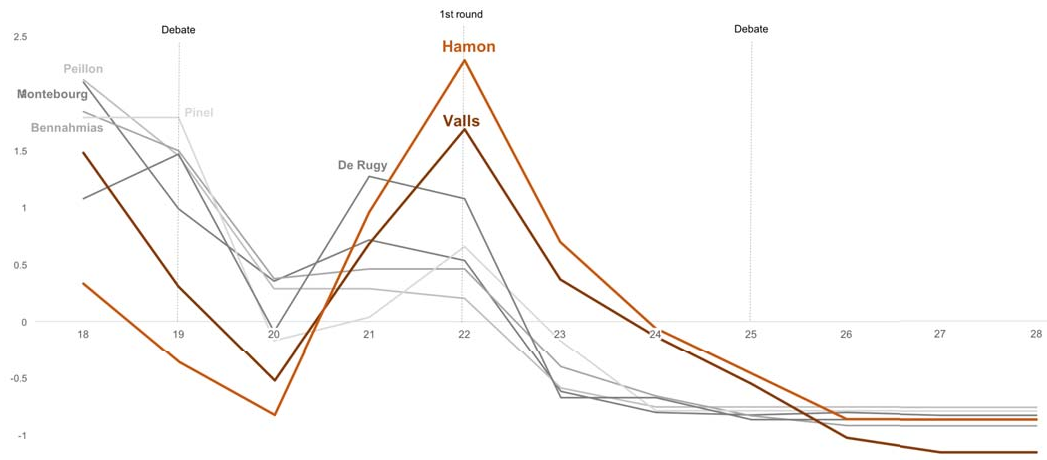
By applying Z-score normalization to hashtag usage, the researchers found a fascinating temporal pattern. "Small" candidates (those polling lower) usually saw their Twitter peak during the debates, where their performance could spark temporary curiosity. In contrast, front-runners saw their massive peaks on election day itself.
Critical Insights & Conclusion
The paper concludes that while the right-wing community was significantly larger and more interactive on Twitter (100k nodes vs. 50k for the left), both followed similar structural laws.
Takeaways for the Industry:
- Social Metrics as Proxies: Mention volume is a robust proxy for ranking, but "noise" from controversial candidates requires sentiment filtering for better accuracy.
- The Bot Factor: The presence of deleted high-activity accounts confirms that SNA is a valid tool for forensic political analysis.
- Media Centrality: Even in a decentralized age, traditional media remains the primary anchor of the political "Giant Component" on social networks.
The study proves that by looking through the "Twitter microscope," we can see the skeletal structure of a nation's political soul—right down to the automated bots trying to sway it.