
Precise Social Marketing: Decoding Hierarchical User Interests via Graph Modeling
Electronic Commerce Research and Applications
This paper introduces a User Interest Graph (UIG) model designed as a three-level hierarchical tree to map complex user preferences in Precision Social Marketing. By integrating multi-dimensional data from platform profiles (Dianping) and employing semantic similarity through HowNet, the model achieves SOTA-level precision in capturing both coarse and fine-grained interest topics.
TL;DR
In the era of social commerce, "pushing" content is easy—but pushing relevant content is a persistent challenge. This paper moves beyond the simple social graph to propose a User Interest Graph (UIG). By modeling interests as a three-level inverted tree and accounting for temporal decay, the authors provide a framework that predicts user preferences with over 90% accuracy on major topics, outperforming existing hierarchical benchmarks.
Context: The Shift from Social Graphs to Interest Graphs
Most social marketing today is invasive. Why? Because it assumes that if you follow someone, you share all their interests. The authors argue that a "User Interest Graph" is the missing link. The challenge is that user-generated content (UGC) is noisy, heterogeneous, and ephemeral. A user might be obsessed with "Smartphones" today, but their interest in specific "Football" gear might have decayed months ago.
Methodology: The Hierarchical Engine
The core of this research is the construction of a 167-node tree, covering topics from "Food" and "Shopping" (Level 1) down to specific niches like "Digital Products" (Level 3).
1. Multi-Dimensional Feature Extraction
The model pulls data from four distinct silos: Collections, Posts, Reviews, and Orders. Using specialized NLP tools (NLPIR), it filters for sentiment, keeping only positive or neutral terms to ensure the graph represents interest rather than dislike.
2. Semantic Similarity & Timed Weights (TW)
How do you know an interest in "Food" implies an interest in "Restaurants"? The authors use HowNet, a Chinese ontology, to calculate semantic similarity (SS).
The Timed Weight (TW) mechanism is particularly clever:
- It combines the weighted semantic similarity with the item's timestamp.
- Interests are propagated bottom-up: Your specific interest in "Huawei Mate 9" (Lv3) increases your inferred interest in "Digital Products" (Lv2), which in turn boosts "Shopping" (Lv1).
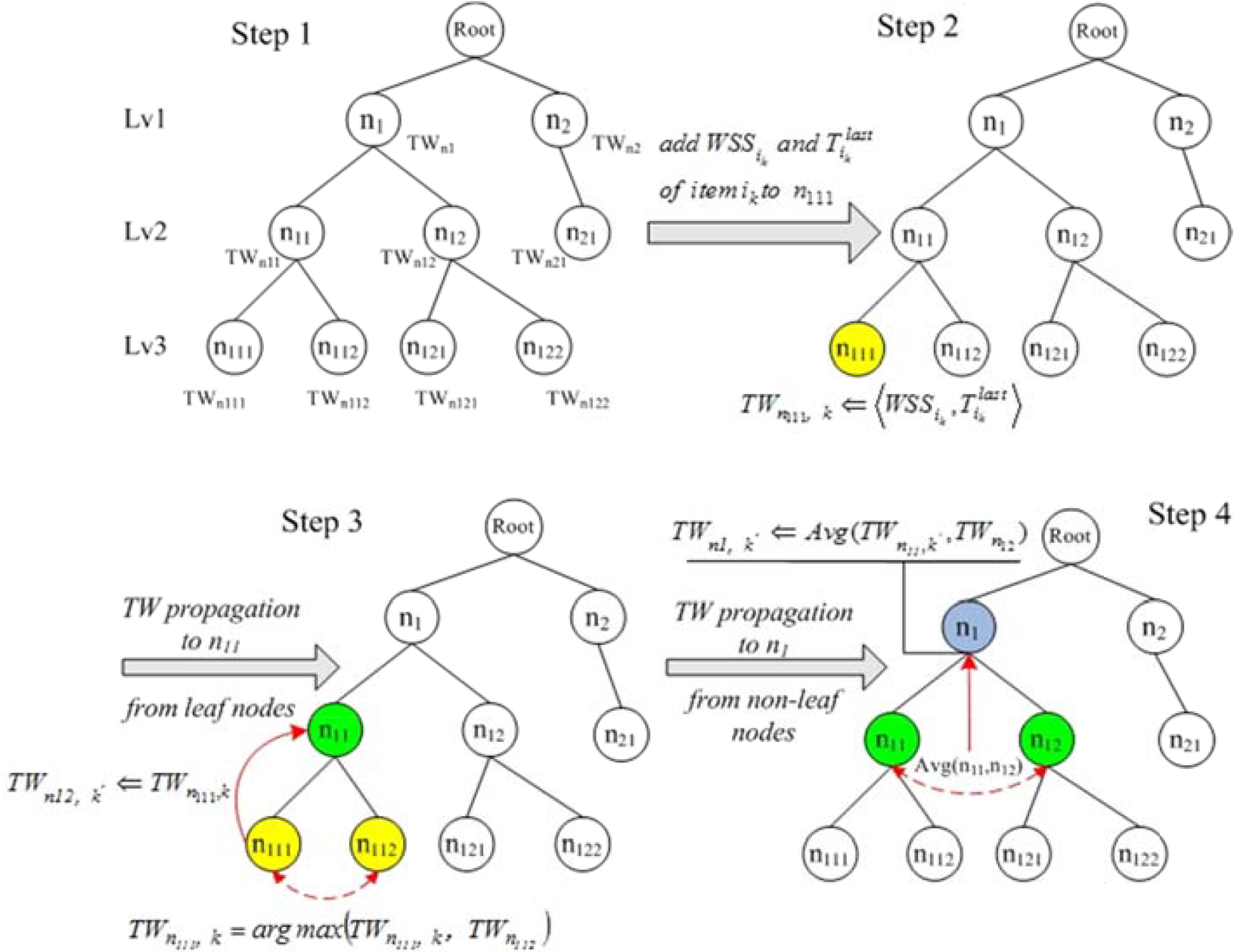 Figure 1: The bottom-up Timed Weight (TW) propagation process.
3. Exponential Decay: Fighting "Interest Drift"
Human interests aren't static. The paper employs an exponential decay constant (), ensuring that an old review from three years ago carries significantly less weight than a purchase made last week.
Experimental Results: Precision at Scale
The authors validated the model against 522 authorized users from Dianping.com, using Likert-scale surveys as the ground truth.
- Accuracy: The model achieved 91.39% precision on Top-level topics and maintained a robust 75.46% even at the highly specific Level 3.
- Benchmark Comparison: Compared to GCPHC and HIG (two industry-standard models), UIG showed a significantly lower Mean Absolute Deviation (MAD) of 0.91.
- Correlation: The Pearson coefficient () reached 0.91 for Level 1, proving a very strong relationship between the model’s predictions and users' actual self-reported interests.
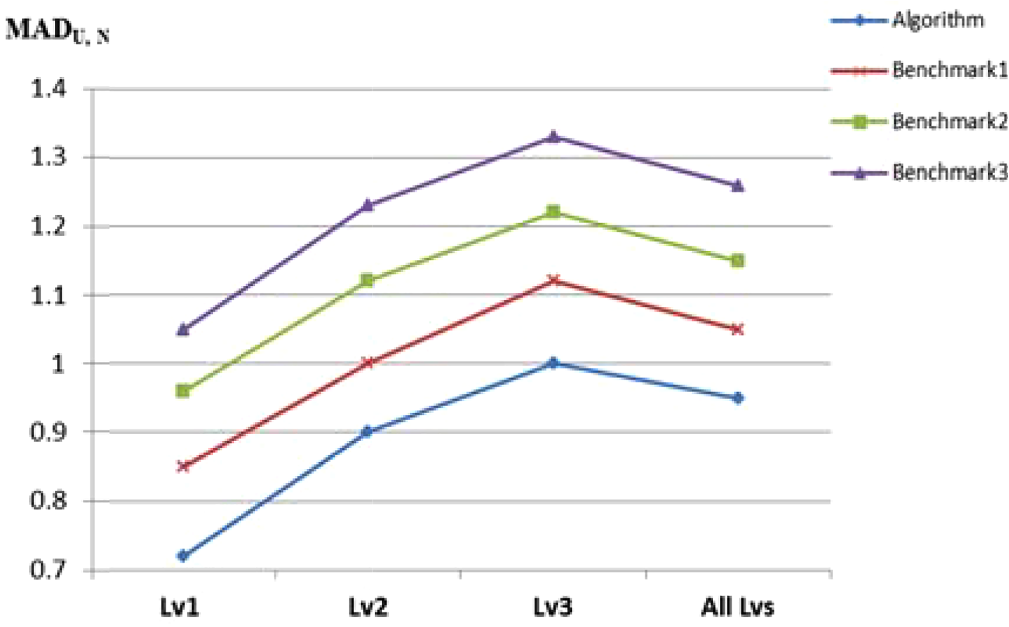 Figure 2: MAD values across different levels, showing UIG's superior accuracy (lower is better).
Critical Insight: Why This Matters
The most profound takeaway is that granularity matters. The paper demonstrates that while most users have similar high-level interests (Avg score 4.12), their fine-grained interests are highly diverse (Avg score 2.74). By capturing this "diversity at the leaves," the UIG model allows for surgical precision in marketing that flat models simply cannot match.
Future Outlook and Limitations
While the model is robust, it currently ignores Negative Interests (what users hate) and focuses primarily on individual data. The authors suggest that the next frontier is a hybrid approach: combining this hierarchical UIG with "Social Influence" (what your friends like) to solve the Cold Start problem for new users who haven't yet generated enough content to build a full tree.
Summary (Takeaway): UIG is a significant step toward "Precision Marketing" that respects user experience by only diffusing content that matches a mathematically verified, time-sensitive hierarchical interest profile.