
Electrosense+: Revolutionizing Radio Crowdsourcing with Edge Decoding and P2P Architecture
Electrosense+: Crowdsourcing radio spectrum decoding using IoT receivers
Electrosense+ is an open, crowdsourcing-based IoT platform for global radio spectrum monitoring and real-time decoding. By utilizing low-cost SDR hardware (RTL-SDR) and a peer-to-peer (WebRTC) architecture, it achieves scalable signal decoding for various protocols like FM/AM, ADS-B, and LTE while maintaining high efficiency.
TL;DR
Electrosense+ is an upgraded open-source platform that transforms low-cost IoT devices into a global, distributed radio receiver. By moving signal decoding from the cloud to the "edge" (the sensor itself) and utilizing Peer-to-Peer (P2P) communication, it allows users to listen to and decode FM, ADS-B, and LTE signals in real-time with minimal bandwidth. It introduces a clever token-based economy to incentivize users to host sensors at home.
Problem & Motivation: The Scalability and Privacy Wall
Crowdsourcing radio data isn't new (think WebSDR or FlightAware), but existing solutions face three major hurdles:
- The Bandwidth Bottleneck: Streaming raw I/Q (In-phase and Quadrature) data through a central server is incredibly "heavy," often requiring 1Mbps+ per user, making it unscalable for a global network.
- The Privacy Paradox: If you stream raw radio data to a user, they could theoretically decode private conversations. This limits platforms to "summary only" statistics, which aren't very exciting for hobbyists.
- Incentive Decay: Why would a layman user keep a Raspberry Pi running 24/7 if they don't get anything back?
The authors' insight was to move the "brain" to the sensor. By decoding the signal at the edge, they only send the result (audio or JSON data) to the user, protecting privacy and saving bandwidth simultaneously.
Methodology: The P2P Edge-Decoding Engine
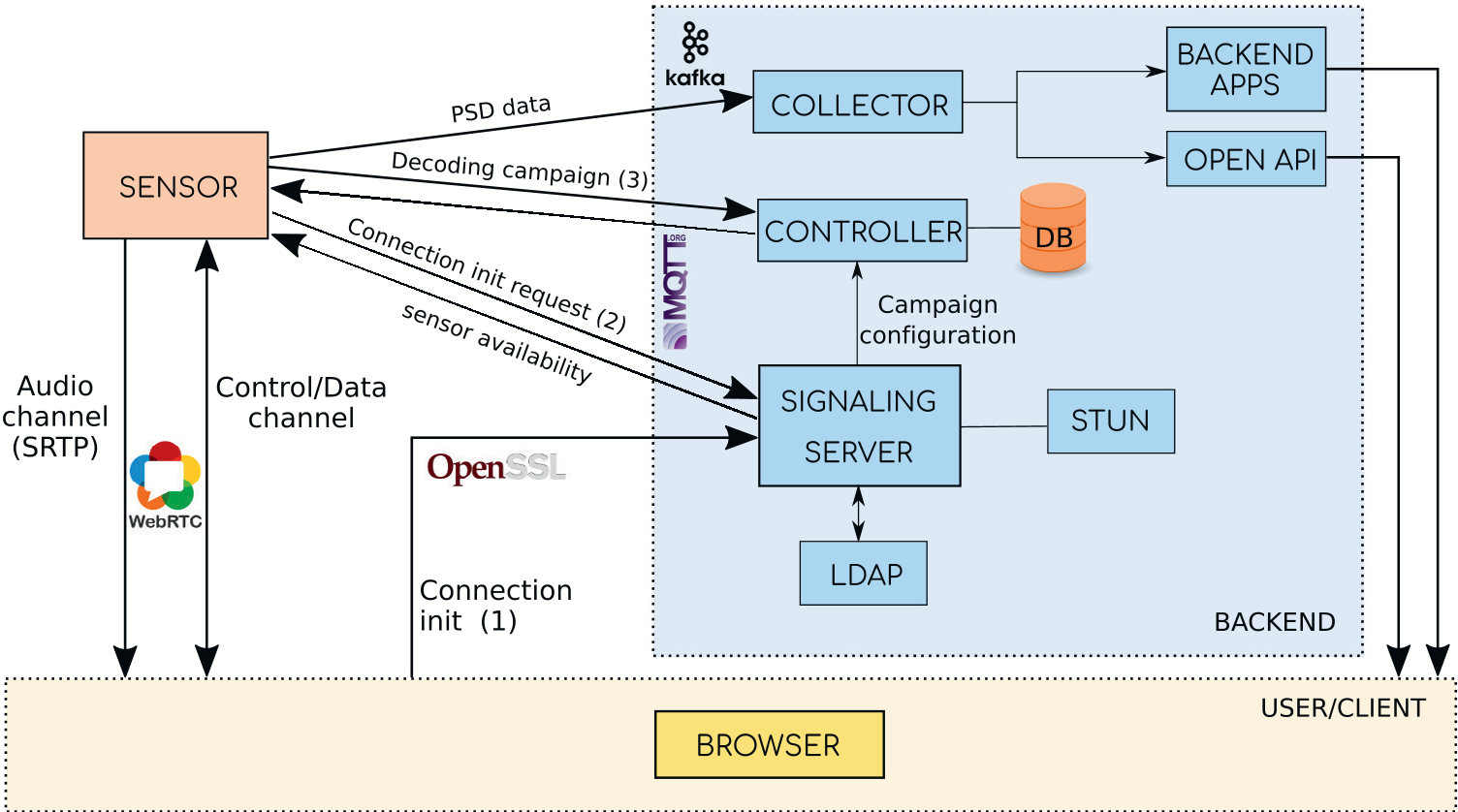
The architecture of Electrosense+ is built on three pillars:
1. Edge-Processing Pipeline
Instead of the sensor acting as a "dumb" pipe, it runs two parallel pipelines:
- PSD (Power Spectral Density): For visualizing the "Waterfall" graph of the spectrum.
- Decoding Pipeline: Using optimized open-source decoders (like
dump1090for aircraft) to process signals locally.
2. P2P Communication via WebRTC
To ensure low latency and bypass NAT/Firewalls, Electrosense+ uses WebRTC. This creates a direct tunnel between the sensor in someone's living room and the user's browser, bypassing the central backend for actual data flow.
3. The Token Economy
To keep the network alive, they proposed a virtual accounting system. Users spend tokens to "tune" into a sensor, and those tokens are distributed to sensor owners. The reward formula specifically targets Sensor Density—owners in underserved geographic areas earn more, encouraging the network to fill coverage gaps.
Experiments & Results: High Performance on Low-Cost Gear
The researchers tested the system on a Raspberry Pi 3B+ with an RTL-SDR v3 dongle.
- Bandwidth Efficiency: While raw I/Q streaming can consume massive bandwidth, Electrosense+ FM streaming only uses ~50 kb/s. Even complex ADS-B data stays under 200 kb/s.
- CPU Optimization: Despite being a "low-cost" device, the Pi manages to handle even LTE-Cell decoding, though it takes a significant CPU hit (~69%). Most decoders leave the Pi's CPU usage below 40%.
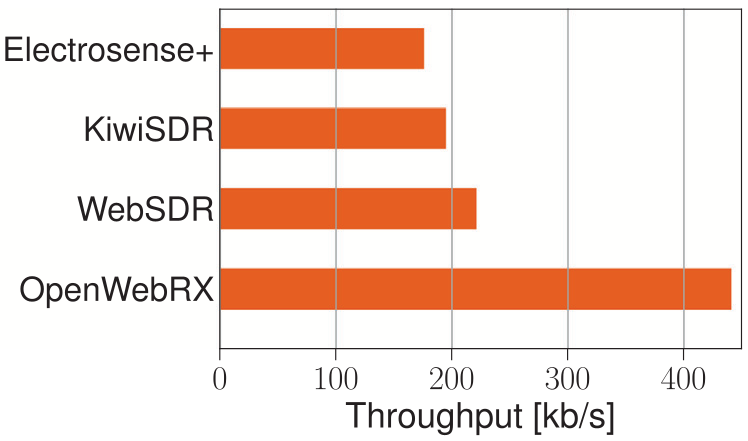
Comparison with veterans like WebSDR and OpenWebRX shows that Electrosense+ is not only more efficient in network throughput but also provides a more robust framework for different types of signal "Apps."
Critical Analysis & Conclusion
Electrosense+ is a masterclass in modern IoT architecture. By shifting from the "Cloud-Centric" model to a "P2P-Edge" model, they solved the three biggest issues in crowdsourced sensing.
Takeaway: The success of this platform suggests that the future of the "Internet of Radio" lies in modularity. By providing an API for the community to plug in new decoders (DAB, LoRA, etc.), Electrosense+ could become the "App Store" of the radio spectrum.
Limitations: Currently, each sensor only supports one concurrent user for decoding because small SDR dongles can only tune to one frequency at a time. Future iterations using wideband front-ends (like HackRF or LimeSDR) could theoretically support multiple users decoding different bands simultaneously, though this would challenge the Raspberry Pi's CPU limits.