
Elekspot: Scaling Urban Place Recognition through Crowdsourced Wi-Fi Intelligence
Elekspot: A Platform for Urban Place Recognition via Crowdsourcing
Elekspot is a scalable crowdsourcing platform designed for urban indoor place recognition using Wi-Fi location fingerprints. It leverages a cloud-based architecture (Google App Engine/Bigtable) and the Averaged kNN algorithm to provide room-level accuracy while maintaining system efficiency across diverse urban environments.
TL;DR
Elekspot is an end-to-end platform designed to turn smartphones into ubiquitous indoor sensors. By crowdsourcing Wi-Fi fingerprints and solving the technical hurdles of scalability, device heterogeneity, and reliability, it enables room-level place recognition in dense urban environments (like malls and department stores) without requiring expensive infrastructure.
The Urban Localization Gap
In the modern metropolis, we spend 90% of our time indoors, yet our primary navigation tool—GPS—fails behind concrete walls. While Wi-Fi Positioning Systems (WPS) exist, mapping an entire city's interior is a Herculean task for a single entity. Crowdsourcing offers a solution, but it introduces "The Chaos of the Real World":
- Heterogeneity: A Samsung Galaxy and an iPhone 15 see the same Wi-Fi signal differently.
- Scalability: Searching through millions of fingerprints in a millisecond is computationally expensive.
- Reliability: How do you know if a user-contributed fingerprint is accurate?
Methodology: The Four Pillars of Elekspot
1. Scalability via SSBI-n
To avoid the "brute-force" search of every fingerprint in Google Bigtable, the authors developed Signal Strength Based Indexing (SSBI-n). Instead of indexing every visible Access Point (AP), they only index the top (specifically ) APs with the strongest signals. This significantly prunes the search space while keeping a 99%+ hit rate.
2. Solving Device Diversity
Devices report different Received Signal Strength (RSS) values due to hardware differences. Elekspot utilizes "Duplicated Contributions"—where different devices scan the same location—to automatically calculate a linear regression (). They use an Information Entropy metric to ensure the quality of these regressions, keeping the mapping consistent even as new phones enter the market.
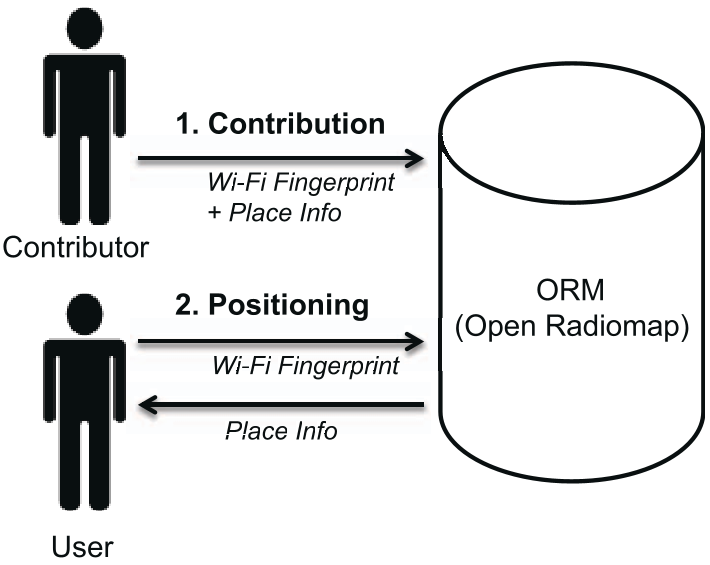
3. Architecture Overview
The system follows a client-server model, balancing local cache efficiency with cloud computing power.
Experimental Performance
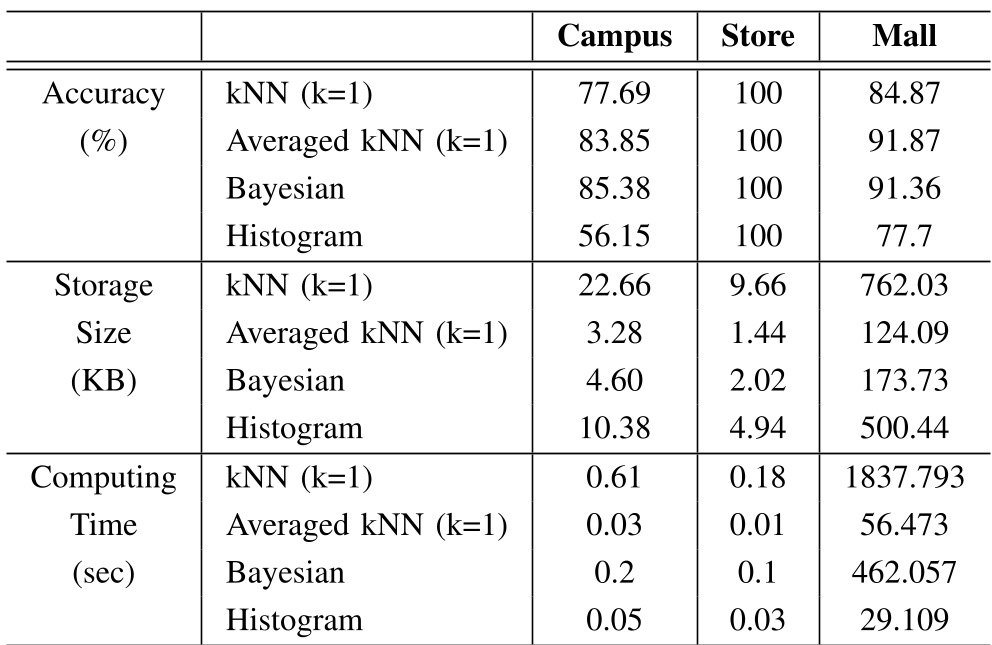
The researchers tested Elekspot in challenging environments: the KAIST campus, a Hyundai department store, and the massive COEX Mall in Seoul.
Efficiency and Accuracy
The Averaged kNN algorithm proved to be the "sweet spot" for cloud deployment. It maintained high accuracy (~91.87% in malls) while consuming significantly less storage and CPU time compared to traditional Bayesian or Histogram methods.
The Confidence Equation
Elekspot doesn't just give a location; it gives a confidence score. By combining Jaccard similarity (cardinality) with a probability density function of RSS values, the system can tell the user how much to trust the result. This confidence decays exponentially as the user moves away from the target place, providing a reliable "ground truth" metric.
Critical Analysis & Future Outlook
Elekspot’s primary contribution is the shift from "pure theory" to "systematic practicality." By addressing the noise inherent in crowdsourced data, it opens the door for hyper-local services like:
- Adaptive Ringers: Silencing phones automatically in theaters.
- Urban Treasure Hunting: Using gamification to incentivize further data collection.
Limitations: The system still relies heavily on the density of Wi-Fi APs. In rapidly changing urban environments, "fingerprint aging" (where APs are moved or removed) remains a challenge that future research in self-updating radiomaps must address.
Conclusion
Elekspot proves that with the right indexing and normalization strategies, the fragmented data of a thousand smartphones can outperform the most sophisticated dedicated tracking hardware. It is a blueprint for the next generation of "Place-Aware" applications.