
[Nature Physics 2026] The "NAND Gate" of Continuous Math: All Elementary Functions from a Single Operator
All elementary functions from a single operator
This paper introduces the EML (Exp-Minus-Log) operator, defined as (eml(x, y) = \exp(x) - \ln(y)), which serves as a single universal primitive for continuous mathematics. Much like the NAND gate in Boolean logic, the EML operator combined with the constant 1 is shown to be sufficient to reconstruct the entire repertoire of a scientific calculator, including all arithmetic operations, transcendental functions, and mathematical constants.
TL;DR
In a groundbreaking shift for scientific computing, researcher Andrzej Odrzywolek has discovered a single binary operator—eml(x, y) = exp(x) - ln(y)—that, paired with the constant 1, can generate every function on a scientific calculator. From basic addition to complex trigonometry (, , , ), everything is now a binary tree of identical "EML" nodes.
Positioning: This is a fundamental "unification" work, moving mathematics from a collection of disparate tools to a uniform, circuit-like architecture.
Problem & Motivation: The Missing Primitive
In digital electronics, we have the NAND gate. It is the universal building block; give an engineer enough NAND gates, and they can build a supercomputer. Yet, in continuous mathematics, we have always been "stuck" with a messy toolbox. We use , , , , , , and as if they were independent entities.
While we know some are redundant (e.g., ), the mathematical community lacked a single primitive that could do it all. The author’s insight was to bridge this gap, asking: Is the diversity of mathematical functions intrinsic, or is there a hidden generative basis?
Methodology: Hunting for the Sheffer Stroke
To find the EML operator, the author used a process called Systematic Ablation.
- Sieve of Transcendental Constants: Instead of slow symbolic proofs, the author used a "numerical sieve." If an EML-tree equals a target function (like ) at a single point using irrational numbers (like ), it is almost certainly the correct formula.
- The EML Discovery: Through exhaustive search, the operator emerged.
The "Phylogenetic" Tree of Math
The discovery follows a "LUCA" (Last Universal Common Ancestor) pattern, where the simplest expressions branch out into the entire ecosystem of mathematics.
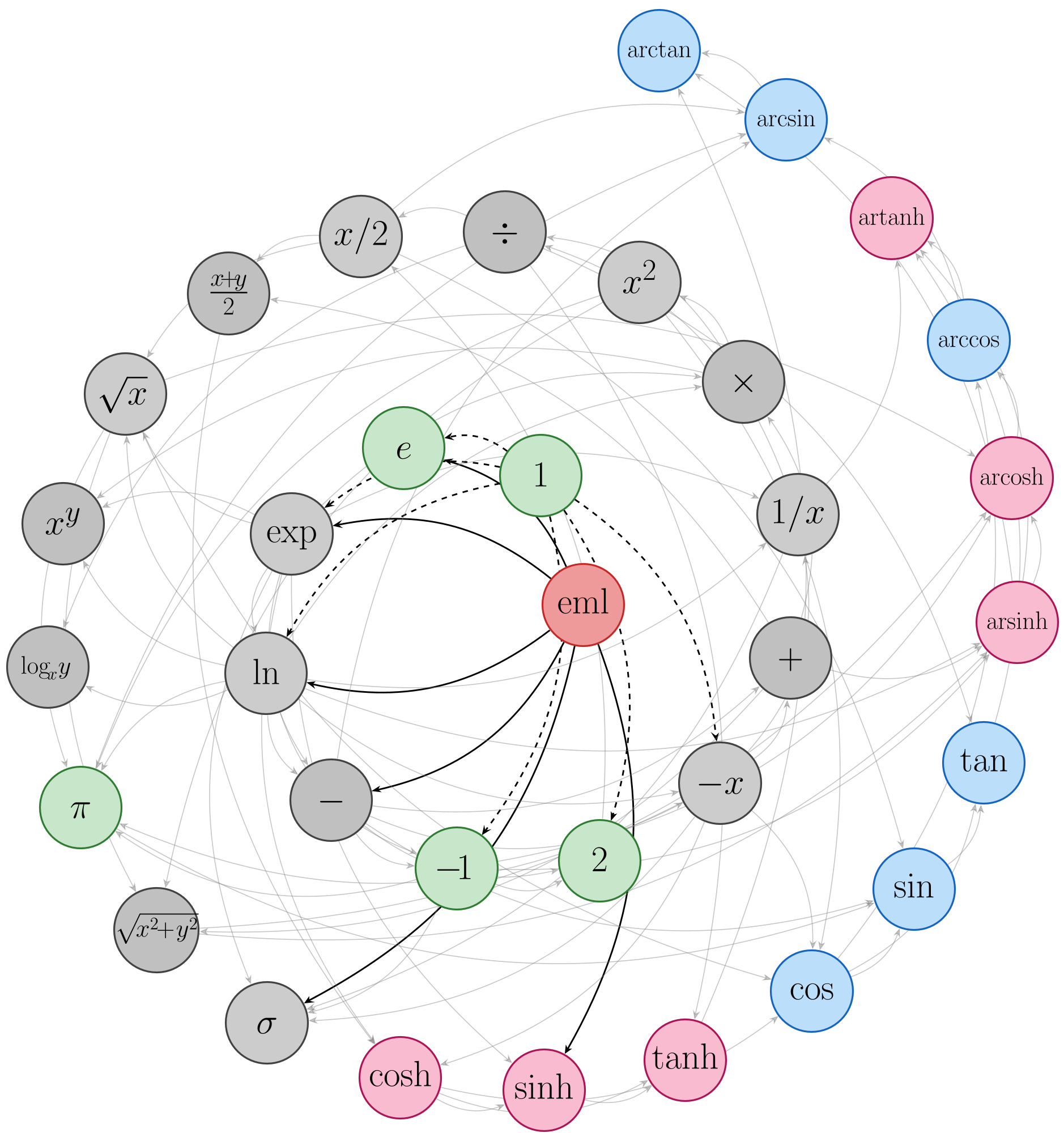 The evolutionary path from EML and the constant 1 to the full repertoire of modern science.
Methodology: The Architecture of a Formula
In the EML world, every formula is a full binary tree. This leads to a trivial grammar: .
- is simply because .
- is more complex: .
This uniformity allows us to treat math like analog circuits.
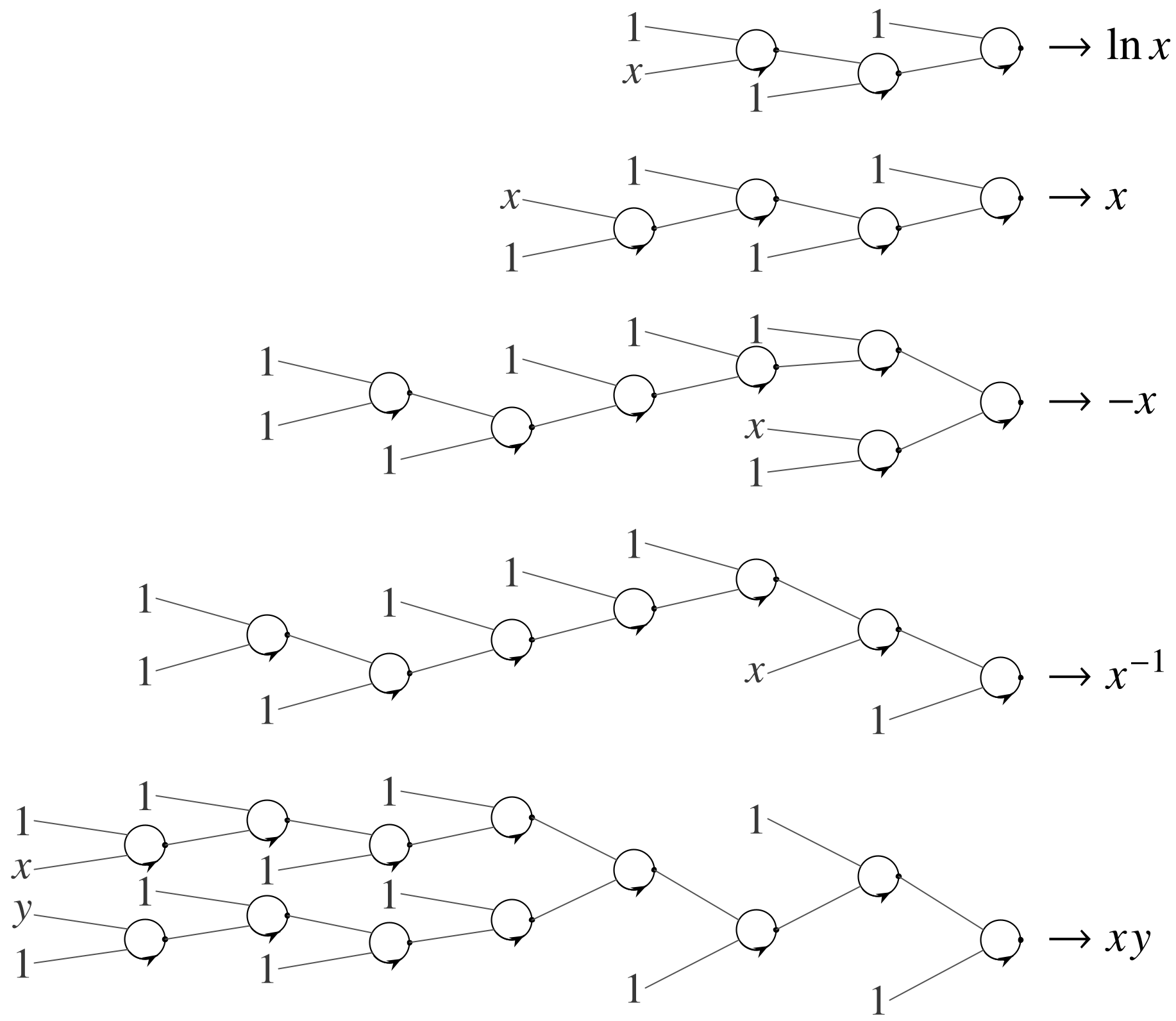 Visualizing log, identity, and multiplication as hardware-like circuits of identical EML units.
Experiments: Symbolic Regression via Gradient Descent
One of the most exciting applications is in AI and Symbolic Regression. Usually, discovering a formula from data requires searching through millions of combinations of , , , and .
With EML, you only have one architecture: a deep EML tree. By treating the connections as weights (), the author used standard optimizers like Adam to "grow" the correct formula.
- Success: The weights "snapped" to 0 or 1, recovering exact symbolic laws from noisy data.
- Comparison: Unlike traditional Neural Networks, which are "black boxes," a successful EML tree is perfectly interpretable—it is the formula itself.
Critical Analysis & Conclusion
Takeaway
The EML operator proves that elementary functions are members of a much simpler class than we thought. We can now imagine a "Single-Instruction Computer" for math, or specialized AI hardware that only knows how to compute .
Limitations
- Complex Domain: To compute real roots or trigonometry, EML must use complex numbers internally (handling ).
- Vanishing Precision: At very high depths, the nested exponentials can lead to numerical overflows, requiring careful "clamping" in PyTorch/NumPy.
The discovery of EML is likely just the beginning. The paper hints at a ternary operator that requires no constants at all—the ultimate simplification of the mathematical universe.