
Architecting Collective Intelligence: Designing Software Ecosystems via Stigmergy
Elements of software ecosystem early-stage design for collective intelligence systems
The paper introduces a conceptual framework for the early-stage design of Collective Intelligence (CI)-centered Software Ecosystems (SECOs). It proposes the Stigmergic Information System (SIS) model as a foundation, formalizing self-organization via feedback loops and mapping these design elements to real-world platforms like Wikipedia.
Executive Summary
TL;DR: This paper bridges the gap between Software Ecosystem (SECO) theory and Collective Intelligence (CI) by introducing a design framework focused on self-organization. By leveraging the Stigmergic Information System (SIS) model, the authors provide a blueprint for early-stage design where feedback loops and user contributions are the primary drivers of growth.
Context: Published at ESEC/FSE'13, this work moves beyond viewing ecosystems as mere business networks, positioning them as complex, self-regulating technical systems. It is an essential read for architects of crowdsourcing and social computing platforms.
The Problem: The "Phase Zero" Challenge
Most software engineering literature describes SECOs as a "Phase 2" phenomenon: first, you build a successful product; then, you open it to third parties. However, in Collective Intelligence (CI) systems—like Wikipedia or Yelp—the ecosystem is the product.
The authors argue that waiting for an ecosystem to emerge spontaneously is risky and expensive. For startups, "getting it right the first time" requires an intentional design of the interaction between human agents and the digital environment.
Methodology: The Stigmergic Intuition
The core insight of this paper is Stigmergy—a bio-inspired mechanism (observed in ants and termites) where agents communicate indirectly by modifying their environment.
The SIS Model for SECOs
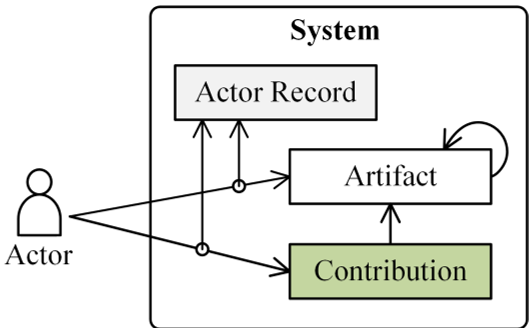
The authors apply the Stigmergic Information System (SIS) model to a generic SECO structure. The model focuses on the "Stigmergy Cycle" ():
- Actors make Contributions.
- These contributions modify Artifacts (the environment).
- The System highlights these changes to other Actors, stimulating further activity.
Core Design Elements
The paper simplifies the architecture into five fundamental blocks:
- Actor: The human agent with manipulation privileges.
- Artifact: A persistent container (e.g., a wiki page) with a fixed data structure but fluid content.
- Contribution: The act of adding or removing content.
- Actor Record: A layer logging history and credentials (distinct from a public profile).
- System: The "medium" that facilitates the feedback loop—crucial in digital spaces where "air" or "physical proximity" doesn't exist to carry signals.
Evaluation: The Wikipedia Example
To validate the model, the authors map these elements to Wikipedia, the ultimate CI-centered SECO.
The mapping reveals why Wikipedia is so robust:
- Self-Regulation: The "Talk Pages" and edit histories serve as the environmental signals that trigger further peer review or expansion.
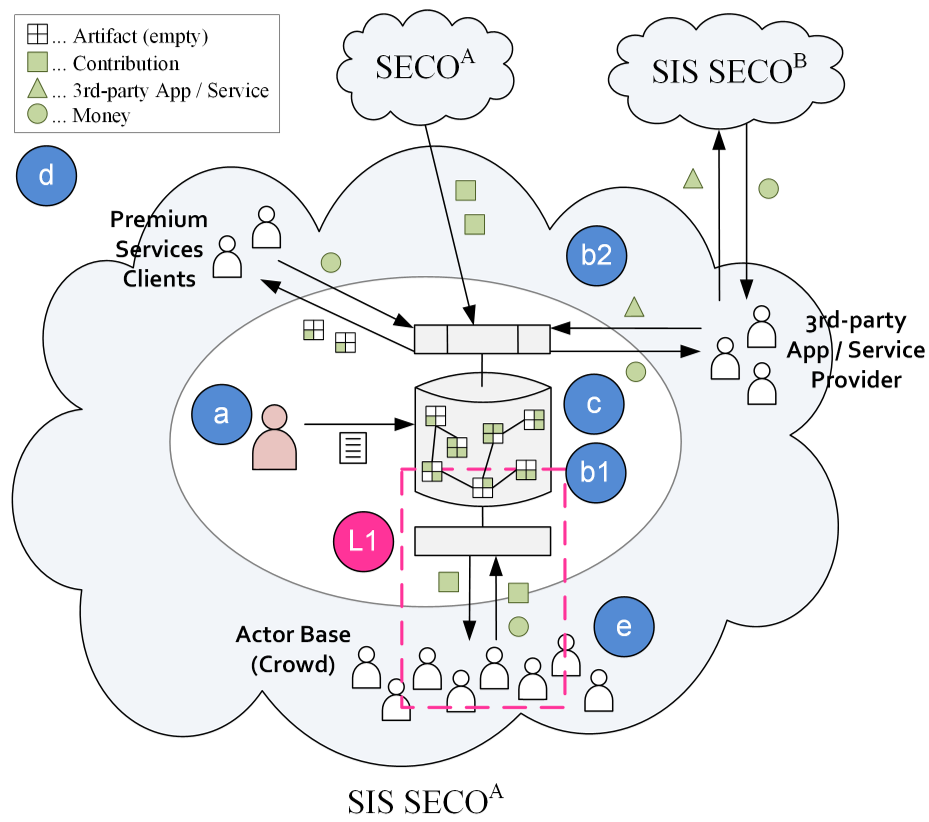
- Ecosystem Growth: By providing database dumps and the open-source MediaWiki platform, Wikipedia generates a "network of shared values," leading to the broader Wikimedia ecosystem (Wiktionary, Wikidata, etc.).
Deep Insight & Conclusion
Takeaway
The value of this paper lies in its treatment of Feedback Loops as First-Class Entities. In CI systems, the software is not just a tool; it is a catalyst for human emergence. If the "Stigmergy Cycle" stalls, the ecosystem dies.
Critical Analysis
- Limitations: While the paper provides a high-level conceptual mapping, it lacks concrete quality metrics (e.g., how do we measure the "health" of a stigmergy cycle quantitatively?).
- Future Outlook: In the age of AI, this framework is more relevant than ever. Modern CI systems now involve "Human-AI Collective Intelligence," where the Actor might be a Large Language Model (LLM) making contributions to the Artifact alongside humans.
By formalizing the "Elements" of these systems, Musil et al. provided a vocabulary that allows architects to move from "building a platform" to "cultivating an intelligence."