
ELF: Bridging the Gap Between Continuous Flows and Discrete Language
ELF: Embedded Language Flows
Embedded Language Flows (ELF) is a continuous diffusion language model based on Flow Matching that operates in a contextual embedding space. It achieves SOTA performance among diffusion models, outperforming leading discrete and continuous DLMs (like MDLM and Duo) in generation quality while using 10x fewer training tokens.
TL;DR
The success of diffusion models in images (like Stable Diffusion or FLUX) has long left researchers wondering why language modeling remains dominated by Autoregressive (AR) or Discrete Diffusion methods. Embedded Language Flows (ELF) provides a compelling answer. By performing Flow Matching in a continuous embedding space and only discretizing at the final step, ELF outperforms current diffusion baselines with 10x better data efficiency and superior generation quality.
Problem & Motivation: The Discretization Trap
Traditional Diffusion Language Models (DLMs) are caught in a tug-of-war. Discrete DLMs (like MDLM) operate on tokens but miss the geometric benefits of continuous spaces. Modern Continuous DLMs (like Diffusion-LM) often try to "fix" the embeddings at every step using rounding losses or cross-entropy.
The authors of ELF argue this is unnecessary. They posit that by forcing the model to worry about tokens at every time step, we "handcuff" the flow dynamics. Their insight: Let the flow be free. By staying in the continuous domain until the very last moment, the model can leverage the smooth trajectories of Flow Matching.
Methodology: The Core Mechanics
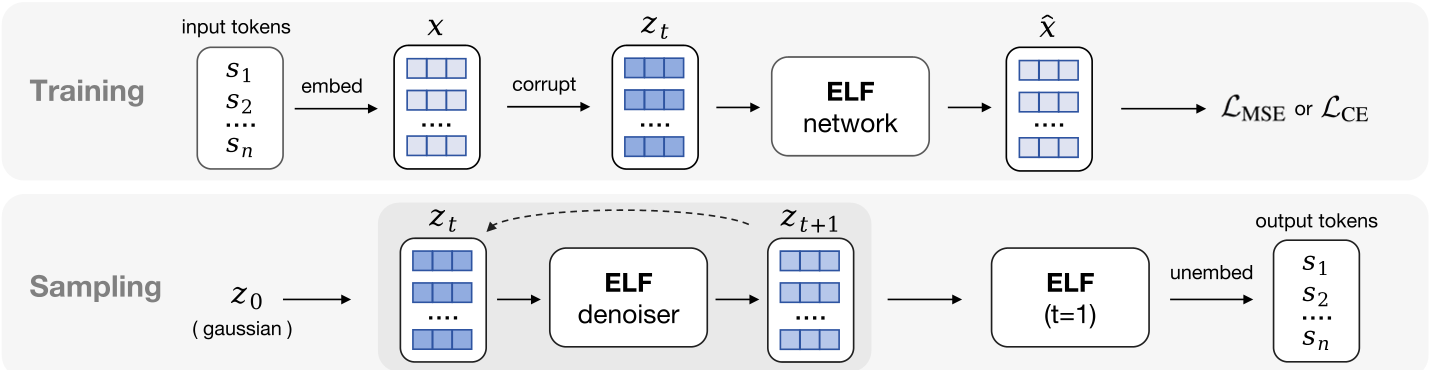
ELF utilizes Flow Matching on high-dimensional embeddings. Instead of predicting the velocity () directly, it adopts x-prediction (predicting the clean data point ). This is a crucial design choice: it allows the network to share weights between the denoiser (which refines embeddings) and the unembedder (which maps embeddings to tokens).
Architecture
- Encoder: A frozen T5 encoder maps tokens to a continuous latent space.
- Bottleneck: A linear layer compresses representations (e.g., to 128-d) to find the "low-dimensional manifold" of language.
- The Shared-Weight Network: A Transformer that operates in two modes:
- Denoise Mode: , predicts the clean embedding.
- Decode Mode: , projects the embedding back to vocabulary logits.
Advanced Guidance
Because ELF lives in a continuous space, it can natively use Classifier-Free Guidance (CFG). By interpolating between a "self-conditioned" prediction and a null-conditioned one, ELF can navigate the trade-off between generation diversity (Entropy) and quality (Perplexity).
Experiments & Results
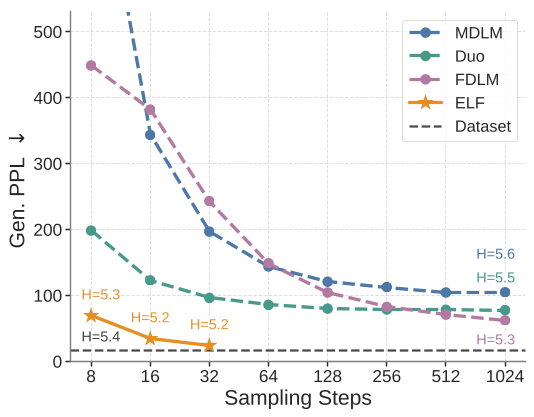
ELF-B (105M parameters) was tested against the heavyweights of the diffusion world.
- Efficiency: ELF achieved better results with 45B tokens of training than prior models did with over 500B tokens.
- Inference Speed: Using an SDE-inspired stochastic sampler, ELF generates high-quality text in as few as 8-32 steps, whereas older models often required hundreds.
- SOTA Performance: In conditional tasks like German-to-English translation, ELF outperformed both discrete diffusion and autoregressive baselines at similar scales.
Deep Insight: Why Why Does x-Prediction Matter?
The paper reveals a fascinating ablation: -prediction (common in image models) completely collapses in language. Because language embeddings are high-dimensional but lie on low-dimensional manifolds, predicting the "noise" is an ill-posed problem. Predicting the clean embedding () acts as a strong inductive bias that keeps the model grounded in the data manifold.
Conclusion
ELF proves that the "discreteness" of language isn't an insurmountable barrier for continuous flow models. By simplifying the interface—using a frozen encoder and a single shared-weight network—ELF achieves a level of "minimalist efficiency" that could pave the way for diffusion models to finally challenge the Autoregressive hegemony in LLMs.
Limitations
Despite its efficiency, ELF still relies on a frozen T5 encoder, which might limit its "knowledge" to what the encoder saw during its own pre-validation. Future work scaling these models to billions of parameters with jointly learned encoders could be the next frontier.