
Beyond Semantics: Eliciting Positive Emotions Using Human Appraisal Examples
Eliciting Positive Emotional Impact in Dialogue Response Selection
The paper introduces a novel approach for emotion elicitation in dialogue systems by utilizing human appraisal examples. The method, built upon Example-Based Dialogue Modeling (EBDM), selects responses that aim to elicit a positive emotional impact in the user, achieving superior performance in coherence and emotional connection compared to standard semantic-matching baselines.
TL;DR
Researchers have developed a dialogue response selection system that doesn't just "talk" back—it strategically chooses responses to make the user feel better. By analyzing "tri-turn" sequences (Query → Response → Future State) from human-to-human conversations, the system identifies which responses act as triggers for a positive emotional shift.
Background: The Empathy Gap in HCI
While modern AI can process information with incredible speed, it often fails at the "emotion appraisal loop." In human interaction, we don't just process words; we evaluate them as stimuli that trigger emotional changes. Experts (like therapists) use this skillfully to provide support. For an AI to be truly assistive, it must move beyond Emotion Recognition (understanding what you feel) and Emotion Simulation (acting like it feels) toward Emotion Elicitation (affecting how you feel).
The Core Insight: The Tri-Turn Architecture
The researchers identified a flaw in standard Example-Based Dialogue Modeling (EBDM): it only looks at the relationship between a Query and a Response. To understand emotional impact, you need a third component: the Future.
By observing how a user's emotional state changes from the initial Query to the Future turn after the system's Response, the model can quantify "Impact."
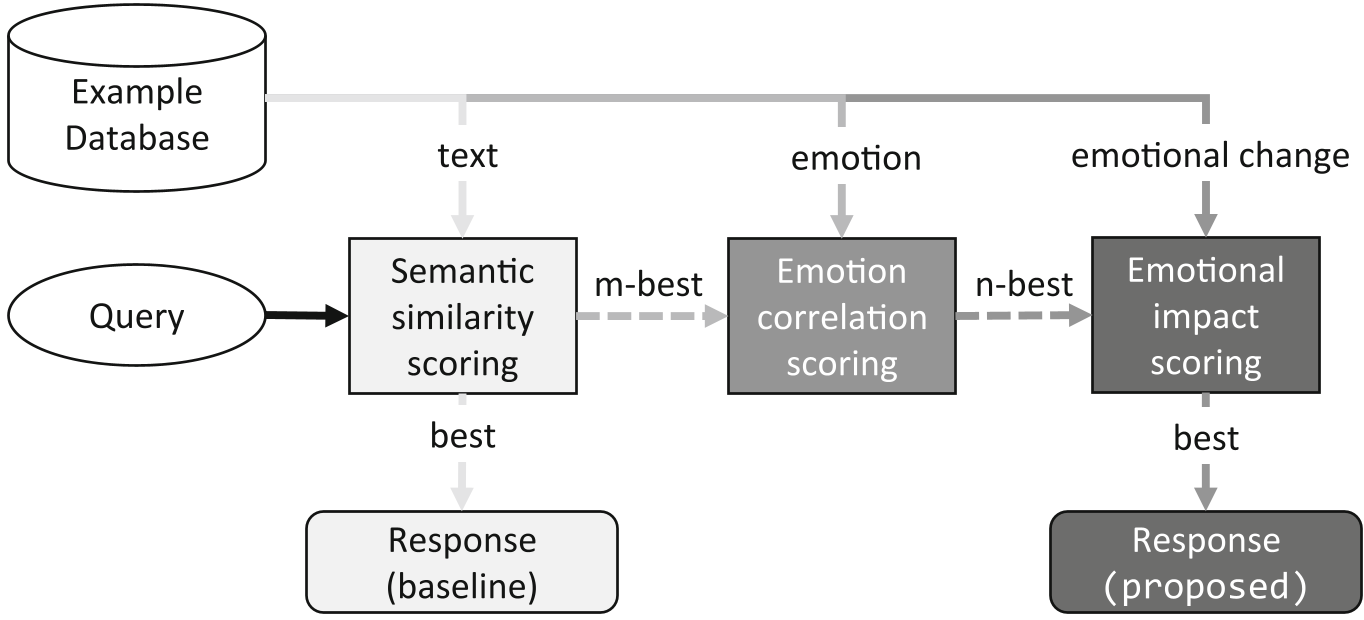 Figure 1: The response selection pipeline, transitioning from semantic filtering to emotional impact optimization.
Methodology: The Three Pillars of Selection
Instead of a single score, the system uses a tiered re-ranking process:
- Semantic Similarity: Uses TF-IDF and Cosine Similarity to find candidate responses that make sense contextually.
- Emotion Similarity: Operates in the Valence-Arousal space. It doesn't just look for "happy" or "sad" labels; it uses real-time "traces" filtered through Pearson’s correlation to find queries that match the user's current emotional trajectory.
- Expected Emotional Impact: Among the top candidates, it picks the one where, in the training data, the "Future" turn showed the highest increase in Valence (positivity).
Experiments and Results
The team utilized the SEMAINE database, a gold-standard corpus for emotionally colored conversations. They specifically focused on "Poppy" (cheerful) and "Prudence" (sensible) characters to build a database geared toward positive outcomes.
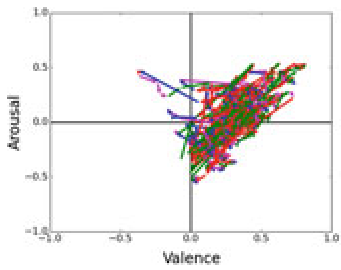 Figure 2: Analysis of emotional paths showing how different agent personalities (Poppy, Spike, etc.) drive users toward different regions of the Valence-Arousal space.
Key Findings:
- Contextual Awareness: The system can give different responses to the same text. For a "Thank you" delivered with low valence, it might offer a supportive wish for the future; for a "Thank you" delivered with high valence, it might respond with a warmer, reciprocal compliment.
- Human Preference: In crowdsourced tests, the proposed method was voted significantly more coherent and better at building an emotional connection than the baseline.
Critical Analysis & Conclusion
This work demonstrates that "Emotional Intelligence" in dialogue systems can be treated as a retrieval problem if the database is rich enough. By measuring the delta in user emotion across tri-turns, the model effectively "reverses" the appraisal process to find the right trigger for a target feeling.
Limitations:
- The system relies on high-quality real-time emotional annotations (FEELtrace), which are difficult to obtain in "wild" real-world applications without specialized sensors or advanced audio-visual models.
- The example-based nature means it is limited by the diversity of its training corpus (e.g., the SEMAINE data).
Future Outlook: Integrating this "Impact-driven" selection into generative Large Language Models (LLMs) could provide the best of both worlds: the infinite flexibility of generative text and the grounded emotional safety of appraisal-based elicitation.