
EB_LPA: Boosting Link Prediction by Pruning Network Noise
Elimination based algorithm for link prediction on social networks
The paper introduces the Elimination Based Link Prediction Algorithm (EB_LPA), a novel preprocessing framework designed to enhance link prediction in social networks. By identifying and removing "weak" nodes and edges before applying standard predictors like Local Random Walk (LRW), the method achieves significant improvements in precision on the Gnutella P2P network dataset.
TL;DR
Link prediction—the art of guessing who will connect next in a social network—is often hampered by "noise" from inactive users. This paper presents EB_LPA, an elimination-based algorithm that prunes weak nodes and edges before making predictions. By focusing on the "active core" of the Gnutella network, the authors increased prediction precision from 15.87 to 22.7.
Background: The Dynamic Sociogram
Social networks (Sociagrams) are breathing entities; they grow, shift, and decay. In the classical link prediction problem, we take a snapshot of a graph at time and try to predict its topology at time .
The authors argue that the biggest hurdle isn't just finding new links, but filtering out the segments of the network that are effectively "dead." If a user has very few connections and doesn't participate in many "friend circles," they are unlikely to facilitate new connections.
Methodology: The Power of Elimination
The EB_LPA algorithm follows a four-step pipeline designed to refine the graph's search space:
- Node Scoring (FCircles): The algorithm calculates a score for each node based on the number of "Friend Circles" (up to distance ) it belongs to.
- Node Elimination: A user-defined percentage () of the weakest nodes (those rarely involved in circles) are removed.
- Edge Weighting & Pruning: Weights are assigned to edges based on the strength of the nodes they connect. The bottom of edges are discarded.
- Core Prediction: Finally, the famous Local Random Walk (LRW) algorithm is applied to the newly "cleaned" adjacency matrix.
The EB_LPA Workflow
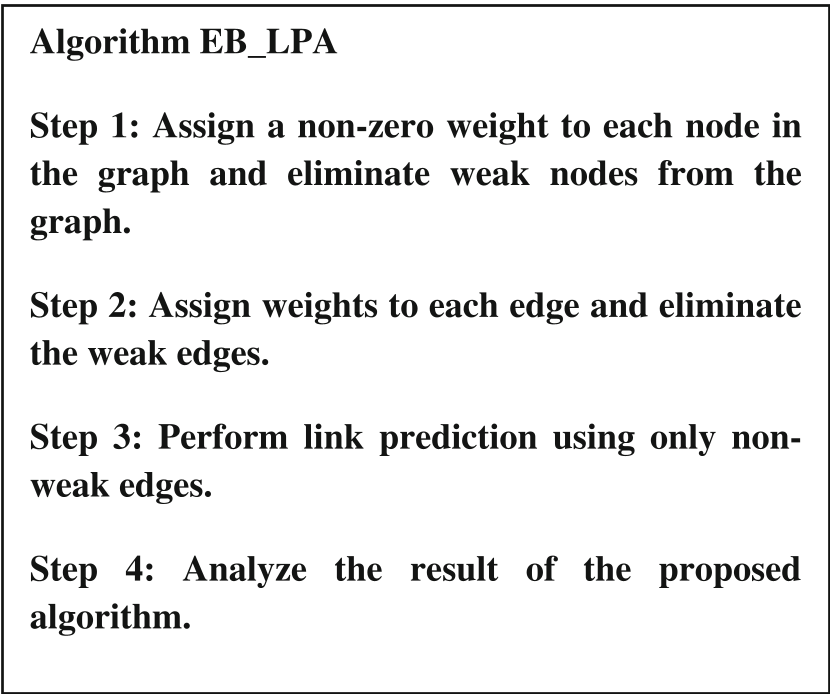 The logic relies on the intuition that active nodes in dense clusters drive the majority of network evolution.
Experimental Insights
The authors tested their approach using the Gnutella Peer-to-Peer network data. The experimental matrix focused on three parameters:
- : The depth of friend circles (distance).
- : Percentage of nodes eliminated.
- : Percentage of edges eliminated.
Key Results
The baseline LRW algorithm achieved a precision of 15.87. However, as shown in the data below, the EB_LPA approach consistently hit higher marks.
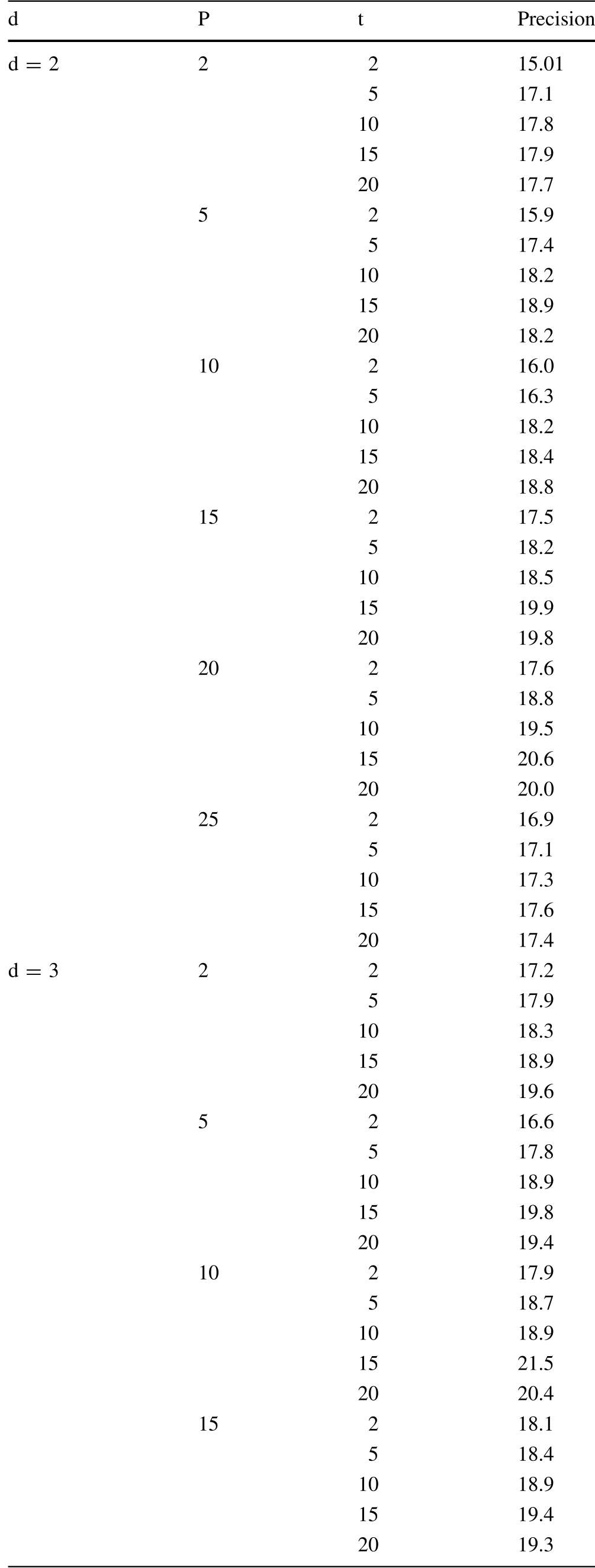
The best performance was observed at and , where precision reached 22.7. Interestingly, the authors found that if they eliminated too many edges ( or higher), the precision began to drop, suggesting a "sweet spot" for network pruning.
Performance Visualization
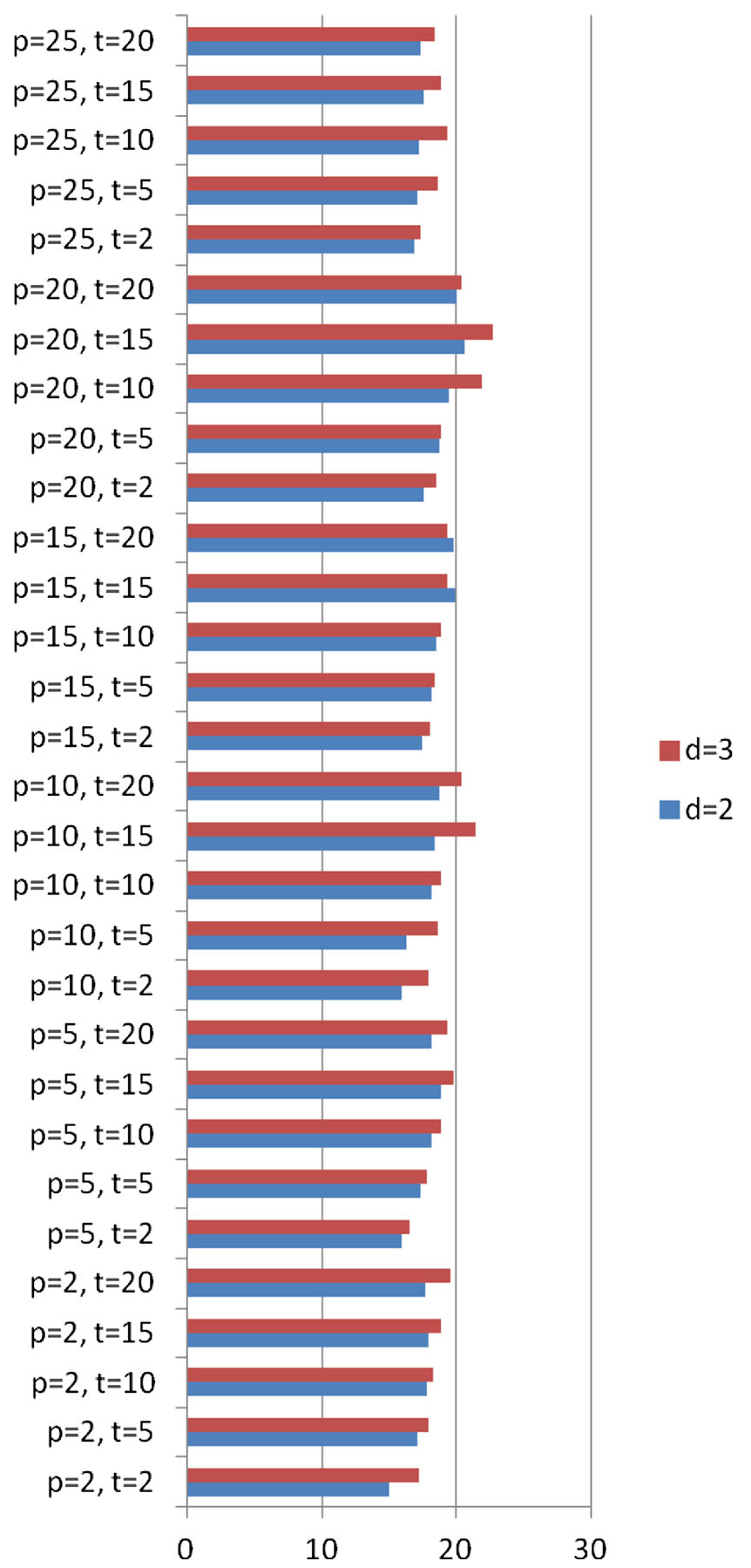 The graph clearly shows that when , the algorithm consistently captures more topological intelligence than when .
Critical Analysis & Conclusion
This paper offers a refreshing "subtractive" approach to a traditionally additive problem. By acknowledging that not all network components are equal, EB_LPA significantly reduces the noise that usually confuses random walk predictors.
Limitations: The current model ignores "new arrivals"—new nodes that join the network between and . In real-world social platforms, new users are a primary driver of growth. Furthermore, the selection of the hyper-parameters , , and currently requires manual tuning, which may vary across different types of networks (e.g., academic citations vs. P2P file sharing).
Future Outlook: Integrating this elimination logic into Deep Graph Learning could be a game-changer. Imagine a Graph Convolutional Network (GCN) that learns to "drop" less informative edges during training to focus its attention on the most predictive sub-structures.