
ENSHA: Bridging the Gap Between Efficiency and Economy in Flexible Job-Shop Scheduling
16432_An elitist nondominated sorting hybrid algorithm for multi-objective flexible job-shop scheduling problem with sequence-dependent setups.
The paper introduces the Elitist Nondominated Sorting Hybrid Algorithm (ENSHA) to solve the Multi-Objective Flexible Job-Shop Scheduling Problem with Sequence-Dependent Setup Times/Costs (MOFJSSP_SDST/C). It optimizes two conflicting objectives: makespan (efficiency) and total setup costs (economy), achieving state-of-the-art performance across 39 benchmark instances and a real-life pharmaceutical case study.
In the world of high-tech manufacturing—think semiconductors or pharmaceutical compounding—scheduling is not just about "how fast" a job gets done. It is equally about "how much it costs" to reconfigure a machine between different tasks.
While the Flexible Job-Shop Scheduling Problem (FJSSP) is a classic "NP-hard" challenge, most research focuses on minimizing time (makespan). However, in industries like the one producing 6-Ethylchenodeoxycholic acid (a complex chemical process), the cost of cleaning and recalibrating equipment between batches is a critical economic factor.
A recent paper by Z.C. Li et al. introduces the Elitist Nondominated Sorting Hybrid Algorithm (ENSHA), the first approach to treat Total Setup Cost (TSC) as an independent objective alongside makespan in the context of sequence-dependent setup times and costs.
The Core Challenge: The Cost of "The Swap"
In many factories, the time and cost to set up a machine depend on the sequence of tasks. If you go from product A to product B, it might take 10 minutes and cost 200. This is Sequence-Dependent Setup Time/Cost (SDST/C).
Existing models often fail because they:
- Ignore the purely economic aspect (Setup Cost).
- Use "greedy" assignment rules that only look at the soonest available machine, ignoring the long-term cost impact.
The Methodology: ENSHA's Dual-Engine Approach
The authors propose a hybrid framework that utilizes two populations—a Main Population (MP) and an Auxiliary Population (AP)—to ensure the search never gets stuck and always learns from its best results.
1. Advanced Job Assignment Rules
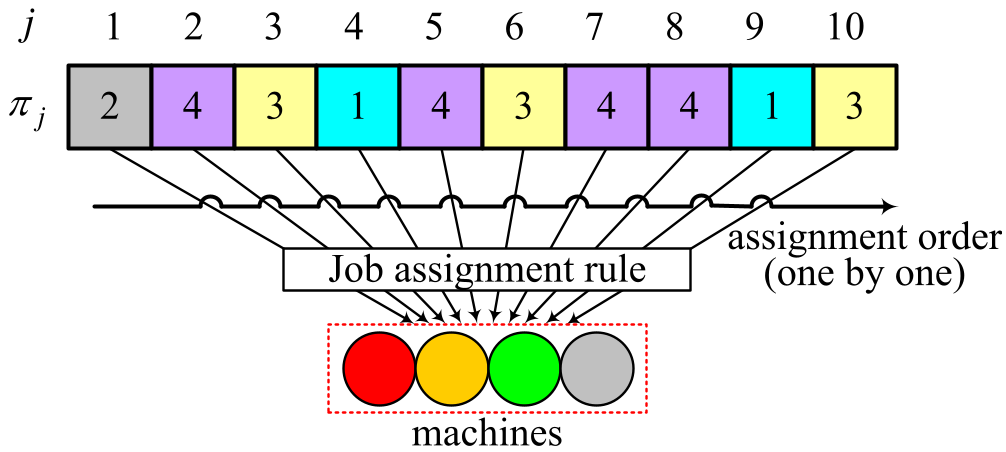
Before the algorithm even starts "evolving" solutions, it needs to decide how to assign jobs to machines. The authors moved beyond simple "Shortest Processing Time" rules and introduced three new heuristics:
- Rule 1 (CT + SC): Minimizes the sum of completion time and setup cost.
- Rule 2 (CT * SC): Minimizes the product of the two (finding a balance).
- Rule 3 (DOMINANCE): Uses Pareto dominance locally to pick the best machine.
2. The Evolutionary Framework
The Main Population (MP) uses the standard mechanics of NSGA-II:
- Non-dominated Sorting: Ranks solutions based on how well they balance time vs. cost.
- Crowding Distance: Ensures the algorithm finds a diverse range of solutions, not just one "type."
The Auxiliary Population (AP) is where the "Machine Learning" happens. It uses an Estimation of Distribution Algorithm (EDA):
- It analyzes the "DNA" of the best solutions found so far.
- It creates a Probabilistic Model (a matrix) of which jobs usually follow which others.
- It "samples" this model to create new offspring that share the "good traits" of winning schedules.
3. Cooperation-Based Refinement
After every generation, the best individuals from both the MP (evolved through crossovers) and the AP (generated from the statistical model) are combined. Only the "fittest" survive to the next generation.
Results: Surpassing the Experts
The researchers tested ENSHA against 39 standard benchmarks and a real-world case from a pharmaceutical plant in China.
Experimental Performance
When compared to industry standards like MOEA/D and SPEAII, ENSHA consistently found better "Pareto fronts" (the set of optimal trade-offs where you can't improve time without increasing cost).

Real-World Application
In the pharmaceutical case study, human schedulers usually took an hour to create a plan for 30 batches and 5 machines. ENSHA produced a significantly better schedule in just over 2 minutes.
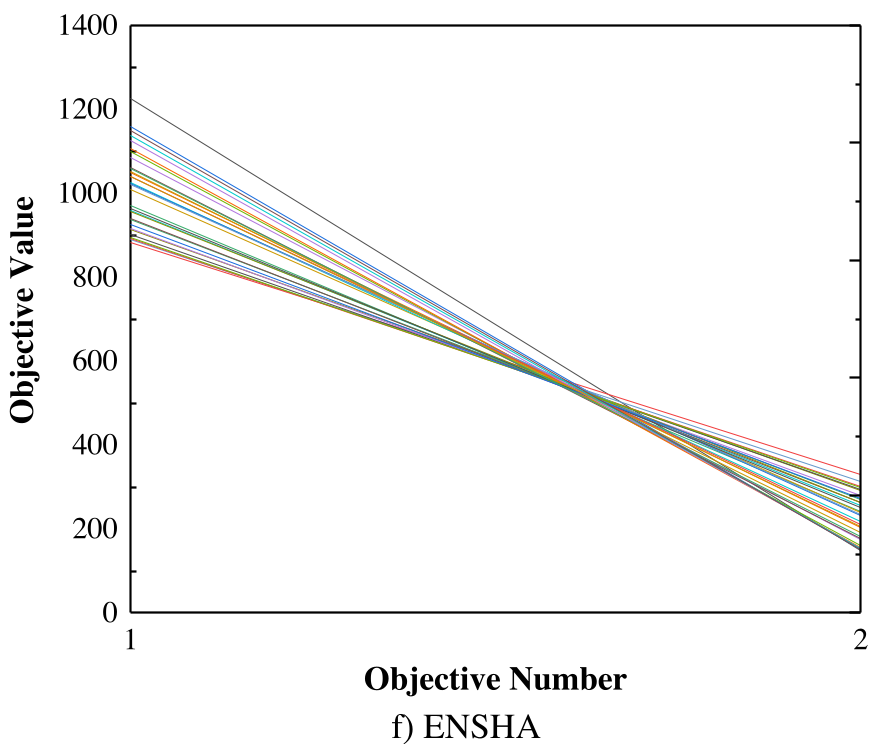
The resulting "value paths" (shown below) demonstrate that ENSHA provides a wide variety of choices for a manager—from "high efficiency/high cost" to "low cost/lower efficiency" options.
Conclusion
The ENSHA algorithm proves that by combining the structural search of genetic algorithms with the statistical learning of EDAs, we can solve incredibly complex logistical problems. By treating cost as an equal priority to time, it offers a tool that is not just mathematically impressive, but commercially vital.
Key Takeaway: Don't just optimize for speed; the "switching cost" in a flexible system is often where the real profit lies.