
ELM vs. KNN: Decoding Dyslexia through EEG and Machine Learning
Abstract-Dyslexia is a specific learning difficulty associated with brain capability in processing numbers and letters. Analysis of Electroencephalogram (EEG) could provide insight information on differences in brain processing. In this work, two machine learning techniques were applied to distinguish EEG signals of normal, poor and capable dyslexic children during writing word and non-word. The performance of knearest neighbour (KNN) with correlation distance function and extreme learning machine (ELM) with radial basis function (RBF) were compared. The performance of each classifier was determined using sensitivity, specificity and accuracy. It was found that ELM was capable of classifying the dyslexic children with 89% accuracy compared to KNN which is only 83%. These results showed that ELM is feasible and reliable in recognising normal, poor and capable dyslexic children through writing
This study presents a comparative analysis of K-Nearest Neighbour (KNN) and Extreme Learning Machine (ELM) for classifying EEG signals from normal, poor, and capable dyslexic children during writing tasks. By employing Discrete Wavelet Transform (DWT) for feature extraction, the research demonstrates that ELM with a Radial Basis Function (RBF) kernel achieves a superior State-of-the-Art (SOTA) accuracy of 89%.
TL;DR
This paper explores the neurological signatures of dyslexia by analyzing EEG signals during writing tasks. By comparing the classic K-Nearest Neighbour (KNN) with the more modern Extreme Learning Machine (ELM), the authors demonstrate that ELM can classify children into three categories—Normal, Poor Dyslexic, and Capable Dyslexic—with an impressive 89% accuracy, significantly outperforming traditional methods.
Background & Motivation: Moving Beyond Reading
Dyslexia is often framed as a reading disorder, but the neurological pathways for writing are equally critical for early diagnosis. The authors argue that writing requires intense active participation and focus, reflected in the Beta (13-30Hz) and Theta (4-7Hz) frequency bands.
Current screening relies heavily on physical assessments. This study aims to ground diagnosis in biological data (EEG), addressing the need for a faster, more accurate classification system that can distinguish not just between dyslexic and non-dyslexic children, but also the severity and "recovery" status (Poor vs. Capable).
Methodology: The Power of Extreme Learning
The technical core of the paper lies in the comparison of two distinct algorithmic philosophies:
- KNN (The Baseline): A distance-based classifier using Correlation Distance. While simple, it often fails to capture the high-dimensional nonlinearities of brain signals.
- ELM (The Innovator): A Single Hidden Layer Feedforward Network (SLFN). Unlike standard neural networks, ELM randomly assigns input weights and only "learns" the output weights through a Moore-Penrose pseudo-inverse. This prevents the "gradient vanishing" or overfitting issues common in iterative training.
Feature Extraction via Discrete Wavelet Transform (DWT)
To make sense of raw EEG data, the team used the Daubechies Wavelet (db2, db4, db6, db8). DWT is preferred for EEG because it captures localized frequency shifts in the time domain, which is vital for transient writing activities.
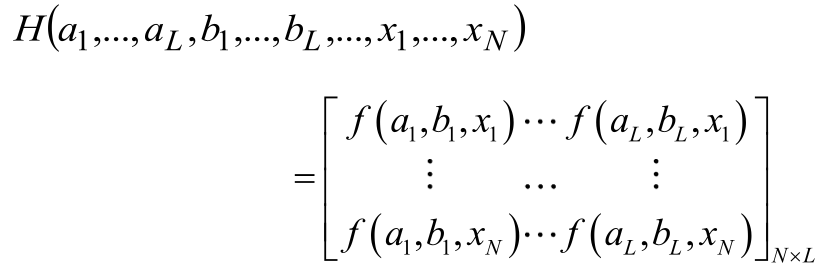 Figure 1: The mathematical representation of the ELM Hidden Layer Matrix used for rapid classification.
Experimental Results: Why ELM Wins
The researchers divided 30 subjects into training (70%) and testing (30%) sets.
- Accuracy: ELM achieved 89% using the db2 wavelet, while KNN peaked at 83%.
- Sensitivity (True Positive Rate): ELM was particularly effective at identifying "Capable" dyslexics (those who improved through intervention), reaching a sensitivity of 0.91.
- The "Poor" Challenge: Both models found "Poor" dyslexic children (severe cases) the hardest to classify, likely due to higher signal noise or variance in brain processing patterns among those struggling most.
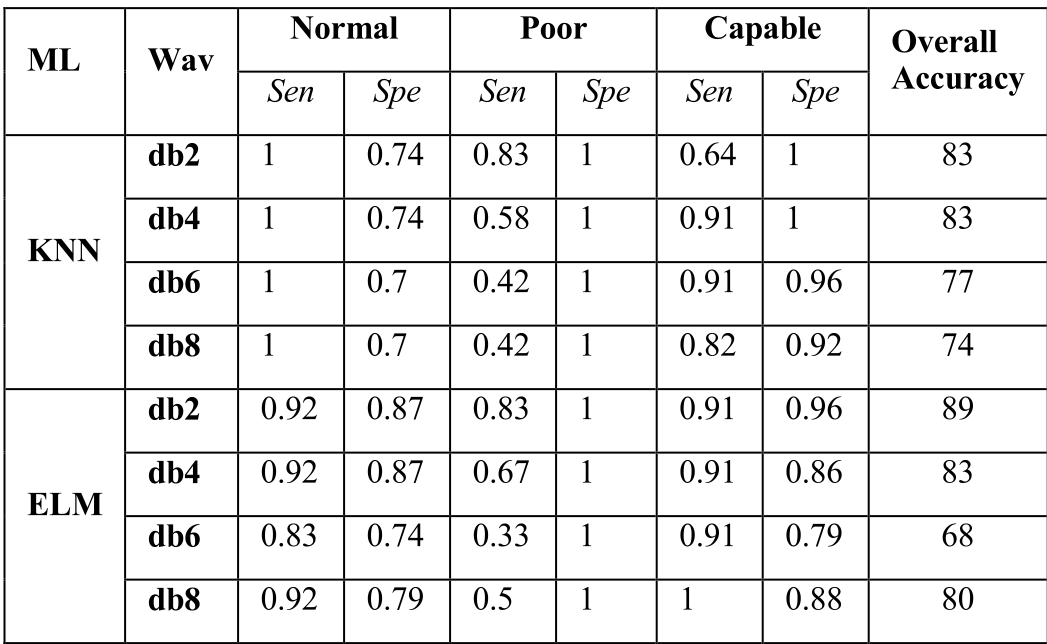 Figure 2: Comprehensive performance metrics comparing KNN and ELM across different wavelet orders.
Critical Insights & Future Outlook
The key finding is that ELM’s generalization ability makes it superior for EEG data. Because brain signals are inherently noisy and unique to each individual, the random weight initiation of ELM creates a robust feature representation that doesn't overfit to specific subject quirks as easily as KNN's distance-bound logic.
Limitations & Next Steps
- Sample Size: 30 subjects is a solid pilot but needs scaling for clinical validation.
- Feature Depth: Moving beyond power band ratios to include phase-locking values or connectivity metrics could further boost accuracy.
- Hybrid Models: The authors suggest that merging these classifiers or exploring Deep ELM could be the key to hitting the >95% accuracy threshold required for medical tools.
Conclusion
This study provides a strong case for using writing-based EEG tasks and ELM classifiers as a viable, fast, and objective method for dyslexia screening, potentially changing how intervention programs are assigned in schools.