
EM-Psychiatry: Decoding Mental Emergencies via Ambient Intelligence and MEMM
EM-Psychiatry: An Ambient Intelligent System for Psychiatric Emergency
The paper introduces EM-Psychiatry, an ambient intelligent (AmI) system for remote psychiatric emergency monitoring using a Maximum-Entropy Markov Model (MEMM). It leverages a multi-modal fusion of noninvasive biosensors (ECG, EDA, BVP) and psychometric scores to achieve an 82.67% prediction accuracy for acute mental states.
TL;DR
EM-Psychiatry is a pioneering framework designed for the continuous, remote monitoring of psychiatric emergencies. By fusing real-time biometrics (ECG, EDA, BVP) with clinical history through a Maximum-Entropy Markov Model (MEMM), the system transitions mental healthcare from reactive office visits to proactive, at-home ambient intelligence. It achieves an impressive 82.67% accuracy in identifying "Emergency" and "Atypical" states, significantly outperforming traditional self-report models.
The Gap in Psychiatric Care: Why Interviews Aren't Enough
Psychiatric emergencies—characterized by acute disturbances in mood or behavior—often result in self-harm or violence. Current clinical models rely heavily on periodic questionnaires like the Beck Depression Inventory (BDI). However, mental states are highly volatile; a crisis can develop in minutes. The industry faces an "Observation Gap" where patients are unmonitored between visits, and self-reports are often biased or intentionally misleading during a crisis.
Methodology: From Biosensors to Hidden States
The core innovation lies in the Maximum-Entropy Markov Model (MEMM). Unlike standard Hidden Markov Models (HMM), which are generative and assume observations only depend on the current state, MEMM is a discriminative model that calculates the conditional probability of a state sequence given an observation sequence.
1. Multi-Modal Data Fusion
The system extracts features from three distinct physiological channels:
- Electro-dermal Activity (EDA): Measures skin conductance to gauge sympathetic arousal (stress level).
- Electrocardiogram (ECG): Analyzes R-R intervals and QTc-intervals to detect objective markers of depression and substance abuse.
- Blood Volume Pulse (BVP): Peak-to-peak interval variations are used as a proxy for frustration.
2. The Architectural Pipeline
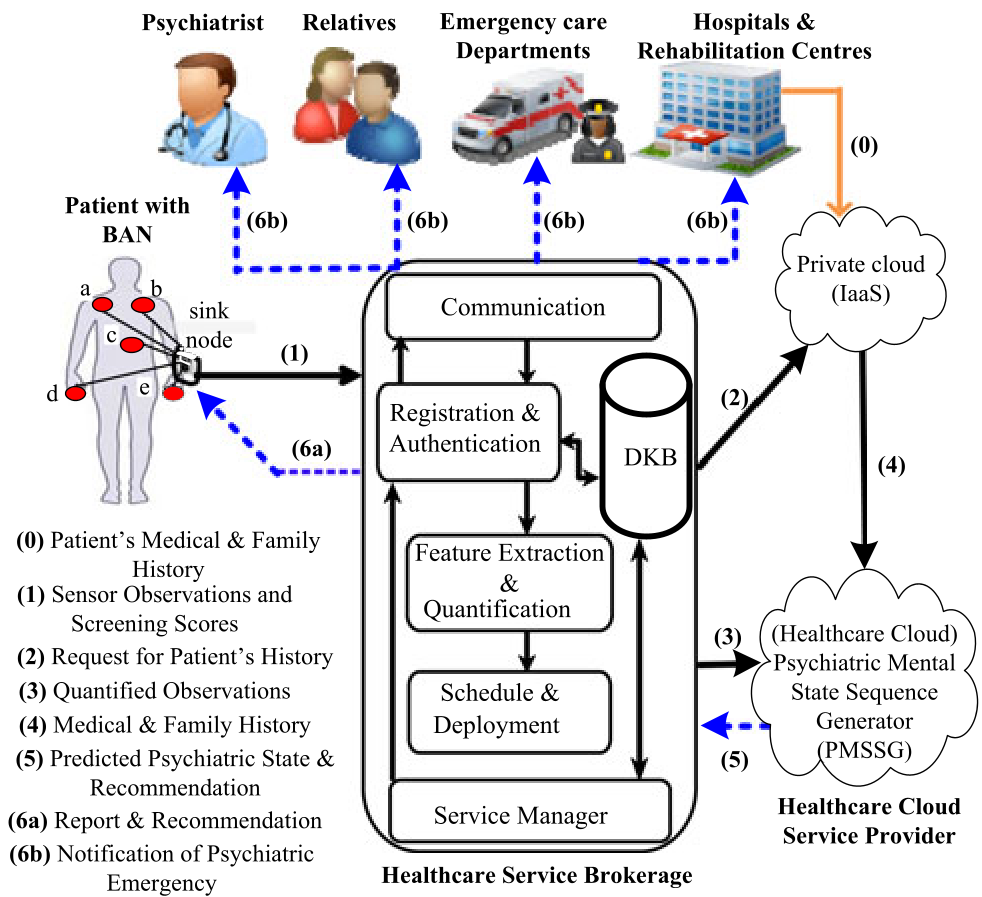
The framework fragments the care environment into a Body Area Network (BAN), a Healthcare Service Brokerage, and a Healthcare Cloud.
3. State Sequence Generation
Using a Modified Viterbi Algorithm, the system generates the most probable sequence of psychiatric states (Normal, Atypical, or Emergency). The model transition probability is defined as: This formula ensures that the current psychiatric state is assessed based on both the previous state and the current biological stressor.
Experimental Results and SOTA Comparison
The researchers implemented a prototype using Arduino-based sensors and an OpenStack private cloud. The results confirm a significant performance delta when adding bio-signals to traditional clinical methods.
- Accuracy Boost: The MEMM model reached 82.67%, whereas the traditional questionnaire-based "m-psychiatry" model reached only 71.18%.
- Feature Sensitivity: The use of GDA-PC (Generalized Discriminant Analysis-Principal Component) features allowed for better class separation than standard PCA.
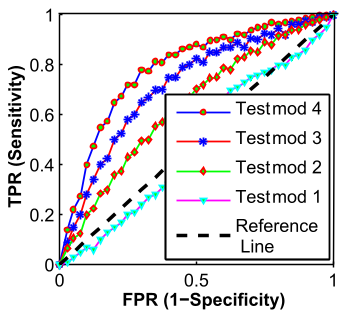
The ROC curves demonstrate that while static features (Mode 1) provide a baseline, the inclusion of three biosensor channels (Mode 4) dramatically expands the Area Under Curve (AUC).
Critical Insights & Future Outlook
The "Why" behind this paper's success is its focus on Inductive Bias. By modeling psychiatric states as a Markovian process, it acknowledges that mental health is a temporal journey, not a static snapshot.
Limitations:
- Confounding Factors: Physical activity (e.g., exercise) can mimic psychiatric stress in biosensors, potentially leading to false positives.
- Demographics: The study focused on ages 20-65; child psychiatry remains an unexplored frontier for this specific model.
The Takeaway: This work proves that "Ambient Intelligence" is no longer a concept limited to smart thermostats. By turning smartphones and wearables into clinical-grade psychiatric monitors, we are entering an era of "Knowledge-based Semiautonomic Industrialization" of mental health.