
Digital Traces vs. Human Reality: Do Email Networks Truly Reflect Office Social Life?
A comparison of email networks and off-line social networks: A study of a medium-sized bank ଝ
This study presents a comparative analysis of email networks and traditional off-line social networks (friendship, advice, and communication) within a medium-sized bank. Using Exponential Random Graph Models (ERGMs) and QAP correlations, it evaluates how digital communication traces mirror or diverge from self-reported human relationships.
TL;DR
Is your inbox a map of your work life? This study explores the gap between digital "exhaust" (email logs) and reality (friendships and advice). While email is a decent predictor of who is "central" in an office, it fails to capture the rigid barriers of gender, hierarchy, and department that still dominate off-line interactions.
Background: The Digital Goldmine Trap
In the era of Big Data, researchers often treat email logs as a "perfect mirror" of communication. It's cheaper and faster than sending out surveys. But this paper argues that social scientists might be falling into a trap. If we only look at emails, do we perceive a workplace that is more "democratic" and "borderless" than it actually is?
The Core Conflict: Why Digital Isn't Reality
The authors identified two potential reasons for the mismatch:
- Measurement Bias: Humans are bad at remembering every interaction (recall bias), whereas servers never forget.
- Social Flattening: Digital communication might inherently lower the stakes of social status. On the internet, "nobody knows you're a dog"—or in this case, fewer people care about your job title when shooting off a quick update.
Methodology: From Logs to Logic
The researchers didn't just look at one network; they built several. They compared Email Networks (operationalized in three ways, including a "weighted" version for frequent contacts) against Survey Networks (Friendship, Advice, and Information Flow).
They used Exponential Random Graph Models (ERGMs) to move beyond simple correlations. ERGMs allow us to ask: "What are the odds of a connection forming if two people are in the same department, versus if they have the same gender?"
 The visualization of friendship and advice networks reveals distinct clustering compared to the more distributed email logs.
Key Findings: The "Flattening" Effect
The results provide a reality check for technical lead and organizational psychologists alike:
- Centrality Synchrony: If you are a "broker" or a "hub" in the email network, you are likely also a hub for professional advice (Spearman correlation ~0.64).
- The Boundary Gap: This is the most striking finding. In the survey-based "Information Flow" network, being in the same department increased the odds of a tie by nearly 200 times. In the email network, this effect was significantly weaker.
- The Friendship Driver: Why do we email? The ERGM results show that friendship is a stronger predictor of emailing behavior than the official "advice" or "information" networks.
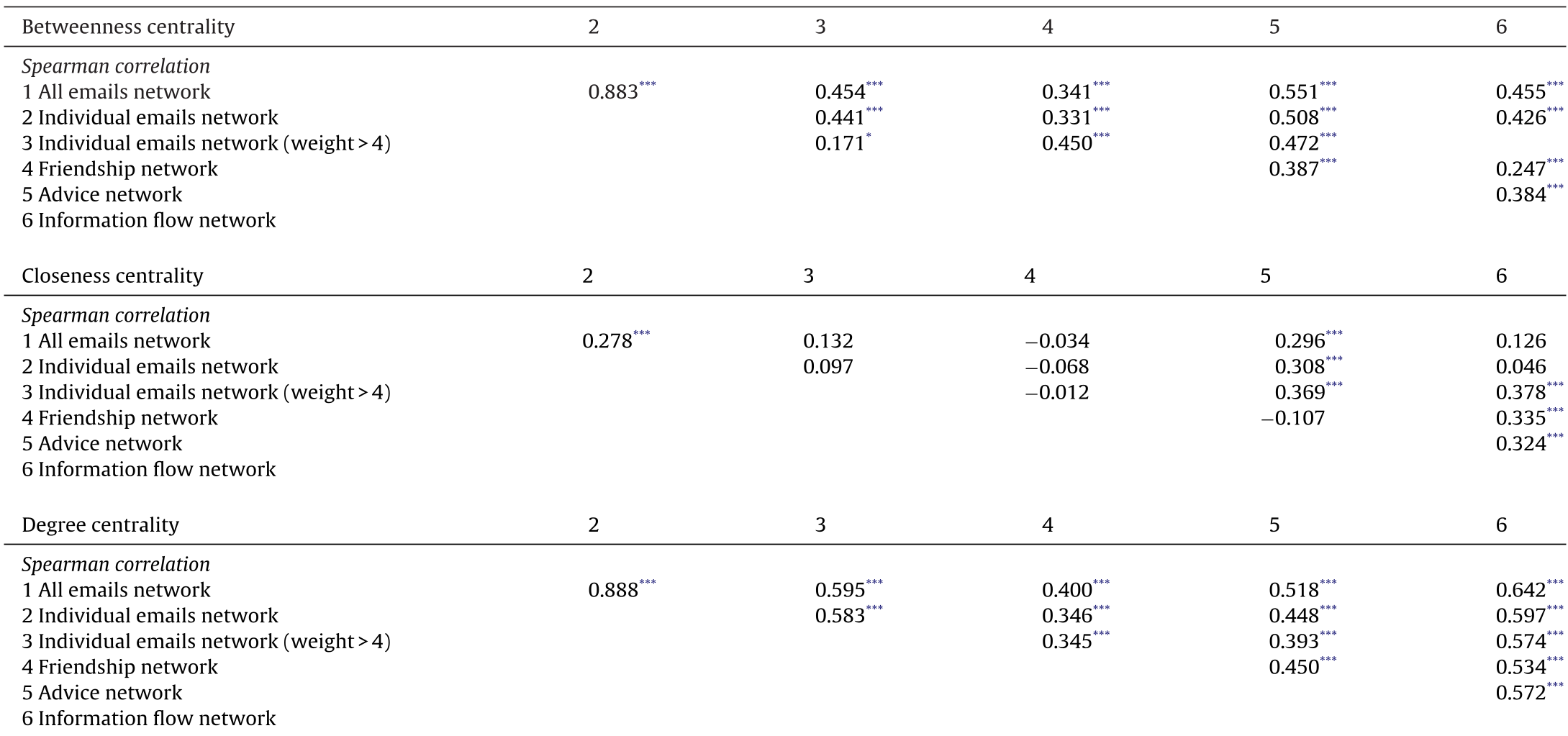 The high correlation in degree centrality suggests email is a valid proxy for visibility, but not necessarily for social intimacy.
Critical Insight: The Hidden Office Walls
The study proves that email data creates an illusion of a flatter organization. While emails flow across departmental lines and hierarchical levels, the heart of the office—where people go for lunch or vulnerable advice—remains highly segregated by traditional boundaries like gender and tenure.
If you are using digital metadata to design office layouts or restructuring teams, you are seeing the "bridge" (email) but missing the "walls" (social norms).
Conclusion & Future Outlook
This work serves as a foundational warning: Metadata is not the territory.
- Takeaway: Using email logs as a proxy for social networks underestimates the friction caused by organizational silos.
- Limitation: This was a single-organization study (a bank). Communication patterns in a tech startup or a hospital might look vastly different.
- Next Step: The future of this research lies in Content Analysis. If we can distinguish a "friendship email" from a "status report" via AI, we can finally bridge the gap between digital logs and human truth.