
Beyond the Scoreboard: Decoding Social DNA in Multiplayer Online Games
emails: {R.vandeBovenkamp, F.A.Kuipers}@tudelft.nl. Permission to make digital or hard copies of part or all of this work for personal or classroom use is granted without fee provided that copies are not made or distributed for profit or commercial advantage and that copies show this notice on the first page or initial screen of a display along with the full citation. Copyrights for components of this work owned by others than ACM must be honored. Abstracting with credit is permitted. To copy otherwise, to republish, to post on servers, to redistribute to lists, or to use any component of this work in other works requires prior specific permission and/or a fee. Permissions may be requested from Publications Dept., ACM, Inc., 2 Penn Plaza, Suite 701, New York, NY 10121-0701 USA, fax +1 (212) 869-0481, or
Summary
Problem
Method
Results
Takeaways
The paper explores social relationship dynamics in Multiplayer Online Games (MOGs) like DotA and StarCraft II, proposing a multi-type graph model to capture interaction types and strengths. By analyzing 10 years of behavioral data, it introduces SAMRA, a Socially Aware Match Recommendation Algorithm that significantly improves match quality and precision.
## TL;DR
Multiplayer Online Games (MOGs) aren't just arenas for competition; they are sophisticated social ecosystems. Researchers from Delft University of Technology analyzed millions of matches to reveal that **social ties are more predictive of player engagement than skill alone**. By building a "Socially Aware Matchmaking" system, developers can reduce match abandonment and turn random teammates into long-term "wingmen."
## Problem & Motivation: The "Blind" Matchmaker
Current matchmaking algorithms are often obsessed with **Elo/Skill ratings**. While "balanced" matches are the goal, they often ignore the social friction that occurs when strangers are forced to cooperate.
* **The Pain Point**: In many competitive games, nearly **41% of matches are aborted** at the start. Why? Because players lack a social bond or trust in their teammates.
* **The Insight**: MOGs are "target-driven" networks. Unlike Facebook (socializing-driven), players meet for a goal. The authors realized that if you can map the implicit relationships (who wins together, who plays repeatedly), you can build a more stable community.
## Methodology: Mapping the Invisible Clique
The researchers proposed a graph model where nodes are players and edges are interactions. Crucially, they didn't treat all interactions the same. They split them into five categories:
1. **SM**: Same Match (Co-presence)
2. **SS**: Same Side (Cooperation)
3. **OS**: Opposite Side (Competition)
4. **MW/ML**: Matches Won or Lost Together (Shared Outcome)
They introduced two key thresholds: **$n$** (minimum interactions) and **$t$** (time window). This allowed them to distinguish between a "passing stranger" and a "trusted ally."
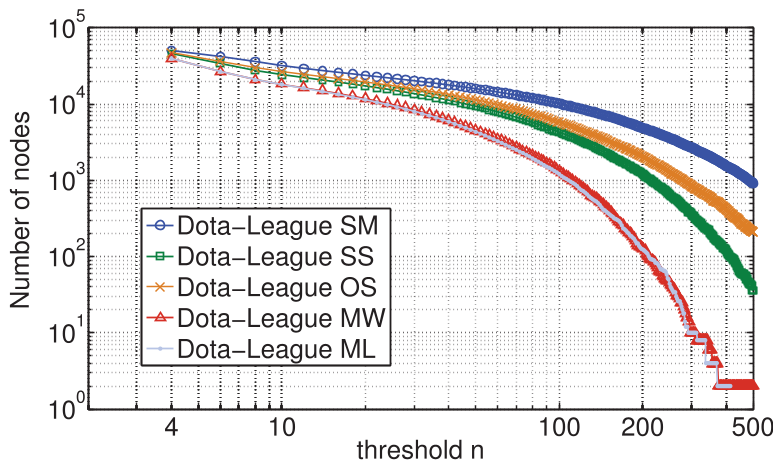
*Fig 1: As the threshold 'n' increases, the network filters out casual contacts, revealing a "hardcore" core of closely-knit players.*
## Key Findings: Genre Matters
The study compared different genres and found striking social differences:
* **RTS (StarCraft II)**: Competitive-heavy. Players often play on opposite sides and seek "challenges" from high-skill opponents (Negative Assortativity).
* **MMOFPS (World of Tanks)**: Cooperation-heavy. Large-scale teams mean players are much more likely to develop "Same Side" bonds.
* **The Early Member Paradox**: Communities in their infancy have fewer players but much higher **clustering coefficients**. Early adopters are significantly more committed to each other than the "masses" who join later.
## SAMRA: The Future of Matchmaking
The team introduced **SAMRA (Socially Aware Match Recommendation Algorithm)**. Instead of just looking at skill, SAMRA uses the "Bonding Score."
* **The Logic**: If a group of players has a history of winning together ($MW$), the system groups them.
* **The Result**: Precision in predicting future play-partners increased significantly. More importantly, the **Bonding Score**—a proxy for player enjoyment—was much higher compared to random or skill-only matching.
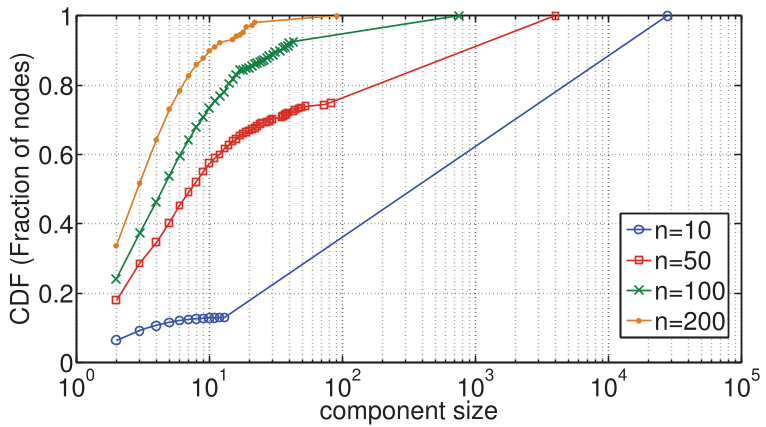
*Fig 2: SAMRA identifies "Islands" of players who have strong existing bonds and ensures they are placed together.*
## Critical Analysis & Takeaways
The paper provides a masterclass in how to treat "implicit" data. By moving away from "Friend Lists" (which players rarely update) toward "Interaction Logs," the researchers revealed the true social fabric of gaming.
**Key Takeaways:**
* **Top Players are Load-Bearing**: Removing the top 10% of active players causes the entire community graph to collapse. Retaining "influencers" is critical for game survival.
* **Dynamics vs. Growth**: A game might look like it’s growing in total users (cumulative), while actually dying in daily activity (periodic). Developers must track periodic interaction graphs to see the "health" of the pulse.
* **Future Potential**: This framework could be applied to **Toxicity Reduction**. If the system understands that triad $(A, B, C)$ has a "negative" social balance, it can prevent a toxic "Same Side" explosion before it happens.
**Conclusion**: Community management isn't just about moderation; it's about **topology**. If you build the right bridges between players, they won't just play for the game—they'll play for each other.