
LinkedIn’s Email Optimizer: Solving the Paradox of "Push" Marketing
Email Volume Optimization at LinkedIn
This paper presents LinkedIn’s large-scale email volume optimization system designed to balance member engagement with email overload. It introduces a Multi-Objective Optimization (MOO) framework that leverages Lagrangian duality to make real-time send/drop decisions, achieving SOTA results in industrial email management.
Executive Summary
In the digital world, more data doesn't always equal more value. LinkedIn's paper, "Email Volume Optimization at LinkedIn," addresses a fundamental tension: emails are vital for bringing users back to the app, but too many emails drive users to hit the "Unsubscribe" button or mark messages as spam.
The core contribution is a Multi-Objective Optimization (MOO) framework. By treating the decision to send an email as a mathematical trade-off between engagement (sessions) and cost (complaints/sends), LinkedIn engineers created a system that maintains nearly 100% of its business value while cutting out over a third of its "noise."
The "Cost-Benefit" Mirage
Many marketing systems operate on a simple logic: if the predicted click-through rate is high, send it. LinkedIn’s analysis reveals why this is a mistake.
As shown in the paper's cost-benefit analysis, excessive emails create two hidden costs:
- Channel Death: High complaint rates lead Email Service Providers (ESPs) to filter LinkedIn's infrastructure into spam folders.
- Attention Dilution: When a user receives 10 emails, their focus is divided. Paradoxically, by sending fewer emails, LinkedIn found that clicks on important messages actually increased because the "noise" was removed.
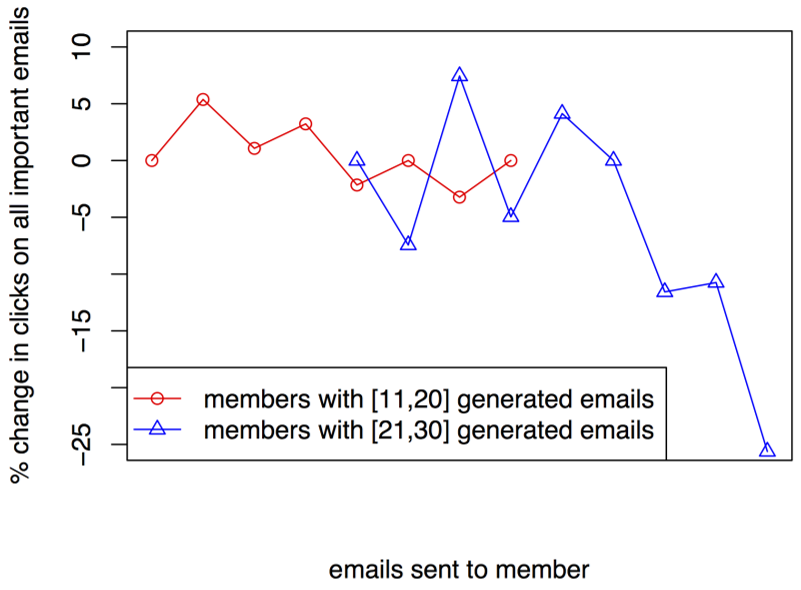 Figure: The downward trend of clicks on important emails as total volume increases.
Methodology: The Math of "Send vs. Drop"
LinkedIn’s approach moves away from naive thresholding. If you only optimize for sessions, you send too much. If you only optimize for complaints, you send too little.
The MOO Framework
The problem is framed as a Primal Allocation Problem:
- Objective: Minimize the Total Number of Emails.
- Constraints:
- Global session counts must stay above .
- Complaint counts must stay below .
- Local product vertical targets (e.g., Jobs, Feed) must be met.
Real-Time Decision Rule
Since you can't solve a million-variable LP in the milliseconds it takes to generate an email, the team used Lagrangian Duality. They solve the problem offline to find stability constants (Dual Variables/MOO Coefficients).
The online decision for an email becomes a simple score:
u P_{comp} - 1$$ - If **Score > 0**, Send. - If **Score < 0**, Drop. This elegant formula allows the system to balance "Business Value" ($\mu P_{sess}$) against "User Annoyance" ($ u P_{comp}$) using only a few stored coefficients. 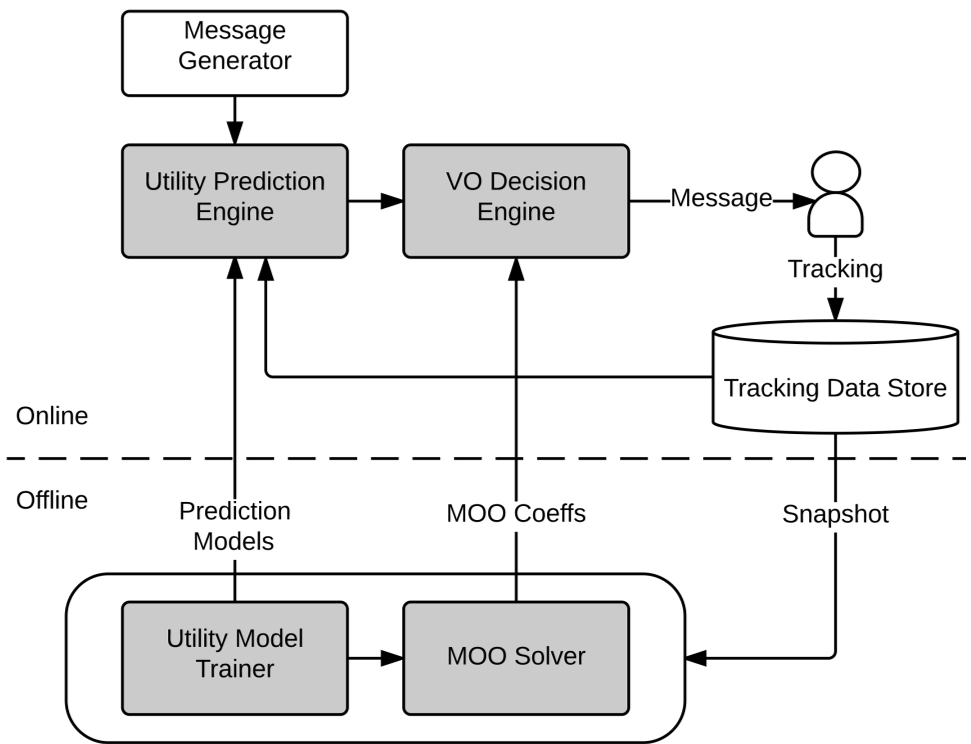 *Figure: Architecture Overview - Connecting Spark training to real-time VO decisions.* ## Experiments: More Value, Fewer Emails The results from LinkedIn's A/B tests are a masterclass in efficiency. By deploying the MOO system, they achieved a **64.51% send rate** (a ~35% reduction in volume) while keeping **98.16% of the sessions**. | Metric | Constraint (Target) | A/B Test Result | | :--- | :--- | :--- | | **Total Sends** | Minimize | 64.51% | | **Global Sessions** | ≥ 98.5% | 98.16% | | **Complaints** | ≤ 60% | 46.97% | Beyond the numbers, the "Attention Effect" was confirmed: pages like LinkedIn Groups and Profile actually saw *increases* in unique visitors (+0.9% and +0.1%) even though fewer emails were sent. This proves that removing low-quality emails makes high-quality ones more visible. ## Critical Insight: The Limitation of Independence The paper admits a significant **Inductive Bias**: it assumes that sending one email doesn't affect the probability of another email (Independence Assumption). In reality, the "Burn-in" effect exists—if I send 5 emails today, the user is less likely to click the 6th. While the current model uses "Past Week Activity" as a feature to mitigate this, the next frontier for this research is **Reinforcement Learning (RL)**, where the system treats the user interaction as a sequential MDP (Markov Decision Process) rather than a series of independent events. ## Conclusion LinkedIn's Email Volume Optimization is a blueprint for any platform platform struggling with push-notification fatigue. By mathematically rigorizing the "Annoyance Factor," they proved that you can protect your brand and your users' sanity without sacrificing growth.