
The LinkedIn Strategy: Balancing Engagement and "In-box Fatigue" Through MOO
Email Volume Optimization at LinkedIn
LinkedIn developed a large-scale Email Volume Optimization system using Multi-Objective Optimization (MOO). By formulating the task as a constrained linear programming problem, they achieved a strategic balance between maximizing member engagement and minimizing negative feedback (unsubscribes/spam).
Executive Summary
TL;DR: LinkedIn engineers addressed the "Email Overload" problem by moving away from binary send/drop rules to a Multi-Objective Optimization (MOO) framework. This system treats email delivery as a cost-benefit calculation, where the "cost" is member annoyance (complaints) and the "benefit" is downstream engagement (in-app sessions).
Background: This paper is a seminal industrial case study on sender-side volume optimization. It demonstrates how a massive social network can maintain its growth metrics while significantly improving the user experience by "sending less, but better."
The "Thresholding Trap": Why Simple Models Fail
The team initially discovered a fundamental conflict. If you only send emails that users are likely to click (high ), you still send many emails that drive complaints—because high-engagement members often have high and high simultaneously.
A naive threshold on one metric ignores the other, resulting in either a massive loss of engagement or a failure to curb the "unsubscribe" rate.
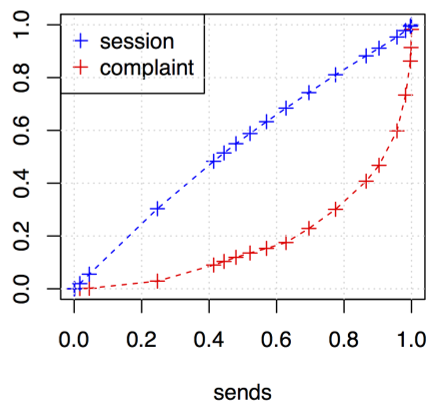 In the graph above, thresholding sessions (left) doesn't fix complaints, and thresholding complaints (not shown) nukes sessions.
Methodology: The Math of Decision Stability
The core of the paper is the formulation of the email delivery as a Linear Programming (LP) problem.
1. The Multi-Objective Framework
LinkedIn optimizes for:
- Objective: Minimize total sends.
- Constraints: Maintain a global percentage of sessions (e.g., ) and keep complaints below a certain threshold.
2. Solving for the "Hidden" Variables
Since you can't solve a global LP for millions of users in real-time, they used Lagrangian Duality. They solve the problem once for the past week's data to find "shadow prices" or co-efficients ( and ).
The final real-time decision rule is elegant and lightweight:
u^* P_{comp}(x_e) - 1 > 0$$ This allows the system to scale to millions of requests because the complex global constraints are baked into just two coefficients ($\mu^*$ for benefit, $ u^*$ for cost). 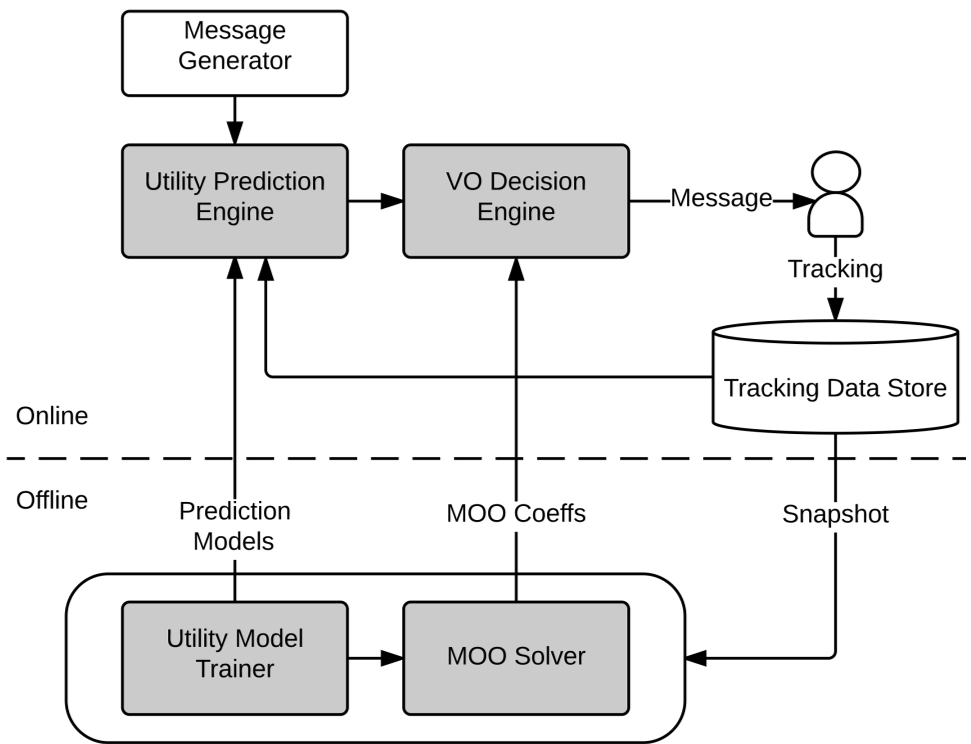 *The architecture separates the heavy lifting (Hadoop/Spark training) from the lightweight online decision engine.* ## Experimental Breakthroughs The online results were transformative. By applying MOO, LinkedIn achieved: - **Volume Reduction**: 35.5% fewer emails were sent. - **Complaint Mitigation**: 53% fewer unsubscribes and spam reports. - **Attention Reshaping**: Surprisingly, for some products like "Groups," visitor numbers actually **increased (+0.9%)**. This confirms the "Attention Budget" theory: by removing low-value noise, users finally noticed and engaged with the high-value content. ### Performance Matrix  *The table shows that the A/B test closely tracked the Offline Replay, proving that past behavior is a reliable predictor for future volume optimization.* ## Final Insight: The Paradox of Sending Less The LinkedIn study proves that **sending more email is not a linear path to more growth**. There is a "burn-in" effect where excessive volume destroys the long-term reach of the brand. By treating user attention as a finite, precious resource and using MOO to protect it, LinkedIn created a win-win scenario for both the business and its members. **Future Outlook**: The next frontier involves relaxing the "independence assumption"—meaning the system will eventually learn that sending one email *now* specifically changes the value of sending another email *later today*.