
Embrace Your Issues: Turning Bug Reports into Navigational Maps for Software Engineering
Embrace your issues: compassing the software engineering landscape using bug reports
The paper "Embrace Your Issues" presents a framework for navigating complex software engineering landscapes using historical bug reports. It introduces two primary systems: an ensemble-based Machine Learning approach for Issue Assignment (IA) and "ImpRec," a recommendation system for Change Impact Analysis (CIA) based on Information Retrieval and network centrality.
TL;DR
In large-scale industrial projects, developers are drowning in information silos. This paper by Markus Borg argues that the "daunting inflow" of bug reports is actually a hidden goldmine. By applying Ensemble Learning and Information Retrieval, the author demonstrates how to automate Issue Assignment (IA) and Change Impact Analysis (CIA), achieving up to 90% accuracy in team allocation and uncovering 40% of code impacts automatically.
Problem: The Information Silo Trap
In massive software ecosystems (like Telecom or Automotive), information is scattered across requirements databases, code repos, and test management systems. This leads to two critical failures:
- Bug Tossing: Issues are manually routed to the wrong teams, causing delays and wasted effort.
- Impact Blindness: In safety-critical systems, developers struggle to identify how a single code fix might break distant requirements or test cases.
The author’s insight is simple but powerful: Issue reports are the "connective tissue" of a project. Every time a developer fixes a bug, they leave a trail (trace links) between the report, the code, and the requirements.
Methodology: Mining the Project Memory
1. Automated Issue Assignment (IA) via Stacked Generalization
Instead of relying on a single classifier, the research employs Stacked Generalization (SG). This ensemble technique combines the strengths of various ML models (like SVMs, Naive Bayes, etc.) to predict which team should handle an incoming report.
2. ImpRec: A Recommendation System for CIA
For Change Impact Analysis, the author developed ImpRec. It doesn't just look at code; it builds a "Knowledge Base" of all artifacts.
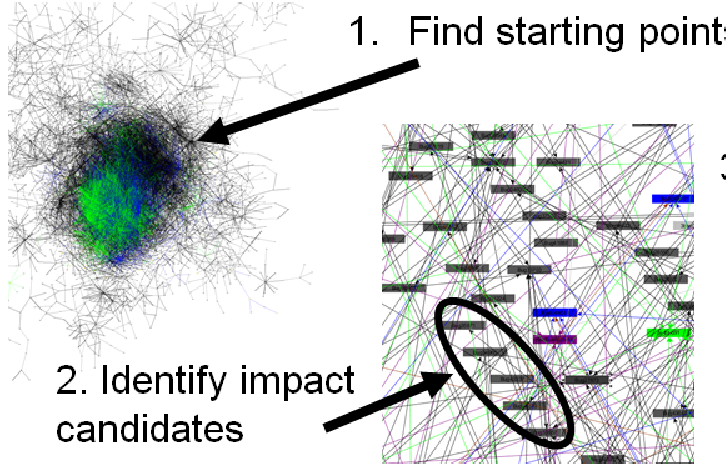 Figure 1: The ranking process of ImpRec, combining IR-based similarity and network analysis.
How ImpRec works:
- Search: When a new issue arrives, it uses Apache Lucene to find similar historical issues.
- Graph Traversal: It conducts a breadth-first search starting from those historical reports to find related artifacts (requirements, design docs).
- Ranking: It ranks candidates using Network Centrality (how "important" an artifact is in the web of links) and textual similarity.
Experimental Results: Industrial Evidence
The systems were evaluated on over 50,000 proprietary bug reports from "Comp Telecom" and "Comp Auto."
Key Findings:
- IA Success: The ensemble models reached 50-90% accuracy. A key "rule of thumb" emerged: you need at least 2,000 historical reports for the models to reach peak performance.
- CIA Precision: In a 12-year longitudinal study, ImpRec placed the "true" impacted artifacts in the Top 10 recommendations 40% of the time.
- Developer Confidence: In-vivo studies (real-world usage) showed that developers used the tool not just to find impacts, but to verify their manual work, boosting confidence in safety-critical audits.
 Figure 2: The research context spanning automated assignment and impact analysis.
Critical Analysis & Conclusion
Takeaway: This work shifts the view of bug reports from "burdensome technical debt" to "navigational infrastructure." By treating issue trackers as a shared memory, organizations can automate the "low-level" routing of tasks and provide a safety net for complex impact analyses.
Limitations:
- The reliance on "high-quality historical data" means that if previous developers didn't document their fixes well, the recommendation engine suffers.
- The system currently struggles with "cold start" scenarios where a new module has no historical bugs to reference.
Future Outlook: The logic of ImpRec could easily be extended to Fault Localization (predicting exactly which line of code is broken) or even processing end-user feedback to automatically suggest architectural changes. In the age of AI, this paper provides a robust blueprint for how "Project Memory" should be structured.