
Embracing the "Other": How Workgroups Invert the Global Clash of Civilizations
Embracing Cultural Diversity: Online Social Ties in Distributed Workgroups
This study investigates cultural homophily in online social ties within a global corporation, specifically testing Samuel Huntington's "clash of civilizations" framework. By analyzing an internal Social Networking System (SNS) across 97 countries, the researchers discovered that while company-wide ties exhibit strong cultural clustering, these "cultural fault lines" effectively reverse within distributed workgroups, where members show a surprising preference for culturally diverse friendships.
TL;DR
Does working for the same company make us more likely to befriend colleagues from different cultures? According to this large-scale study of a global MNC, the answer is a sobering "No"—unless you are part of a specific, distributed workgroup. While the broader company remains a "mesh of civilizations" where people stick to their own kind, workgroups show a statistically significant reversal of homophily, where employees actively form more cross-cultural ties than expected.
Background: The Persistence of "Birds of a Feather"
For decades, sociologists have observed Homophily: the natural instinct to bond with those who look, speak, or pray like us. Even in the age of the "Global Village," digital platforms have failed to erase these lines. Utilizing Samuel Huntington's provocative "Clash of Civilizations" framework—which divides the world into Eight Civilizations (Western, Islamic, Sinic, etc.)—previous research on Twitter and Email showed that digital interactions still cluster heavily within these cultural silos.
The authors of this paper asked a critical question: Can the shared culture and trust of a corporate environment act as a bridge over these cultural fault lines?
Methodology: Mapping the Mesh
The researchers analyzed a snapshot of an internal Social Networking System (SNS) containing over 2 million ties across 97 countries.
- Control Variables: They controlled for shared language, physical distance, religion, and historical political alignments (Cold War blocs).
- Measurement: They developed an "Adjusted Friendship Density" to account for the fact that some countries have more employees than others.
- The "Flip": They compared the entire company network against 87 distributed sales workgroups.
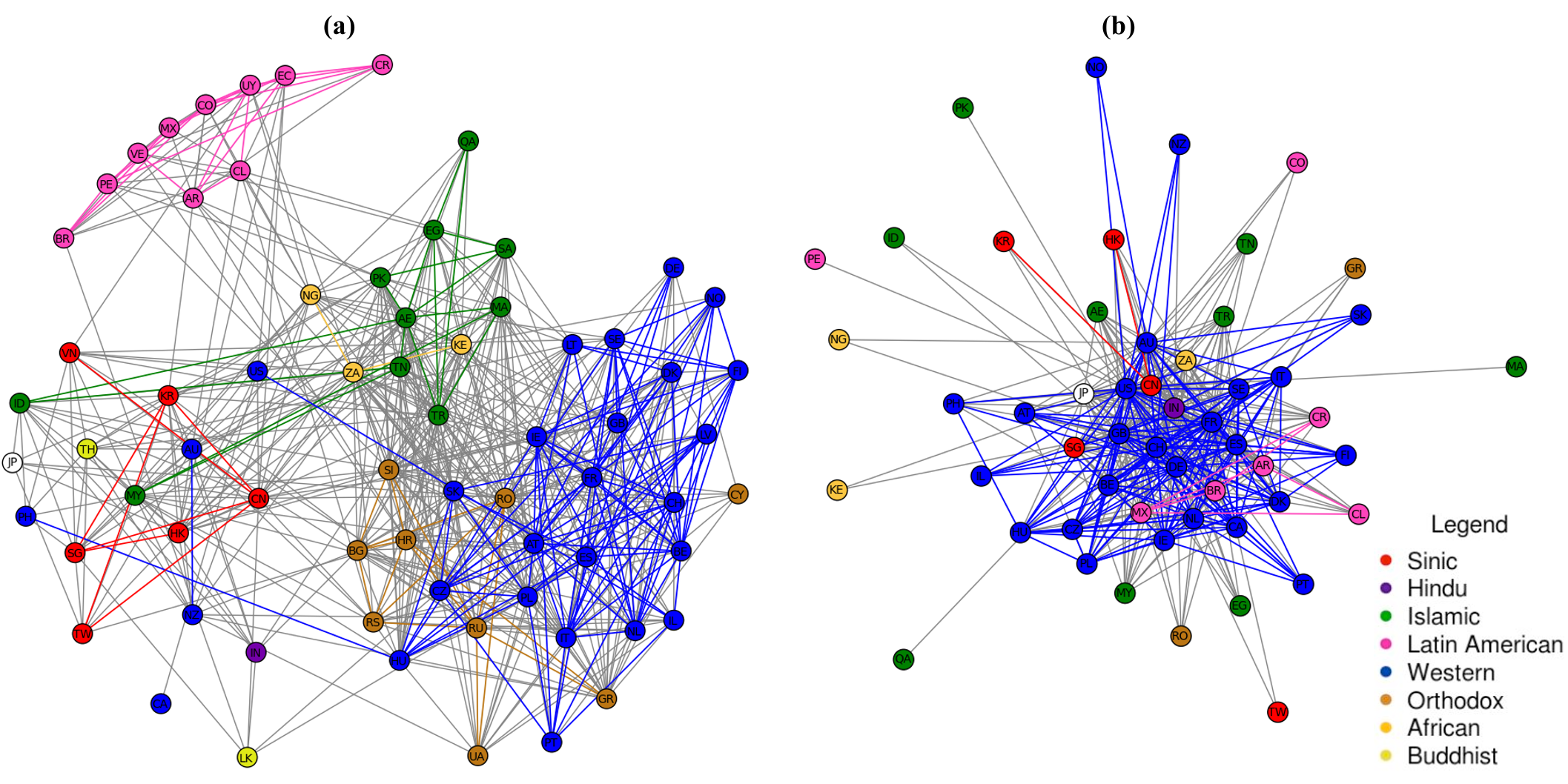 Figure 1: (a) The full company network shows clear monochromatic clusters representing Huntington's civilizations. (b) The workgroup network shows a chaotic, diverse blend where cultural clustering disappears.
The "Workgroup Effect": Why Diversity Wins in Small Teams
The most striking finding was the MRQAP model results. In the general company population, being in the same "Civilization" was a major driver of friendship. However, in the sales workgroups, the effect was negative.
Key Observations:
- Cultural Fault Lines Vanish: Within workgroups, common language and religion ceased to be significant predictors of who became friends.
- Distance Matters Less: While physical proximity still helped, its influence was significantly weakened within the workgroup context.
- Active Diversity: The "reversal" suggests that members weren't just tolerating colleagues from other cultures; they were prioritized as social connections.
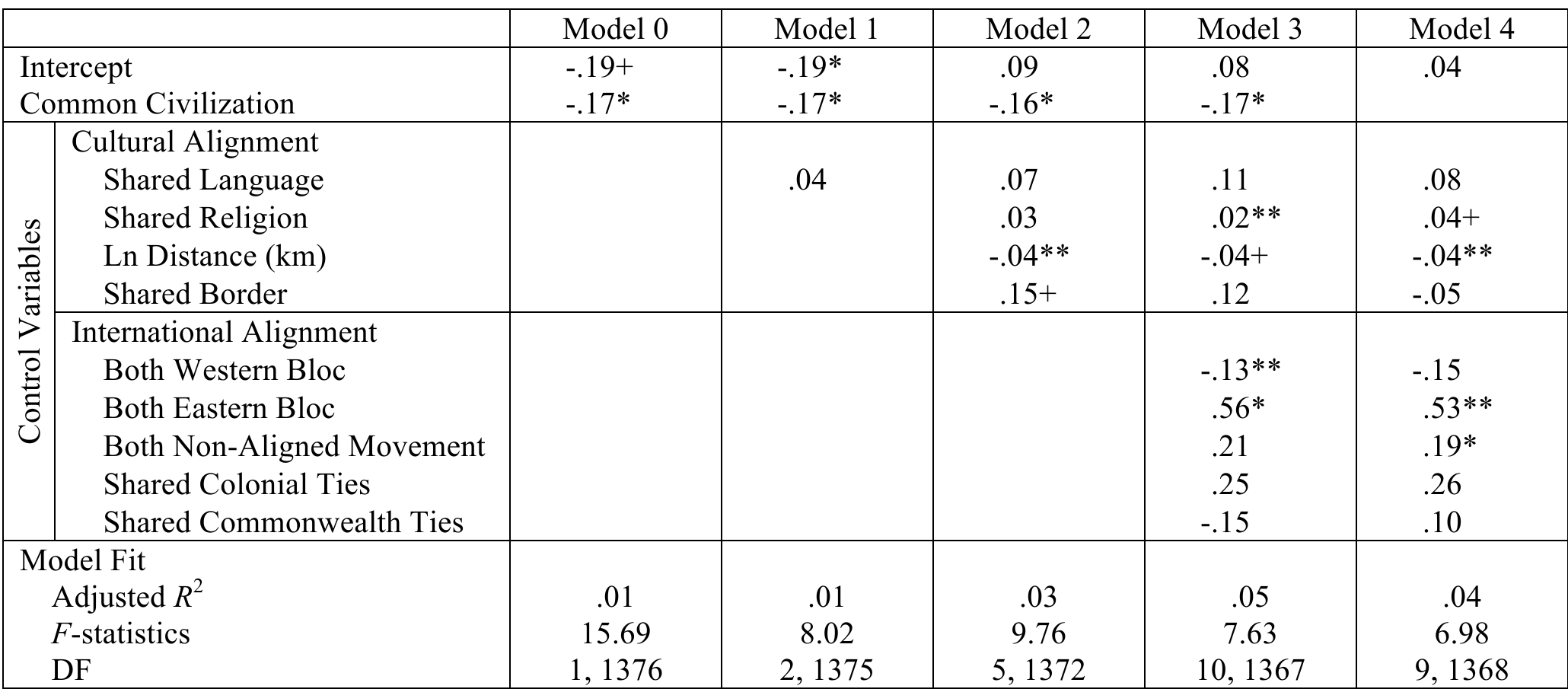 Table: In Model 0 for the Sales Network, "Common Civilization" shows a negative coefficient (-0.17), proving a preference for cultural diversity.
Why the Reversal?
The authors suggest three potential drivers for this phenomenon:
- Instrumental Needs: In global sales, you need local expertise. Diversity is a tool for professional survival.
- Shared Productivity Goals: The "common enemy" (a sales target) unites members more effectively than a vague corporate slogan.
- Social Identity Theory: In a massive 500k-person company, your identity is lost. In a 300-person workgroup, the "Team" becomes your primary identity, making cultural differences within the team feel like "in-group" variations rather than "out-group" threats.
Critical Insight & Practical Takeaway
This paper offers a profound lesson for global HR and organizational design: Scale is the enemy of diversity.
If you want a truly integrated global workforce, simply providing a social platform (an "Internal Facebook") isn't enough; people will naturally sort themselves into cultural silos. Integration only happens in the "trenches"—small, distributed units with high task-interdependence. To "embrace diversity," we must stop looking at the "Full Network" and start engineering the "Workgroup."
Conclusion
While Huntington predicted a "clash" of civilizations, this research highlights a "mesh." The "fault lines" of the world are real and survive even within the most progressive global companies. Yet, the distributed workgroup acts as a unique sociological "pressure cooker" that can actually reverse human tribalism.
Takeaway for the Reader: If your goal is to build an inclusive global network, don't just focus on "Company Culture." Focus on small-group project assignments where the "us vs. them" logic is replaced by "us vs. the deadline."