
Embracing Social Intelligence: The New Frontier of Social-Aware Wireless System Design
Embracing social big data in wireless system design
This paper explores the integration of social big data into wireless system design, proposing a framework to optimize video distribution and resource allocation. It introduces five cross-domain case studies—ranging from cloud CDNs to Information-Centric Networking (ICN)—achieving significant performance gains such as a 30% reduction in monetary costs and up to 23% improvement in cache hit ratios.
TL;DR
This research pioneers a shift from traditional, passive wireless architectures to social-aware systems. By mining "social intelligence" from big data, the authors optimize video distribution, spectrum allocation, and energy consumption. The results are striking: a reduction in operational costs by up to 89% and significant improvements in mobile user experience (QoE).
Background: Why "Social-Agnostic" Networks are Failing
For decades, wireless networks were designed to deliver content from centralized servers to edge clients. However, the rise of Online Social Networks (OSNs) has inverted this paradigm. Content is now generated and consumed within tight-knit social communities.
Traditional systems (using LFU or LRU caching) treat every request as an independent event. This "social-agnostic" approach ignores the fact that if a user in a specific community shares a video, their "friends" or "followers" are exponentially more likely to request that same content. Failing to leverage this leads to massive network congestion and wasted bandwidth.
Methodology: High-Dimensional Social Mining
The authors suggest a three-tier framework for embracing social big data:
- Data Acquisition: A distributed crawler that bypasses API limits via account/IP pools and dynamic program descriptors.
- Social Intelligence Mining: Analyzing user behaviors, propagation features, and community structures.
- Cross-Layer Optimization: Feeding this intelligence into cloud CDNs, ICNs, and wireless spectrum managers.
Key Mechanism: Community-Aware Distribution
Instead of simple geographic routing, the authors propose a weighted graph model to cluster users into communities based on:
- Social Relationships: Direct friendships or followings.
- Physical Proximity: Normalized geo-distance.
- Interest Similarity: Overlap in video watching history.
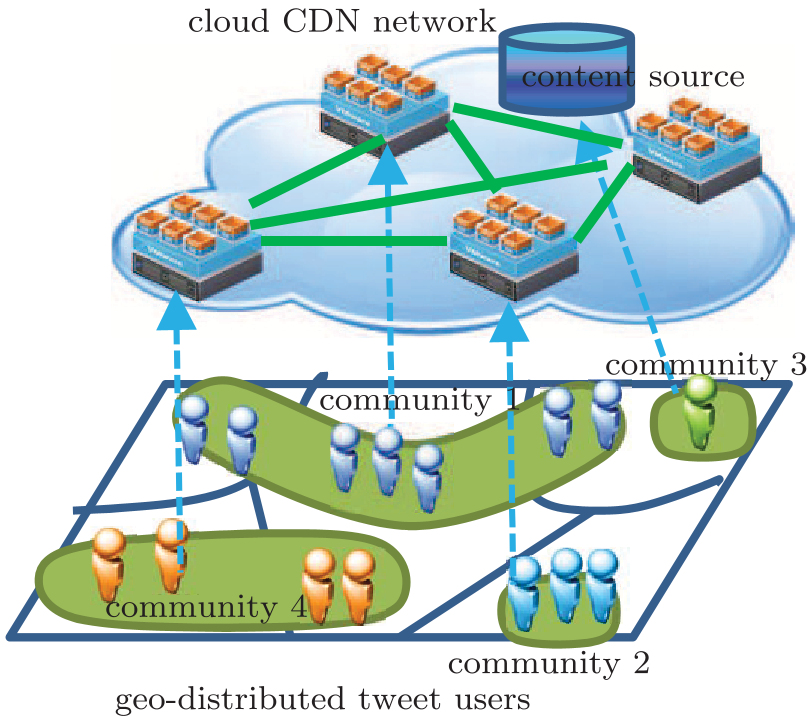 Figure 1: The Cloud CDN infrastructure optimized by community-based request scheduling.
Five Groundbreaking Case Studies
1. Cloud CDN Optimization
By scheduling requests based on community clusters rather than just DNS proximity, the system ensures that content replicas are placed where social "cliques" are actually active. This reduced monetary costs by 30% compared to LFU and 89% compared to social-interest baselines.
2. MSVS via Public Cloud Storage
For Mobile Social Video Sharing (MSVS), the authors used Game Theory (Supermodular games) to incentivize users to upload videos to local public clouds (like Azure). This offloads traffic from remote CDNs, reducing access delay by up to 30% via a Nash Equilibrium strategy.
3. Bitrate and Spectrum Synergy
The research demonstrates that knowing the "social propagation" path allows for better spectrum assignment. By adjusting bitrates dynamically for community leaders and followers, the system strikes a balance between resolution and smooth playback.
4. Location-aware "Green" Streaming
By predicting future bandwidth along a user's route (often predictable via social check-ins), the LAWS algorithm determines the optimal time to download video segments. This minimizes "video freeze" while maximizing battery life.
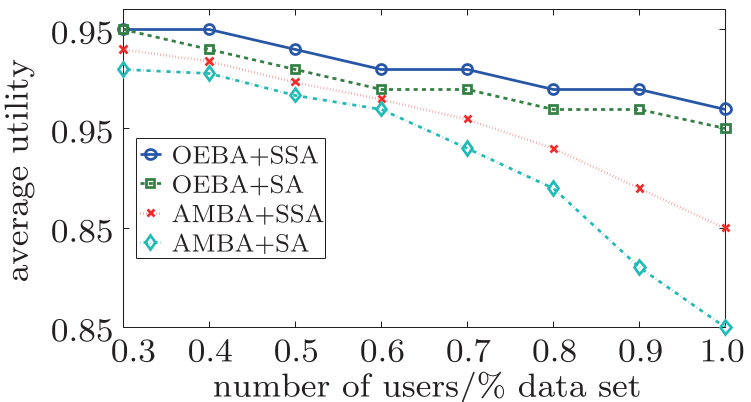 Figure 2: Performance gap between the proposed LAWS algorithm and the theoretical optimal (OPT).
5. Social ICN (Information-Centric Networking)
The authors propose a User-Centric Caching naming scheme: APP ID/User ID/Timestamp/Content ID. This allows routers to cache content based on the influence of the uploader rather than the popularity of a single file, increasing hit ratios significantly.
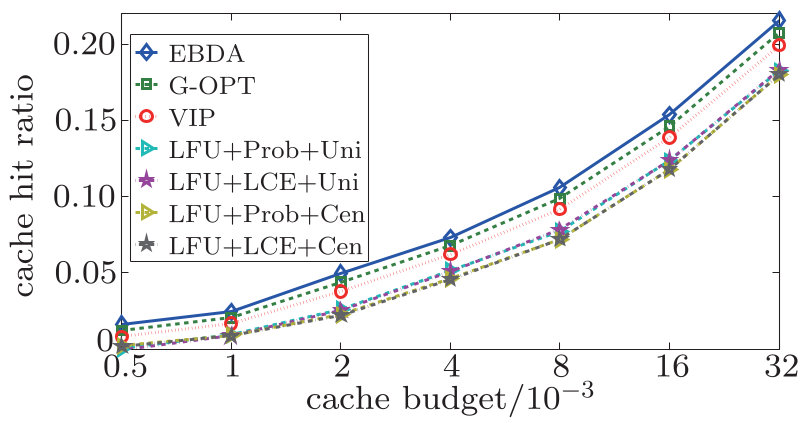 Figure 3: Modified ICN router processing interest and data packets with social identifiers.
Critical Analysis & Future Outlook
The core achievement of this work is proving that social links are a physical resource in wireless design. By treating them as such, the network transitions from reactive to proactive.
Limitations:
- Privacy: Crawling OSN data and tracking user locations raises significant ethical and privacy concerns that need robust encryption and anonymization protocols.
- Scalability of Mining: As social data becomes increasingly unstructured (VR/AR content), the "Program Descriptor" approach may require more advanced LLM-based semantic analysis.
Final Takeaway: This paper is a manifesto for the "Socially-Aware Network." It bridges the gap between social science and wireless engineering, showing that the most efficient way to route a packet is to understand the human connection behind it.