
The Predictive Brain: How Altruism Emerges from Minimizing Prediction Error
Emergence of Altruistic Behavior Through the Minimization of Prediction Error
This paper proposes a computational model demonstrating that altruistic helping behavior in 14-month-old infants emerges from the minimization of Prediction Error (PE). The authors implemented this model in both simulated environments and a physical iCub humanoid robot, achieving successful spontaneous helping without explicit reward-based programming.
TL;DR
Why do infants help strangers without being asked or rewarded? This paper moves beyond traditional "empathy" explanations, proposing that altruism is a result of the brain's fundamental urge to minimize Prediction Error (PE). By modeling this in an iCub robot, the authors show that when a robot predicts a human's next move and that move fails to happen, the robot "helps" simply to make the world match its internal prediction.
Background: Beyond Empathy
In developmental psychology, two main theories dominate the conversation on infant altruism:
- Emotion-Sharing: Infants feel another's distress and act to alleviate it. (Problem: Requires mature self-other differentiation).
- Goal-Alignment: Infants understand what others want to do and adopt that goal as their own. (Problem: Why would they bother to act on it?).
This paper introduces a third path: Prediction Error Minimization. It suggests that the drive isn't social "kindness" initially, but a cognitive necessity to resolve the gap between what we expect to see and what actually occurs.
The Mechanism: The Action Graph
The core of the methodology is the Action Graph, which acts as the robot’s memory. It records:
- Action Nodes (A): Primitives the robot can do (Reach, Grasp, Open).
- Condition Nodes (C): Objects required (Ball, Mug, Box).
- Edges: The statistical probability of one action following another based on past experience.
When the robot observes a human starting a sequence (e.g., reaching for a car), its internal model calculates the most likely next step (e.g., moving the car). If the human stalls or fails—creating a "Prediction Error"—the robot's system experiences a signal spike. To silence this "noise," the robot executes the predicted action itself.
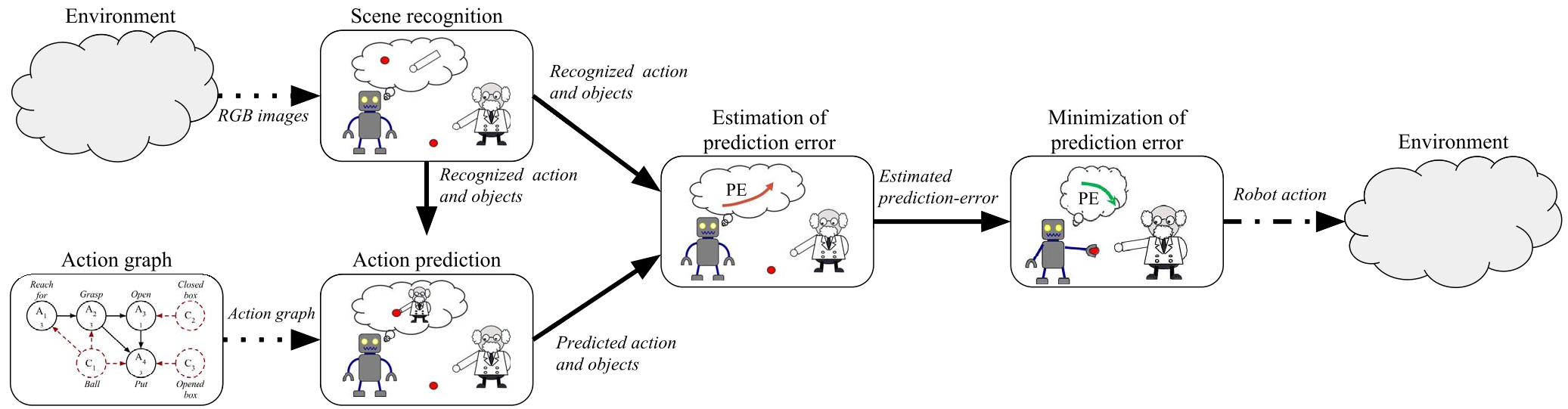 Figure 1: The computational model consists of scene recognition, action prediction, and PE estimation/minimization modules.
Experimental Validation
1. Simulation: The Power of Experience
The authors first tested the model in a noise-free simulation to see how training affects altruism. They found a direct correlation: the more the robot "practiced" actions itself, the better it was at predicting others and, consequently, "helping" them.
2. Humanoid Robot (iCub) Trials
The real test involved the iCub robot interacting with human participants. In a noisy environment with real-time camera tracking, the robot had to distinguish between a "Push" action (Reach from side + Move) and a "Cover" action (Reach straight + Hide).
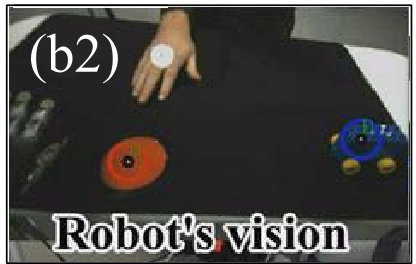 Figure 2: Real-time tracking of human vs. robot hand distance. The red line shows the PE rising until it hits the threshold, triggering the robot's intervention.
Key Results:
- Success Rate: 80-100% for familiar actions.
- Latency: The robot typically waited ~5 seconds for the human to finish before intervening.
- Failure Analysis: When the robot failed to help effectively, it was often due to "Prediction Ambiguity" (multiple possible next steps) or "Perspective Difference" (the robot doing the action for itself rather than handing the object to the human).
Critical Insight: Altruism as a By-product
The most profound takeaway is that the robot has no explicit intention to help. It is not programmed with a "be kind" command. Altruistic behavior emerges as a side effect of the system trying to maintain its own predictive consistency.
Limitations and The Path Forward
While powerful, the current model lacks "Perspective Taking." The robot performs the action to satisfy its internal model, which sometimes means it hoards the object instead of giving it to the human. The authors suggest that the next evolution of this research will involve State Prediction—predicting how the environment should look (e.g., "The box should be open") rather than just what the next muscle movement should be.
Conclusion
This work bridges the gap between high-level social behavior and low-level neurocomputational principles. It suggests that our social nature might be hard-wired into the very way our brains process information and anticipate the future.