
Diversity as a Catalyst: How Varied Social Responses Rescue Cooperation
Emergence of Cooperation in Adaptive Social Networks with Behavioral Diversity
This paper explores the emergence of cooperation in adaptive social networks by introducing behavioral diversity in how individuals manage their social ties. Using Evolutionary Game Theory (EGT), the authors demonstrate that increasing the number of linking strategies (diversity in response rates to adverse partners) significantly promotes and stabilizes cooperative behavior in a Prisoner's Dilemma context.
TL;DR
Why do humans cooperate even when it is costly? While classical Game Theory predicts the triumph of "Defectors," this paper reveals that Behavioral Diversity—the different ways individuals react to bad social partners—is a secret weapon for cooperation. By allowing individuals to break ties at different speeds, the social network self-organizes into a state where cooperators can isolate predators and flourish.
The Paradox of the Rational Predator
In the classic Prisoner's Dilemma, the "Defector" (D) always has a higher immediate payoff than the "Cooperator" (C). In a well-mixed population, this leads to a "race to the bottom" where cooperation goes extinct. Previous research suggested that structured networks (who you know matters) could help, but these models usually assumed everyone reacts to "bad" links in the same way.
The authors argue that this is unrealistic. Humans are diverse; some forgive quickly, while others cut ties at the first sign of betrayal. This paper asks: Does this messiness actually help the group stay cooperative?
Methodology: Co-evolution of Strategy and Structure
The researchers used Evolutionary Game Theory (EGT) to model a population where two things evolve simultaneously:
- Game Strategy: Do you cooperate or defect?
- Linking Strategy: How fast do you break a connection with a defector?
They defined different "types" of players. A high signifies a high degree of behavioral diversity. The network is "adaptive," meaning links aren't permanent; they are constantly being formed and dissolved based on the satisfaction of the players involved.
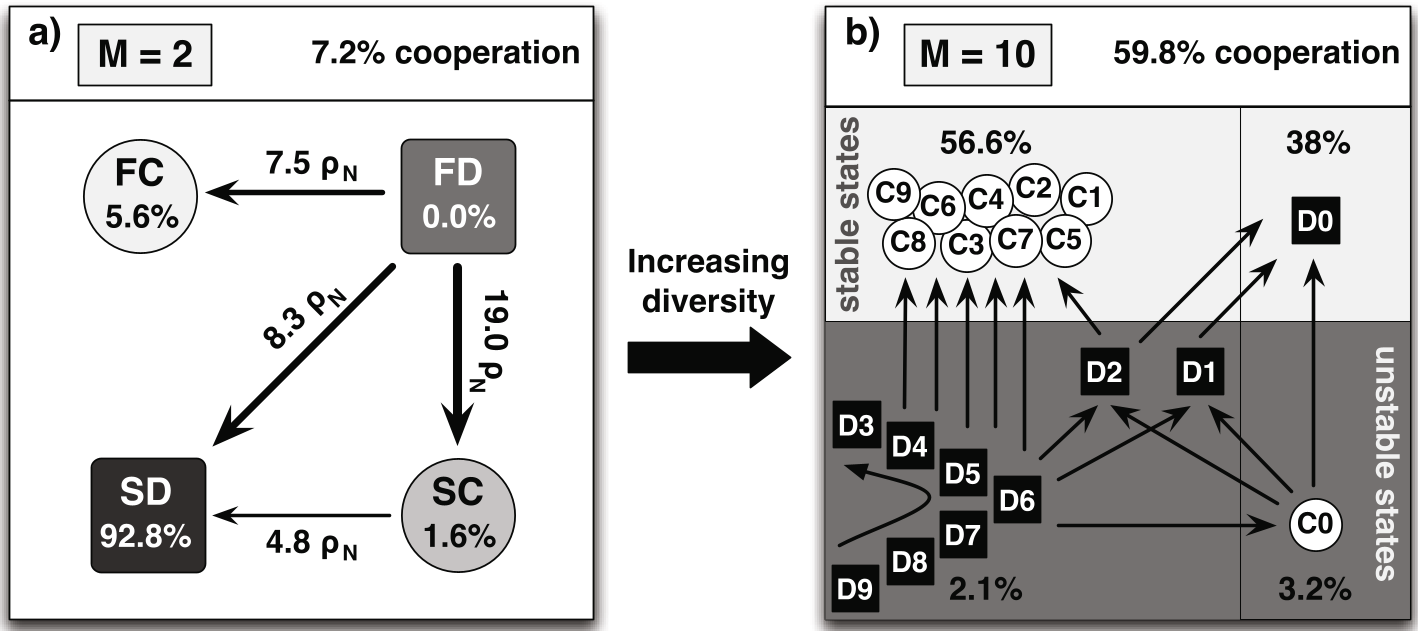 Figure 1: The transition probabilities in a population with 4 strategies. It shows how "Fast Cooperators" (FC) and "Slow Defectors" (SD) interact within the evolutionary landscape.
Why Diversity Wins
The team discovered a remarkable trend: The more ways there are to respond to a defector, the more cooperation thrives.
When diversity is low (small ), "Smarter" defectors can easily exploit steady cooperators. However, when diversity is high:
- The Escape Hatch: A wide variety of defectors (some fast, some slow) creates a "multi-dilemma" environment.
- Selection Bias: Selective pressure wipes out "Fast Defectors" because they lose their sources of income (cooperators) too quickly.
- The Survival of the Diverse: Interestingly, while only "Slow Defectors" survive, all types of Cooperators (from slow to fast) persist in the population.
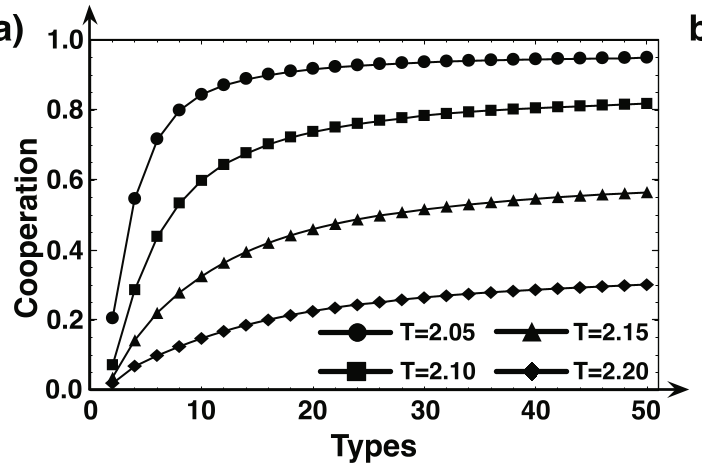 Figure 2: (a) Total cooperation increases as the number of available linking strategies (M) grows. (b) The distribution of types shows that cooperators maintain full diversity while defectors are pushed toward slower reaction rates.
Critical Insight: The "Multi-Dilemma" Environment
The most profound takeaway is that diversity changes the game from a single, rigid struggle into a complex ecosystem. By having many different "reaction speeds" in the population, the transition from "Defector" to "Cooperator" becomes statistically more likely. Diversity inhibits the most lethal path of the "Fast Defector" and paves a road for cooperators to find each other and stick together.
Conclusion & Future Look
This work places behavioral diversity alongside reciprocity and kin selection as a fundamental pillar of cooperation. It suggests that our modern "multi-cultural" and "minority-friendly" policies might not just be moral choices, but evolutionary advantages that keep society from collapsing into a state of pure self-interest.
Limitations: The model assumes a "fast linking" timescale (people change friends faster than they change their fundamental beliefs). Future research could explore what happens when social networks are "sluggish" to change compared to the speed of cultural imitation.