
The Emergence of Social Networks: How Direct and Indirect Reciprocity Create Dynamic Order
Emergence of social networks via direct and indirect reciprocity
This paper presents an agent-based model investigating how social networks emerge from the interplay of direct reciprocity (e.g., Tit-for-Tat) and indirect reciprocity (reputation-based cooperation). By employing reinforcement learning, specifically Q-learning, the study demonstrates that stable global network properties can coexist with highly dynamic individual-level allegiances.
TL;DR
Why are human social networks stable at a macro level (we see the same clusters and densities) but chaotic at a micro level (who we talk to changes constantly)? This paper argues that this "dynamic stability" is an emergent property of two competing forces: direct reciprocity (helping those who helped you) and indirect reciprocity (helping people to build a public reputation). By using Q-learning agents, the research shows that social networks aren't just a "container" for interaction—they are the result of it.
Background: The Limits of Static Graphs
In classical multi-agent systems and evolutionary biology, researchers often treat social networks as "given"—a static grid or a pre-defined scale-free graph where agents play games. However, real life is messier. Alliances expire, new collaborations form, and reputations fluctuate. Existing models struggled to explain why individual degree rankings (who is the "most popular") change so much while global metrics like network diameter stay the same.
The Core Insight: Networks from the Bottom-Up
Instead of building a graph and then letting agents play, Steve Phelps proposes a model where the graph is the record of donations.
- Donation Portfolios: Every agent decides how to split their "wealth" across others.
- Emergent Weight: If Agent A gives to Agent B frequently, a strong directed edge forms.
- Information Hypothesis: Does the source of a reputation matter? The author tests if agents should trust a "global score" or if they should value information more if it comes from someone "close" in the network.
Methodology & Architecture
The model utilizes agents equipped with Q-learning. These agents don't just follow a fixed rule; they try different strategies—Tit-for-Tat (T4T), Reputation Weighted (RW), and a new Reputation Weighted Networked (RWN) strategy—and keep what works.
Mathematically, the "Networked" reputation is defined by: Where the reputation of is discounted by the shortest path distance from . This represents the "Social Proximity" intuition: I trust a stranger's reputation less if they are far away from my immediate circle.
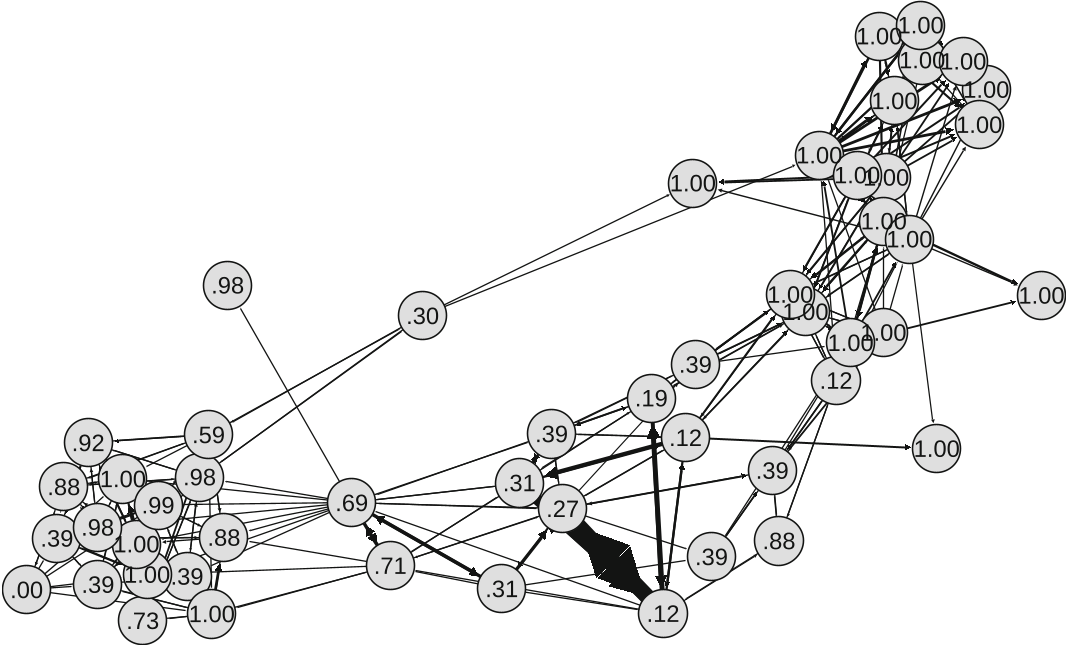 Figure 1: Visualization of a directed graph emergent from agent interactions.
Experiments and Results
The paper reveals two fascinating steady-state behaviors through large-scale simulation ( independent runs):
1. The Superiority of "Social Proximity"
When agents were "stateful" (aware of their own reputation status), the RWN strategy (discounting by distance) became highly prevalent. This suggests that the source of reputation information really matters. By using network distance, agents formed "cliques" that protected them from defectors while allowing them to benefit from both direct and indirect reciprocity.
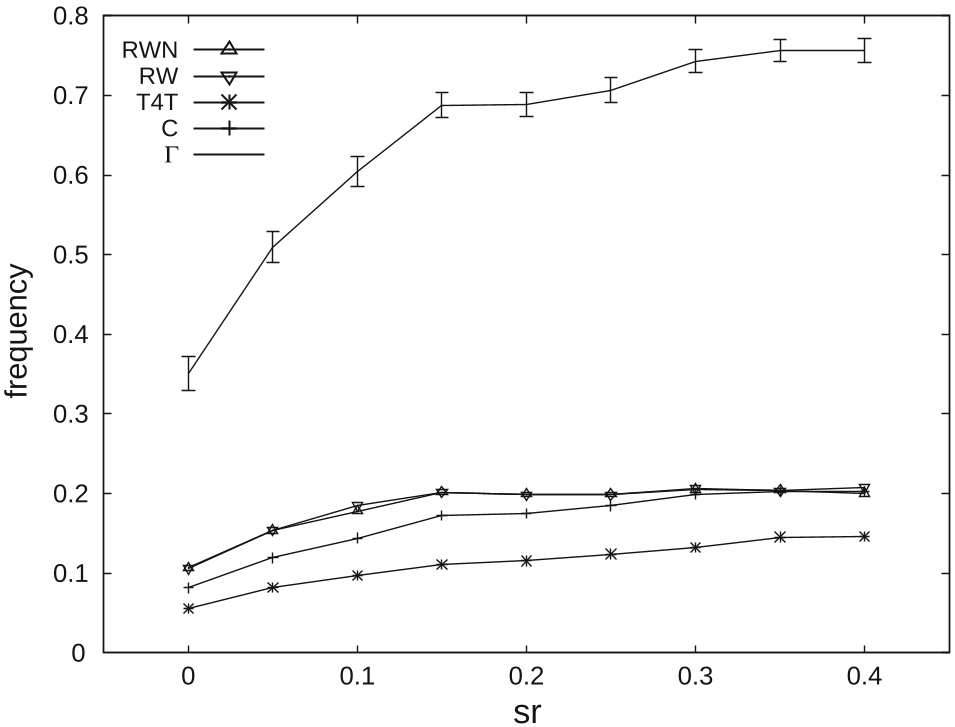 Figure 2: Level of cooperation relative to the proportion of strong reciprocators in the population.
2. Macro Stability vs. Micro Chaos
The most striking result is the verification of the "Kossinets-Watts" phenomenon. The Global Clustering Coefficient (a measure of how "cliquey" the whole network is) stabilizes quickly. Yet, the Dissimilarity Coefficient (measuring the change in individual degree rankings) continues to rise.
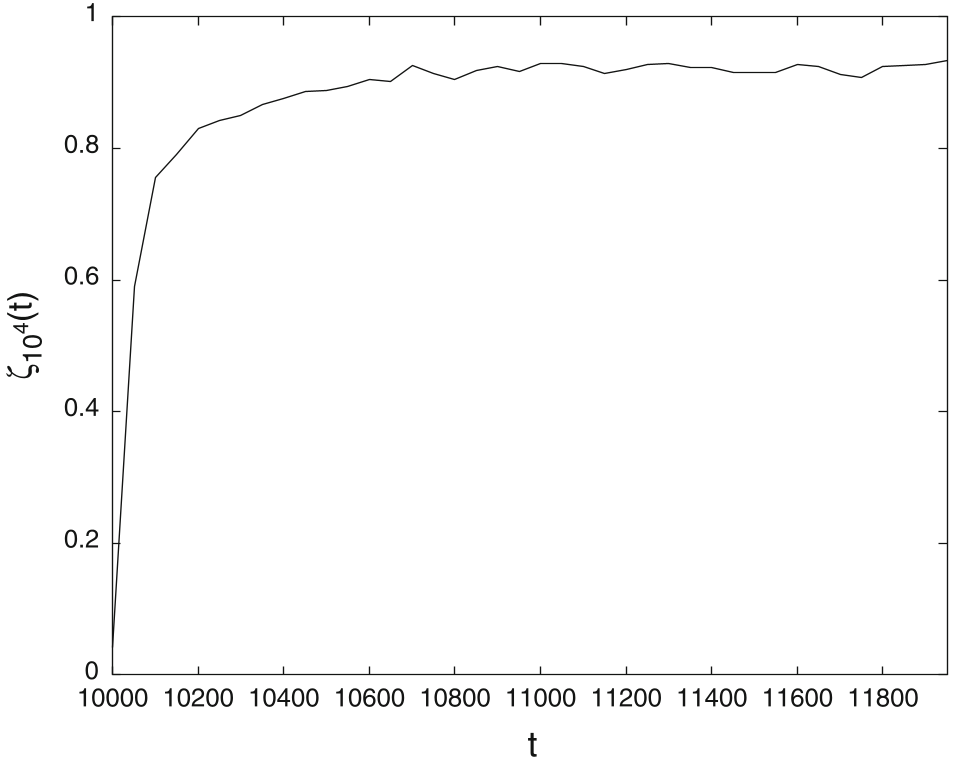 Figure 3: Mean dissimilarity coefficient showing that even in a global steady-state, individual rankings are in constant flux.
Critical Insight & Conclusion
Why does this happen? The author attributes this to the nature of Reinforcement Learning. Agents are always "experimenting" (the -greedy approach). Even when a "Strategic Equilibrium" is reached at the population level, individual agents are constantly switching strategies in response to local fluctuations.
The Takeaway: This work shifts the perspective of social networks from a "static infrastructure" to a "dynamic equilibrium of reciprocity." If you are building a reputation system for a marketplace or a decentralized network, the lesson is clear: don't just provide a global score. Allow the network distance—the social context—to weight that score. That is how robust, human-like cooperation emerges.
Limitations: The model assumes quite a bit of computational overhead for agents to calculate shortest paths across the global graph. In massive-scale real-world networks, agents likely use more localized heuristics rather than global pathfinding.