
Harnessing the Hive Mind: How Web Collective Intelligence Redefines Technology Foresight
Emergence of Web Collective Intelligence and Its Impact on Technology Foresight
This paper explores the emergence of Web Collective Intelligence (WCI) within online communities and its transformative role in Technology Foresight. It defines WCI as the complex, multi-level wisdom generated through the deep interaction of expert users, serving as a superior alternative to traditional expert-only forecasting methods.
TL;DR
The rapid evolution of web technology has birthed Web Collective Intelligence (WCI)—a phenomenon where deep interactions among online expert users create a pool of wisdom surpassing any individual expert. This paper argues that WCI is the key to solving the limitations of traditional technology foresight, such as "time lag" and limited perspective, by utilizing real-time web comments and community-driven knowledge production.
The "Bull" in the Digital China Shop: Why Individual Experts Aren't Enough
Predicting the future of technology was once the exclusive domain of elite panels and the Delphi method. However, the paper points to a classic experiment by Francis Galton: a crowd's average guess of a bull's weight was more accurate than any single expert's estimate.
In today's landscape, we face "wicked" problems like food security and space flight. Traditional methods fail because:
- Time Lag: Patents and papers are published months or years after an idea emerges.
- Cognitive Bottlenecks: A few experts cannot process the massive, multi-lingual influx of global data.
- Rigidity: Traditional foresight is often a closed-loop system, lacking the dynamic feedback of the broader technical community.
Methodology: From Web Comments to Wisdom
The authors propose that WCI emerges in a specific environment—the Network Community—and is carried by Web Comments. Unlike traditional collective intelligence (often seen in animal swarms), WCI is driven by human users with "uncertain cognition," where subjective views eventually converge into objective insights.
The Interaction Pipeline
The paper outlines a structured flow for technology foresight powered by the "hive mind":
- Seed Topics: Initial technology seeds are planted.
- Network Discussion: Experts (General, Domain, and Authoritative) interact via diverse platforms (e.g., ResearchGate, CSDN).
- Data Mining: Unstructured text from comments is processed to extract "implicit wisdom."
- Result Evaluation: The community provides feedback, refining the foresight data through a "weighted average" effect.
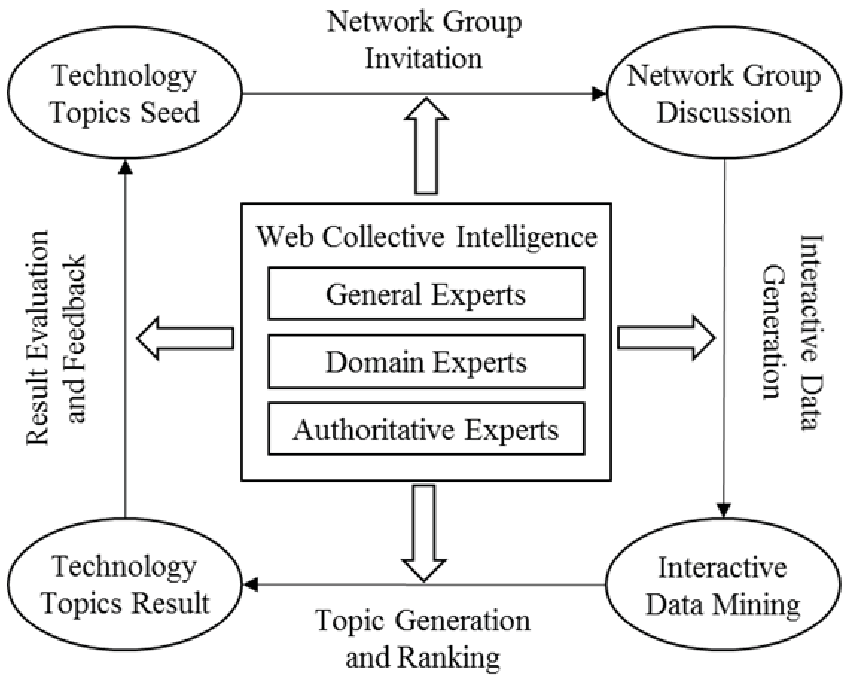 Figure 1: The architecture showing how group participation provides the social and data basis for foresight results.
Categorizing the Digital Brain
The paper classifies the current landscape of WCI into four functional types, proving its versatility:
| Type | Description | Key Examples |
|---|---|---|
| Knowledge Base | Massive collaborative creation and revision. | Wikipedia, Baidu Baike |
| Knowledge Innovation | Outsourcing tasks to non-specific groups (Crowdsourcing). | InnoCentive, Witkey |
| Knowledge Community | Two-way exchange and niche expertise gathering. | Zhihu, ScienceNet |
| Decision Support | Providing objective data for prediction and voting. | NewsFuture, Digg |
Critical Insight: The "SEC-I" of the Web
A standout insight from the authors is the application of the SECI Model (Socialization, Externalization, Combination, Internalization). They argue that network communities act as a "Ba" (a shared space for emerging relationships), where the tacit experience of a senior researcher becomes the explicit "Web Comment" that fuels foresight.
Conclusion & Limitations
WCI represents a paradigm shift from "expert-opinion-driven" to "data-user-driven" foresight. By expanding the participant scale and utilizing real-time interactive data, organizations can identify technological trends much earlier.
However, the paper acknowledges the challenge of uncertain cognition. Because user interaction is localized and subjective, future work must focus on sophisticated weightage systems to filter out noise from true authoritative signals. As we move toward Community 4.0, the "Collective Intelligence" of the web will likely be the primary engine driving global R&D strategy.
Takeaway for Practitioners: Don't just look at what scientists are publishing; look at what experts are discussing in the comments section of technical communities. That is where the future is actually being built.