
TDS: Securing Vehicular Social Networks Against Malicious Alarms
Emergency warning messages dissemination in vehicular social networks: A trust based scheme
This paper introduces the Trust-based Dissemination Scheme (TDS), a novel framework for disseminating Emergency Warning Messages (EWMs) in Vehicular Social Networks (VSNs). It leverages user-post credibility and social reputation to filter false alarms and optimize message broadcasting through a hybrid V2V/V2I architecture.
Executive Summary
In the evolving landscape of the Social Internet of Vehicles (SIoV), the integrity of information is as critical as the speed of its delivery. This paper presents TDS (Trust-based Dissemination Scheme), a sophisticated framework designed to filter out malicious false alarms and optimize the dissemination of Emergency Warning Messages (EWMs). By treating EWM validation as a social media "fake news" detection problem and combining it with a dynamic reputation system, TDS achieves superior delivery ratios and lower network overhead compared to prior SOTA methods like SUDS and SBTE.
The "Fake Alarm" Crisis in VSNs
Vehicular Social Networks (VSNs) utilize social ties—like common routes or driver interests—to improve data routing. However, they are vulnerable:
- Malicious Actors: A single rogue vehicle broadcasting a fake accident can trigger massive traffic jams or secondary collisions.
- Trust Deficit: If users cannot distinguish between a real pile-up and a prank, the entire safety infrastructure collapses.
- Network Congestion: Blind broadcasting leads to the "broadcast storm" problem, wasting precious V2X bandwidth.
Methodology: The Trust Discovery Engine
The core innovation of TDS lies in its multi-layered trust evaluation, moving beyond simple distance-based broadcasting.
1. EWM Validation (The "Fake News" Filter)
TDS views a vehicular network as a heterogeneous user-post interaction graph. Using Non-negative Matrix Factorization (NMF), it analyzes the credibility of a message based on the historical "posting" behavior of the vehicle. If a node has a track record of reliable social interactions, its EWM is prioritized.
2. Node Importance via Percolation Centrality
Unlike static centrality, TDS uses Percolation Centrality (). This captures the "contagion" effect of safety messages, identifying nodes that sit on critical paths of information flow at a specific timestamp .
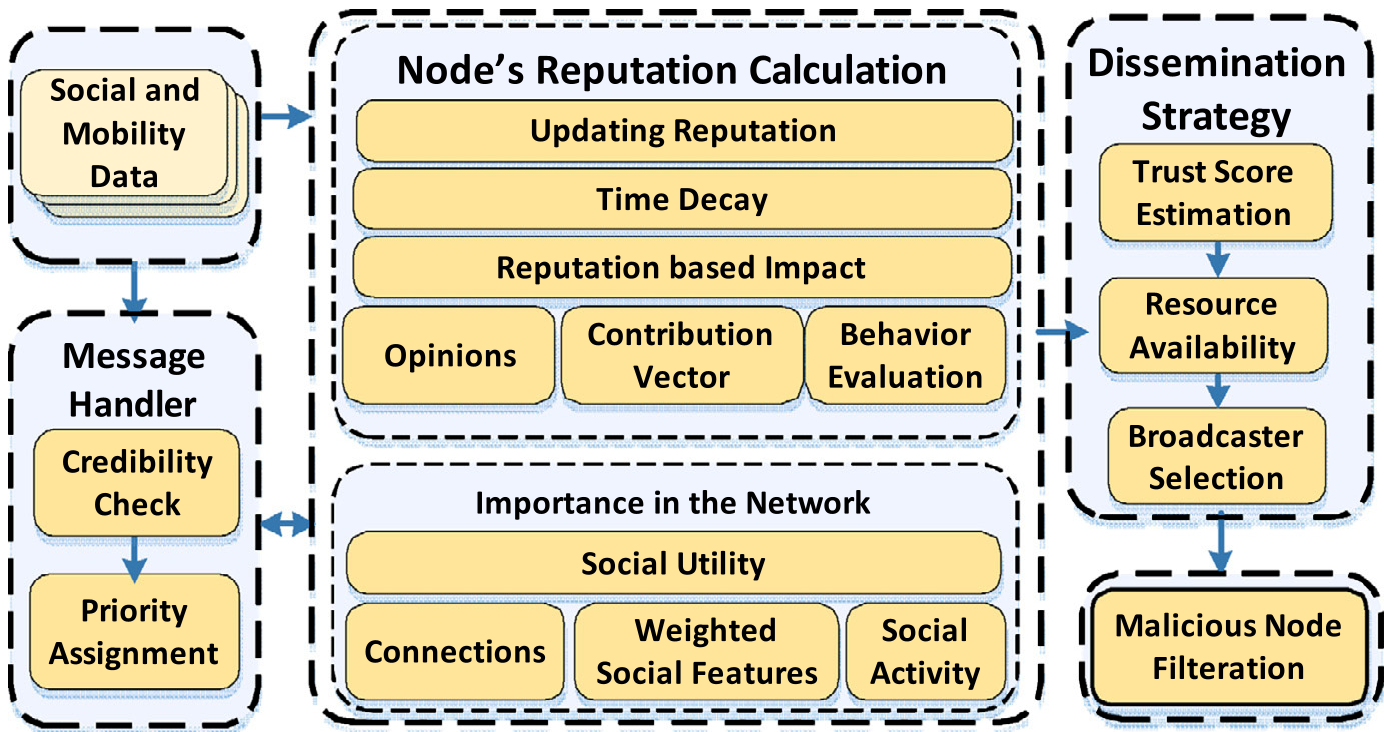 Figure 1: The detailed block diagram shows the pipeline from message handling to trust estimation and final broadcaster selection.
3. Dynamic Reputation Decay
Trust isn't permanent. TDS implements a decay function () that updates a node's reputation based on real-time feedback and social contribution. If a node stops contributing or displays anomalous behavior, its Trust-Score drops exponentially.
Experimental Performance
The authors tested TDS against three major baselines: SUDS, SCARF, and SBTE using the ONE simulator.
Delivery and Scalability
- Sparse Networks: At 10 vehicles/km, TDS achieved a delivery ratio nearly 90% better than SBTE, proving its effectiveness in highway scenarios where connectivity is intermittent.
- Resilience: The system maintains an Mean Square Error (MSE) of only 0.2% in trust estimation even when 70% of the nodes are acting maliciously.
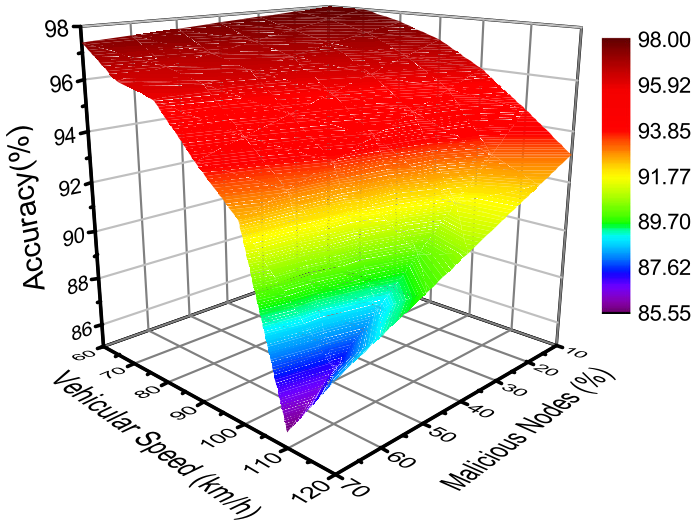 Figure 2: Performance metrics (Delivery Ratio, Delay, Transmissions) against increasing vehicle density.
Critical Insight: Why TDS Wins
The brilliance of TDS is the Hybrid Dissemination Strategy:
- V2I Mode: When Roadside Units (RSUs) are available, it uses group-based interest clusters to "flood" the message to relevant parties efficiently.
- V2V Mode: In the absence of infrastructure, it relies on a "friendship-network" logic, where high-trust nodes act as primary relays, drastically reducing redundant hops.
Conclusion and Future Outlook
TDS successfully bridges the gap between social credibility and physical network reliability. While it introduces a slight processing overhead (roughly 9% more latency than SUDS in specific cases), the trade-off for authentic message delivery is essential for road safety. Future iterations will likely explore urban scenarios where multi-path fading and higher node density introduce new complexities to the social trust manifold.