
The Ghost in the Attention Map: Why AI Capabilities Emerge Randomly
Emergent Capabilities Arise Randomly from Learning Sparse Attention Patterns
This paper investigates the mechanistic origins of emergent capabilities in Transformers, proposing that these skills arise abruptly due to the stochastic acquisition of task-relevant sparse attention patterns. By analyzing Pythia models and synthetic tasks (Linear Maps and Cellular Automata), the authors demonstrate that larger models exhibit higher emergence rates because they learn these critical attention bottlenecks earlier and more reliably.
TL;DR
The "magic" of emergent capabilities in Large Language Models (LLMs) isn't magic at all—it's a stochastic search for sparse attention patterns. A new study from NYU researchers reveals that the sudden jump in a model's ability to solve a task coincides exactly with specific attention heads "locking onto" the correct tokens. By scaling the number of heads or using different mixing architectures like MLP-Mixer, we can potentially force these capabilities to emerge faster.
The Mystery of the "Abrupt Jump"
For years, the AI community has observed a strange phenomenon: as you train a model, its performance on a specific task (like indirect object identification or pattern completion) remains at zero for a long time, then suddenly spikes to near-perfection within a few hundred steps.
The authors of Emergent Capabilities Arise Randomly from Learning Sparse Attention Patterns argue that this is due to the intrinsic difficulty of learning sparse attention patterns. Imagine looking for a needle in a haystack; until you find the needle (the correct attention weight), you have no progress. The moment you find it, the task becomes trivial.
Methodology: Proving the Connection
To prove that attention is the bottleneck, the researchers used Activation Patching. They took a model before it learned a skill and a model after it learned a skill. By "teleporting" the attention maps from the successful model back into the failing one, they were able to instantly "awaken" the capability.
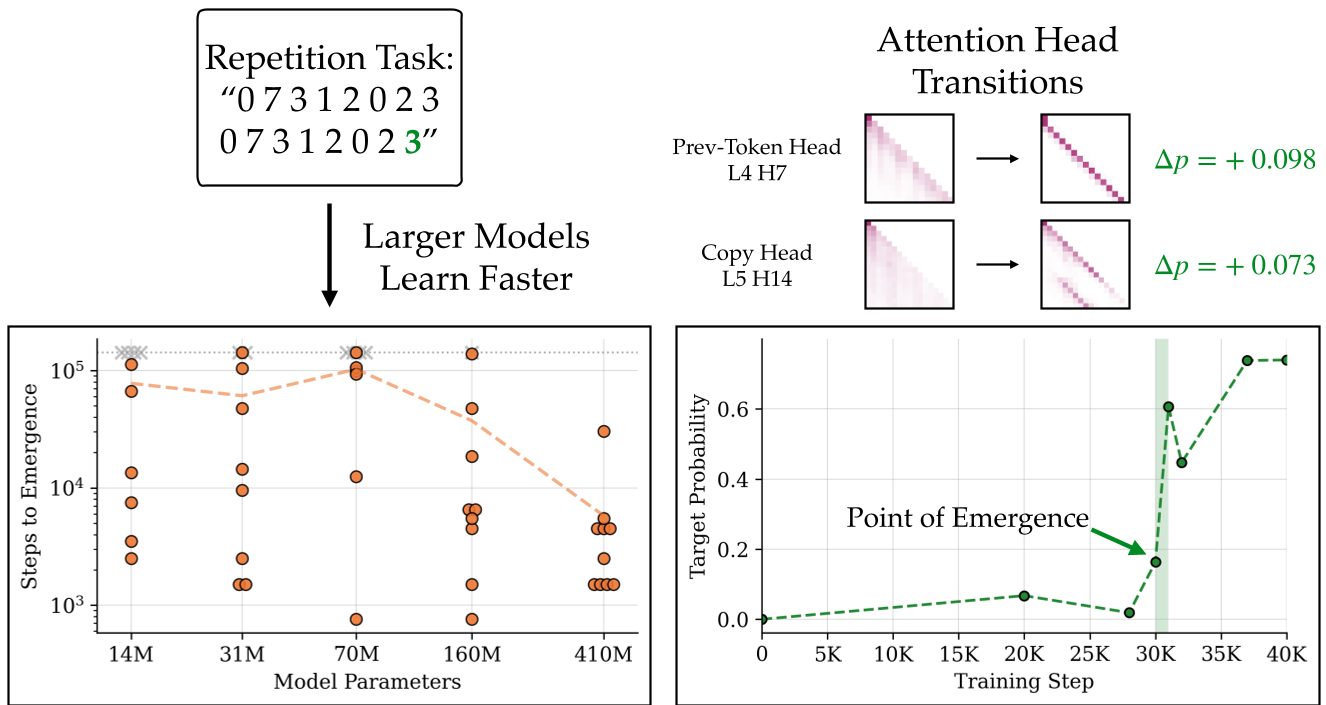 Figure 1: Notice how the correct token probability (right) spikes exactly when the attention maps transition from uniform noise to structured patterns.
Synthetic Lab: Linear Maps & Cellular Automata
Because natural language is messy, the team created two "clean" environments:
- Linear Maps: Testing the model's ability to compute parity across sparse bits.
- Cellular Automata: Testing local window dependencies (like Game of Life).
They found two critical "Difficulty Laws":
- Context Length: As the sequence gets longer, the "plateau" (the time spent doing nothing) grows multiplicatively.
- Sparsity: Patterns that are neither too dense nor too sparse are the hardest for Transformers to "find."
The Architect's Solution: More Heads, Not Just More Parameters
One of the most actionable insights from the paper is the role of Head Count. The researchers found that increasing the number of attention heads (even if total parameters stay the same) makes the model more likely to "stumble upon" the correct sparse pattern.
Interestingly, they compared Transformers to MLP-Mixer. For fixed positional patterns (like the Linear Map task), MLP-Mixer was an order of magnitude faster. However, for tasks requiring flexible, context-dependent logic, the Transformer's dot-product attention remained king.
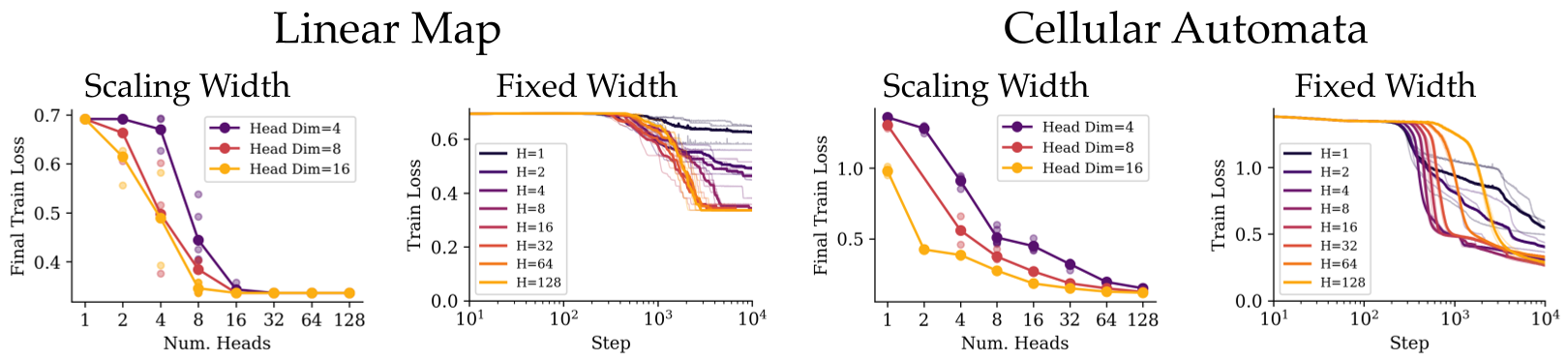 Figure 6: Scaling the number of heads (H) consistently reduces the "wait time" for learning, suggesting that more heads act as more "lottery tickets" in the search for the right pattern.
Critical Insight & Future Outlook
This paper shifts our understanding of scaling. It suggests that "emergence" isn't a byproduct of model size per se, but rather that larger models are better at parallelizing the search for attention patterns.
Key Takeaways for Researchers:
- Attention Interventions: We might be able to accelerate training by "nudging" attention maps toward sparsity early on.
- Pre-pretraining: Training on formal languages (like Dyck-k or NCA) can "warm up" the model's ability to handle complex structures before it ever sees a word of English.
- Limitations: The study focuses on models under 1B parameters. Whether 175B+ parameter models follow the exact same "stochastic search" logic for high-level reasoning is the next frontier.
In conclusion, the "breakthroughs" we see in AI are the result of the model finally finding the right way to look at its input. By understanding this bottleneck, we can move from waiting for emergence to happen by chance to engineering it by design.