
Locus of Control: The Psychological Engine Driving Social Capital in Emergent Networks
Emergent networks, locus of control, and the pursuit of social capital
This study investigates the evolution of "ego networks" among students in a computer-supported collaborative learning environment, specifically linking social network characteristics to the "Locus of Control" personality trait. Using Social Network Analysis (SNA), it demonstrates how "Internals" strategically optimize their network positions to maximize social capital through increased brokerage and reach.
TL;DR
Why do some people seem naturally "better" at networking than others? This paper explores whether our internal belief system—specifically Locus of Control—dictates how we build social structures. The study finds that individuals with an "Internal" locus (who believe they control their fate) act strategically to reduce network redundancy and increase their "brokerage" power, effectively maximizing their access to social capital compared to their "External" counterparts.
Contextual Positioning
Published in the proceedings of CSCW '04, this work sits at the intersection of Social Psychology and Computer-Supported Cooperative Work. It addresses a critical gap in early 20th-century sociology: moving beyond what a network looks like to why certain individuals occupy powerful positions within it.
Problem & Motivation: The Missing Link in SNA
Traditional Social Network Analysis (SNA) often treats participants as nodes in a vacuum, focusing on the macro-patterns of the graph. However, the authors argue that structural positions aren't accidental. They hypothesize that Instrumental Action—the rational pursuit of goals—drives networking. The missing link was a psychological predictor for this behavior.
The authors identified Locus of Control (Rotter, 1966) as the differentiator:
- Internals: Believe success results from their own efforts. They are active information gatherers.
- Externals: Believe success is a matter of luck or "powerful others." They tend to be more dependent and passive.
Methodology: Mapping the Student Network
The researchers tracked 63 senior engineering students in a distributed, distance-learning environment. Over three time points (T1: Start, T2: Mid-semester, T3: End), they mapped the students' ego-networks using three metrics:
- Density: How redundant are your contacts? (Low density is better for unique info).
- Brokerage: Do you act as the "bridge" between two people who don't know each other?
- Reach: How many people can you access within "two degrees of separation"?
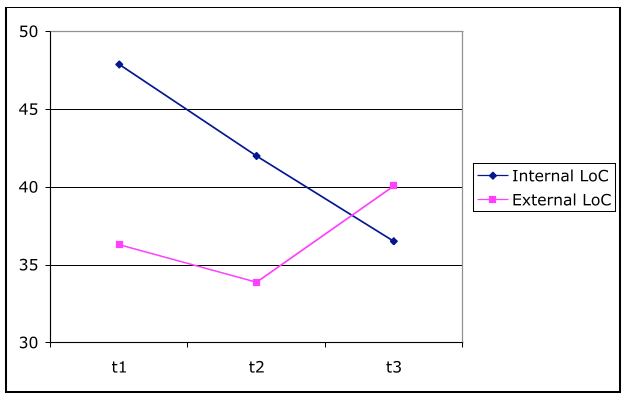 Figure 1: Comparison of 2-step reach showing Internals (higher scores) expanding their network access more effectively than Externals.
Key Insights & Results
1. The Strategic Pivot
Internals started with higher density (perhaps sticking to known friends) but strategically decreased it over time (H1). This suggests they actively sought out "weak ties"—acquaintances who offer non-redundant, diverse information.
2. Seizing the "Broker" Role
By the end of the semester, Internals occupied significantly more brokerage positions (H2). They positioned themselves as the "gatekeepers" of information between disparate groups in the class.
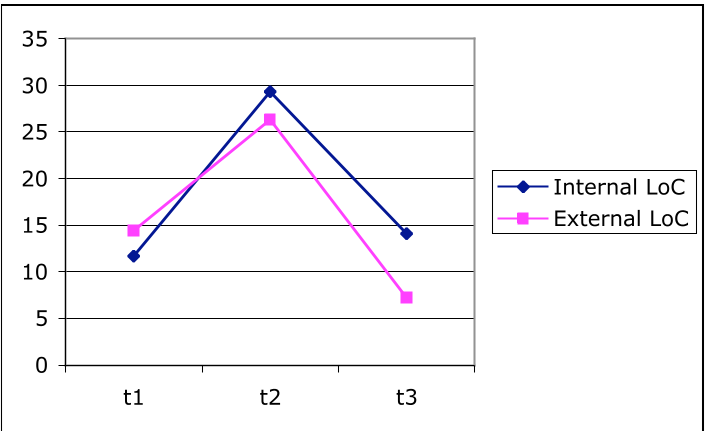 Figure 2: Brokerage frequency showing Internals pulling ahead of Externals as the semester progressed.
3. Maximum Reach
Internals consistently maintained a higher "reach" within the network (H3). Their immediate contacts were better integrated into the overall network, ensuring that Internals were always "in the loop" regarding class projects.
Critical Analysis & Conclusion
This paper provides empirical evidence that personality shapes structure. Internals don't just "get lucky" with networking; they appear to engage in a "strategic pursuit of relationships."
Takeaways for Design
In today's era of Slack and Microsoft Teams, this research implies that digital environments do not automatically "level the playing field." Individuals who feel less in control of their environment (Externals) may need system-level interventions or "nudges" to help them bridge social gaps, whereas Internals will naturally exploit the system for capital.
Limitations
- Sample Size: With only 63 students, the power of the study is limited.
- Context: The study was conducted in a specific engineering course; social dynamics might differ in purely social or non-academic settings.
Conclusion: As we build future collaborative tools, we must recognize that the "network" is not just a layout of wires and permissions—it is a reflection of the psychological drive of the humans within it.