
S-Aframe: Orchestrating Intelligent "Smart Rides" in the Chaos of Vehicular Networks
EMERGING TOPICS IN COMPUTING
S-Aframe is an agent-based multilayer framework designed for Vehicular Social Networks (VSNs) that integrates a novel Context-Aware Semantic Service (CSS). It enables the development of self-adaptive applications on Android, utilizing mobile agents to provide intelligent service matching and handle intermittent connectivity in opportunistic VANETs.
TL;DR
S-Aframe is a pioneering Android-based framework that brings "intelligence" to Vehicular Social Networks (VSNs). By combining Mobile Agents (code that travels) with Semantic Reasoning (understanding meaning), it solves the twin problems of flaky vehicular connectivity and the rigid inability of current apps to understand user needs beyond simple keywords. It turns your car into a social sensor capable of autonomously finding a carpool match even while moving at 100 km/h.
Problem & Motivation: The "Disconnected" Social Network
While we use Facebook or Uber daily, these rely on a persistent, high-quality Internet connection. In the world of VANETs (Vehicular Ad-hoc Networks), connectivity is opportunistic. Cars zoom past each other, creating windows of communication that last only seconds.
Traditional middleware for these networks is often "dumb"—it looks for exact matches. If you search for a "Rideshare to Downtown" and a driver offers a "Commute to Central Business District," a standard system fails. The authors realized that for VSNs to work, the system needs to:
- Self-Heal: Handle agents getting lost when a car drives out of range.
- Understand Semantics: Know that "Sedan" is a type of "Car" and matches a "Vehicle" request.
Methodology: The Secret Sauce of S-Aframe
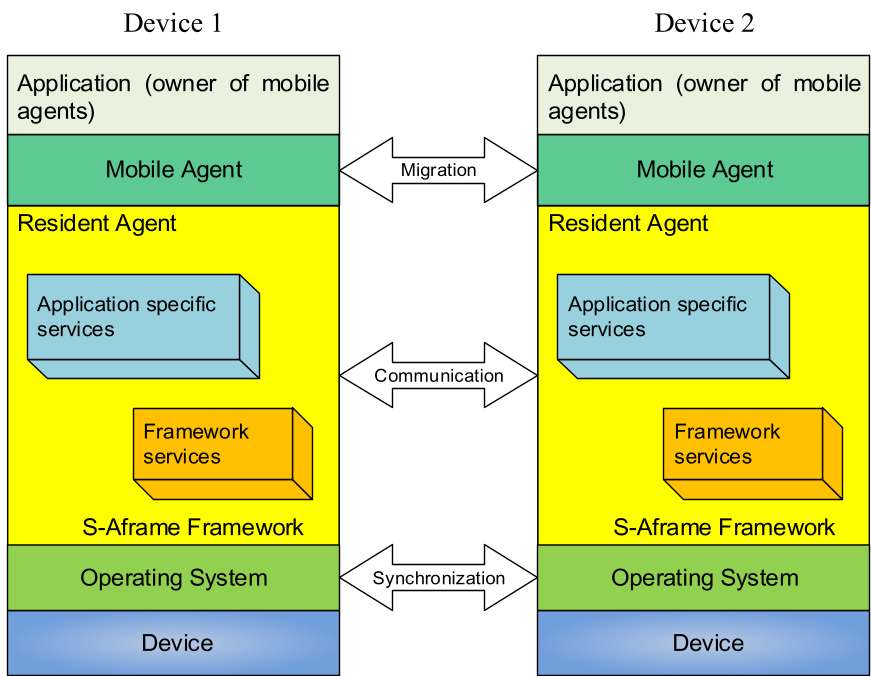
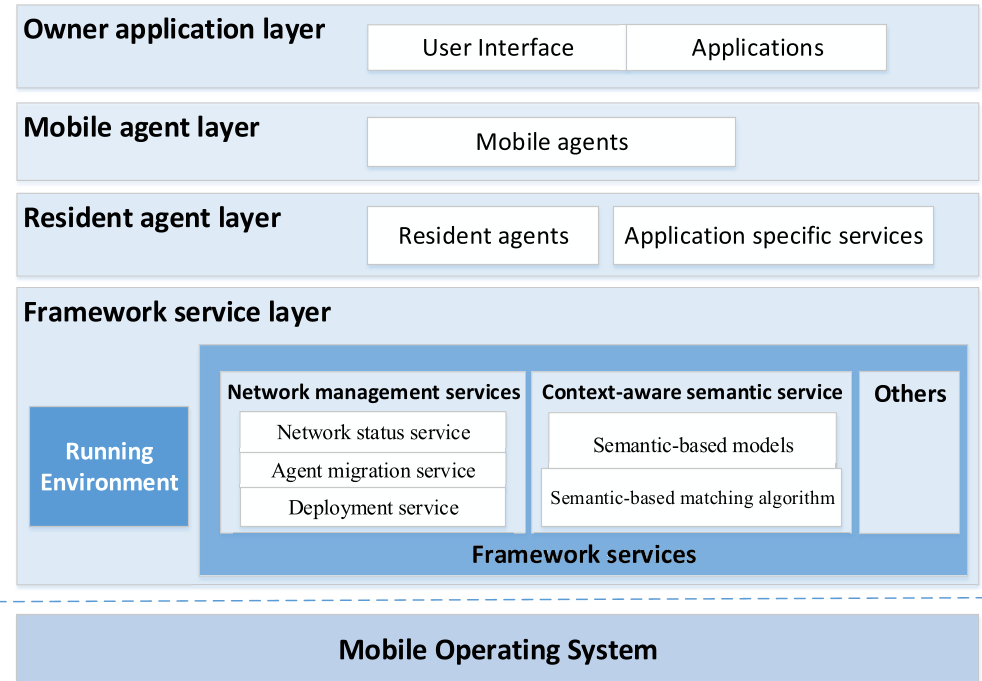
The framework operates on a four-layer stack, but the real innovation lies in the Resident Agents and the Context-Aware Semantic Service (CSS).
1. The Multilayer Architecture
Instead of sending raw data, S-Aframe sends Mobile Agents. These are small pieces of code that carry their "execution state" with them. If a node disconnects, the agent waits locally and resumes when a new node appears.
2. Semantic Matching (CSS)
Instead of keyword matching, CSS uses Ontologies. It calculates similarity based on the distance between concepts in a tree. For example, it calculates the "depth" of a common ancestor in a concept graph to determine how well two users' needs align.
Experiments: Performance in the Real World
The authors didn't just write theory; they tested it on a fleet of Android devices (Nexus 10 tablets and phones).
- Reliability: Even under extreme conditions—where nodes were "killed" every 10 seconds—the mobile agents maintained a successful task completion rate.
- Efficiency: A mobile agent migrates between devices in about 2.74 seconds. Given WiFi ranges, this is fast enough to complete tasks between cars passing at highway speeds.
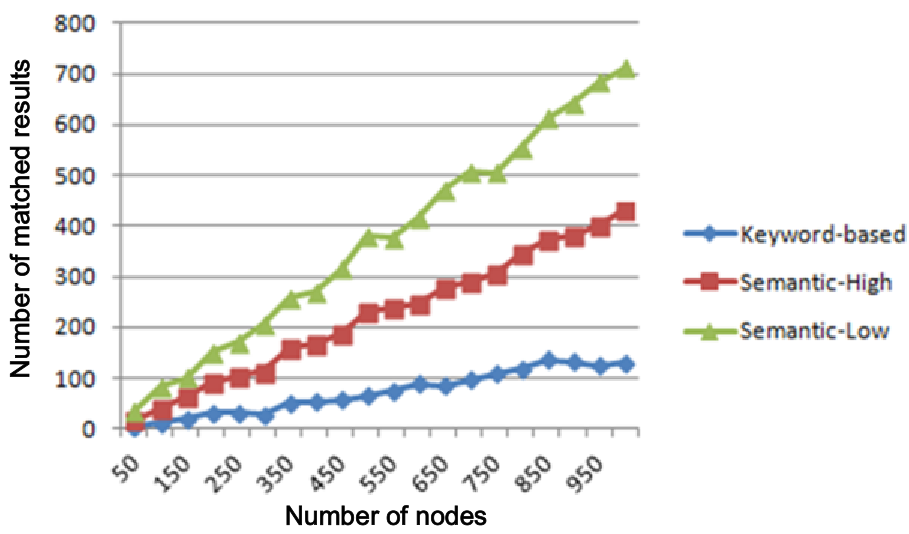
- Semantic Superiority: As shown below, the Semantic approach (red and blue bars) consistently finds more valid matches than the rigid keyword-based approach (green bars), especially as the network scales.
Application Example: "Smart Ride"
The paper concludes with a practical test: a ride-sharing app. A passenger (Shirley) broadcasts a request. A mobile agent hops through nearby cars, compares her destination and preferences against driver context using the CSS, and autonomously flags "Victor" as a match—even though their service descriptions didn't use the same words.
Critical Insight & Future Outlook
Takeaway: S-Aframe proves that the future of the Internet of Vehicles (IoV) isn't just about faster 5G; it’s about decentralized intelligence. By moving the "thinking" (semantic matching) to the edge (the cars themselves), we reduce reliance on expensive cloud infrastructure.
Limitations: The current implementation uses RDF and Jena2, which can be heavy. As the authors admit, using "huge" ontologies on mobile devices can slow down matching. The next step for this research would be "Ontology Slimming"—using only relevant subsets of knowledge to keep the system snappy.
Conclusion: S-Aframe is a solid step toward a world where your car isn't just a machine, but an intelligent agent capable of negotiating your social and travel needs on the fly.