
Beyond One-Label Logic: The Rise of Sentiment Quantification in Twitter
SPECIAL SECTION ON EMERGING TRENDS, ISSUES AND CHALLENGES FOR ARRAY SIGNAL PROCESSING AND ITS APPLICATIONS IN SMART CITY
This paper introduces a novel "quantification" task for Twitter sentiment analysis, moving beyond single-label classification to identify all co-existing emotions within a tweet. The authors propose an advanced pattern-based scoring method integrated into the SENTA tool, achieving an F1-score of 45.9% across 11 distinct sentiment classes.
In the world of Natural Language Processing (NLP), we often force complex human emotions into tidy boxes. We ask models: "Is this tweet Happy or Sad?" But human expression is rarely that binary. A user complaining about a game might be frustrated, angry, and disappointed all at once.
A seminal paper from Keio University, "Multi-Class Sentiment Analysis in Twitter: What If Classification Is Not the Answer," argues that the traditional classification paradigm is fundamentally flawed for social media. Instead, they propose a shift toward Quantification.
TL;DR
The researchers introduce "Sentiment Quantification"—the task of identifying all sentiments in a tweet and assigning them weights. Using a pattern-based approach integrated into their SENTA tool, they demonstrate that we can move from simple polarity to a nuanced 11-class emotional map, achieving a 45.9% F1-score in a task where most traditional classifiers fail.
The Problem: The "Single-Label" Blind Spot
Most sentiment analysis tools operate on the assumption that a piece of text has one dominant emotion. However, the authors' manual annotation of thousands of tweets revealed a striking reality: over 55% of tweets contain more than one sentiment.
For instance, consider this tweet:
"I bought it yesterday, and now it's discounted. Just why Valve why? :("
Is it Sadness? Disappointment? Frustration? Realistically, it’s a blend. If a system only picks "Sadness," the company misses the "Frustrated" signal that might require a customer service intervention.
Methodology: Patterns, Not Just Words
To solve this, the authors moved beyond simple "bag-of-words" (Unigrams). They focused on Advanced Pattern Features.
1. The Architecture of a Pattern
Instead of just looking for the word "happy," the system looks for structural sequences. It converts a tweet into a sequence of Part-of-Speech (PoS) tags and sentiment markers.
- Example:
[PRONOUN] [LOVE_VERB] [PRONOUN] [INTERJECTION] - This allows the model to recognize the way an emotion is expressed, making it robust against slang and varied sentence structures.
2. The Two-Stage Process
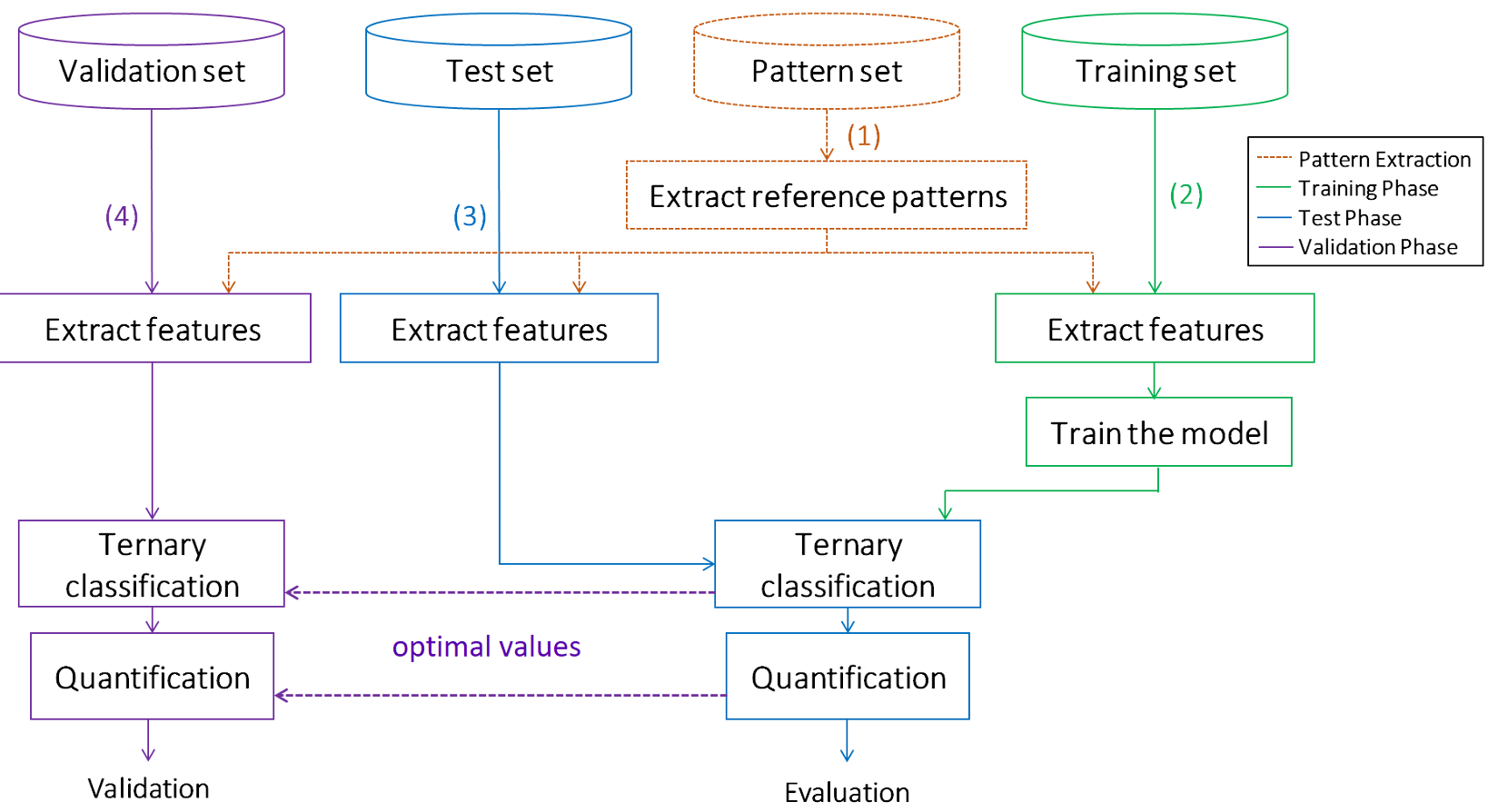
The workflow follows a logical hierarchy to manage complexity:
- Ternary Classification: First, determine if the tweet is Positive, Negative, or Neutral.
- Granular Quantification: If Positive, the system scores the tweet against specific positive sub-classes (Happiness, Love, Fun, Relief, Enthusiasm) using a resemblance function.
Why This Works: The Power of Resemblance
The core "secret sauce" is the resemblance function . It calculates whether a tweet contains a pattern exactly, or if it contains the components with words in between, or only partial matches.
By tuning the weights of Unigrams (), Basic Patterns (), and Advanced Patterns (), the researchers found that Advanced Patterns () are the most influential. Unigrams actually contributed very little, proving that sentiment context is found in structure, not just vocabulary.
Experimental Evidence
The team tested their approach on 11 sentiment classes. While the ternary classification was highly accurate (77.4%), the quantification task proved much harder but yielded significant improvements over the baseline.
| Approach | Precision | Recall | F1-Score |
|---|---|---|---|
| Proposed Quantification | 0.403 | 0.653 | 0.459 |
| Baseline (Binary) | 0.270 | 0.563 | 0.365 |
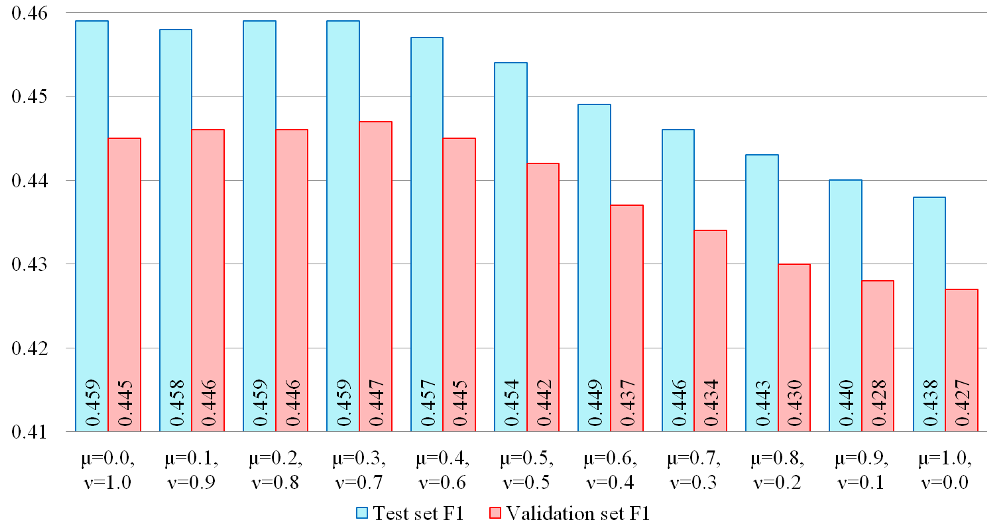 Figure: The F1-score remains stable across test and validation sets, proving the model generalizes well to new data.
Critical Analysis & Takeaways
The beauty of this paper lies in its honesty about the difficulty of the task. Sentiment is subjective; even human annotators only agree on granular labels about 67% of the time.
Key Insights:
- Quantification is the future: Moving from "labels" to "scores" allows for better downstream analytics for brands.
- Structural Bias: The study assumes a tweet is either all positive or all negative sentiments. Exploiting "mixed-polarity" tweets (where joy and worry co-exist) is the untapped frontier.
- SENTA Tool: The update to the SENTA tool makes these advanced features accessible to researchers who aren't experts in pattern extraction.
Conclusion
This work challenges the NLP community to stop oversimplifying data. By treating sentiment as a measurable quantity rather than a binary choice, we move closer to a machine that actually understands the "vibe" of human conversation.
For more technical details, refer to the full paper: "Multi-Class Sentiment Analysis in Twitter: What If Classification Is Not the Answer" by Bouaziz and Ohtsuki (IEEE Access).