
EMIR: Bridging the Affective Gap in Mobile Music Retrieval
EMIR: A Novel Music Retrieval System for Mobile Devices Incorporating Analysis of User Emotion
The paper introduces EMIR, a novel Music Information Retrieval system for mobile devices that enables music discovery through user emotions. It employs machine learning to map both song lyrics and multi-lingual, non-descriptive user queries into a common six-dimensional latent emotion space for similarity-based ranking.
TL;DR
EMIR (Emotional Music Information Retrieval) is a mobile-centric system that bypasses traditional keyword searches (like artist or genre) in favor of emotion-driven discovery. By mapping lyrics and "non-descriptive" user queries (e.g., "feeling lonely") into a shared 6D emotion space, it provides a personalized, mood-aware soundtrack for the user's life.
Background & Motivation: Beyond Metadata
Most music platforms like Spotify or Last.fm are excellent when you know what you want to hear. But what happens when you don't have a specific track in mind, and you only know how you feel?
The authors identify a major limitation in existing MIR systems: they are "emotion-blind." They rely on explicit tags, leaving a massive gap for Non-Descriptive Queries. The motivation behind EMIR is to treat emotion as a first-class citizen in the retrieval process, turning subjective feelings into searchable, quantitative data.
Methodology: Mapping the Human Condition
The core innovation of EMIR lies in its ability to translate text—both professional song lyrics and casual user input—into a unified mathematical representation.
1. The Six-Dimension Emotion Model
Influenced by Picard’s work on Affective Computing, the system categorizes all input into six buckets: Anger, Disgust, Fear, Joy, Sadness, and Surprise.
2. The Retrieval Engine
Instead of standard TF-IDF (Term Frequency-Inverse Document Frequency), which works well for fact-based search, the authors implemented a Revised BM25 Model.
- Architecture: It analyzes sentence structure in lyrics to find latent emotional relationships.
- Saturation Weighting: It applies specific weights to emotions in queries to handle the nuance of how people express intensity in natural language.
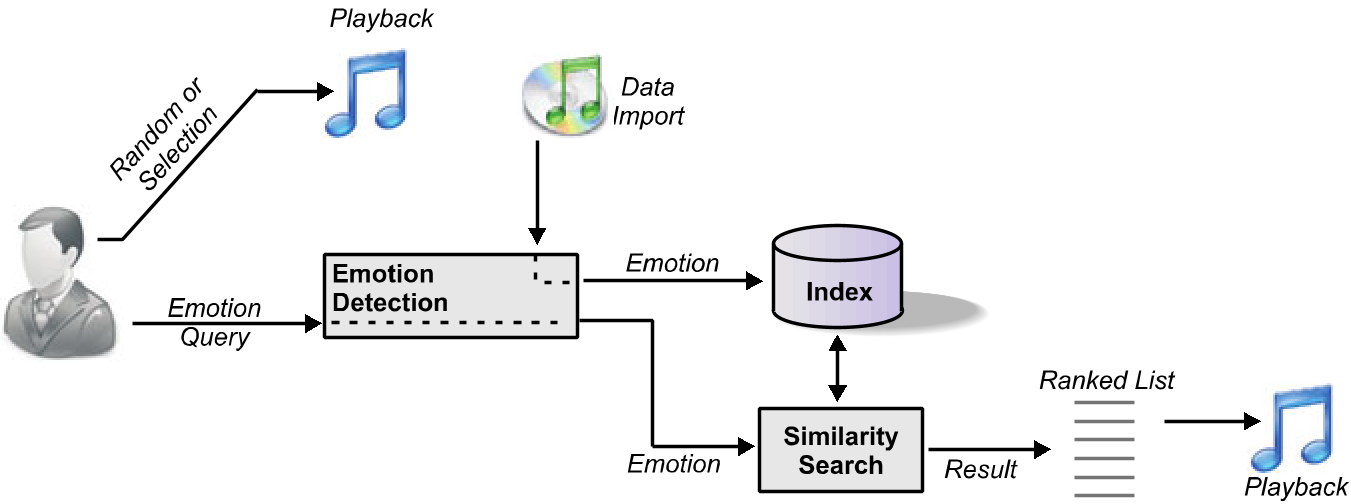 Figure 1: The EMIR Architecture, showcasing the flow from user query to the emotion detection engine and the ranked results.
Implementation & User Experience
Designed for the Android ecosystem, EMIR provides a seamless loop of interaction:
- Input: User enters a state of mind.
- Detection: The machine learning engine plots this state in the 6D space.
- Ranking: The system pulls songs from the database whose lyrics share a similar emotional coordinate.
- Tracking: The "Mood Curve" visualizes the user's emotional journey over time.
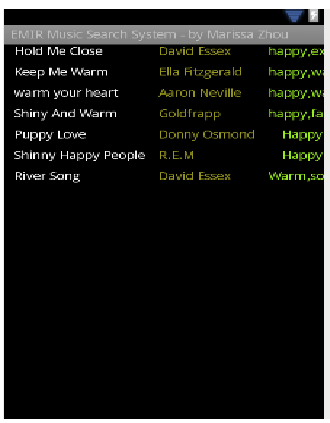 Figures 2 & 3: The Search Interface and the resulting ranked list of playback options.
Critical Insight & Future Outlook
The brilliance of EMIR is its focus on the Latent Space of Lyrics. While many researchers focus on the audio signal (tempo, pitch, key), the textual content of lyrics often contains a more explicit emotional roadmap.
Limitations
- Lyric Dependency: The system currently relies on text. However, instrumental music (which carries immense emotion) would be invisible to this specific implementation.
- Complexity of Emotion: Using only six categories is a baseline; human emotion is often a "blend" (e.g., bittersweet), which might require a continuous manifold rather than discrete categories.
The Future: Mood Monitoring
The authors suggest a fascinating path forward: passive mood monitoring. Imagine a system that updates your recommended playlist by analyzing your social media status updates or the tone of your emails in real-time. EMIR is a foundational step toward a world where our devices truly "understand" our internal state.
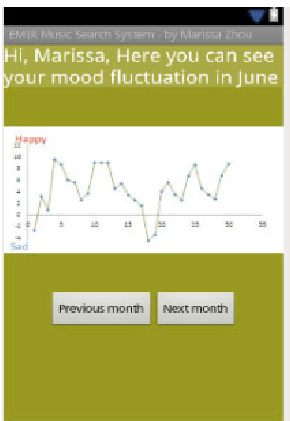 Figure 4: Tracking user sentiment over time via the system's Mood Curve.
Conclusion
EMIR successfully demonstrates that the bridge between human emotion and music retrieval is not only possible but highly effective for mobile users. By leveraging NLP and machine learning, the system transforms music from a collection of files into a responsive emotional companion.