
Emojis as Distant Supervision: Unlocking Emotion Recognition in Portuguese Text
Exploring Emojis for Emotion Recognition in Portuguese Text
The paper explores emotion recognition in Portuguese text by leveraging emojis as silver-standard labels. Using a dataset of over 1 million tweets, the authors trained Naive Bayes and SVM classifiers to perform two tasks: 6-class emotion categorization based on Ekman's model and a 62-class direct emoji prediction task, achieving a peak F1-score of 0.708 for emotion recognition.
TL;DR
Researchers from the University of Coimbra have developed a method to automatically label emotions in Portuguese tweets by using emojis as natural "tags." By processing over 1 million tweets and deploying Naive Bayes and SVM classifiers, they achieved a significant F1-score of 0.708 in emotion classification, proving that social media symbols can bypass the need for expensive manual annotation.
Background & Motivation: The Data Bottleneck
In the world of Affective Computing, the greatest hurdle is not the algorithm, but the labels. Manually annotating a text with an emotion like "disgust" or "surprise" is subjective and slow. For Portuguese—a language with 220 million speakers but fewer NLP resources than English—this bottleneck is even tighter.
The authors' insight is simple yet powerful: Users already label their own emotions. When someone ends a tweet with a 😭 or a 😄, they are providing a high-fidelity emotional signal. The paper explores whether these icons can be mapped back to Ekman's six basic emotions (Anger, Disgust, Fear, Happiness, Sadness, Surprise) to create a self-labeling machine learning pipeline.
Methodology: From Icons to Vectors
The researchers collected 2 million tweets, pruning them down to 1.1 million after removing "emotionally-contradictory" tweets (e.g., those containing both a laughing and a crying emoji, often signaling irony).
1. Feature Engineering
While they experimented with linguistic features (negation words, exclamation marks) and affective lexicons (ANEW-PT, NRC-VAD), the TF-IDF weighted n-grams proved most effective. This suggests that in the short, informal context of Twitter, the presence of specific word combinations (e.g., "odeio" for hate, "linda" for beautiful) carries more weight than complex emotional dimensions like "arousal" or "dominance."
2. The Architecture
The study compared two classic models:
- Multinomial Naive Bayes (NB): Which remarkably outperformed the more complex SVM in most tests.
- Support Vector Machines (SVM): Used as a robust baseline for high-dimensional text data.
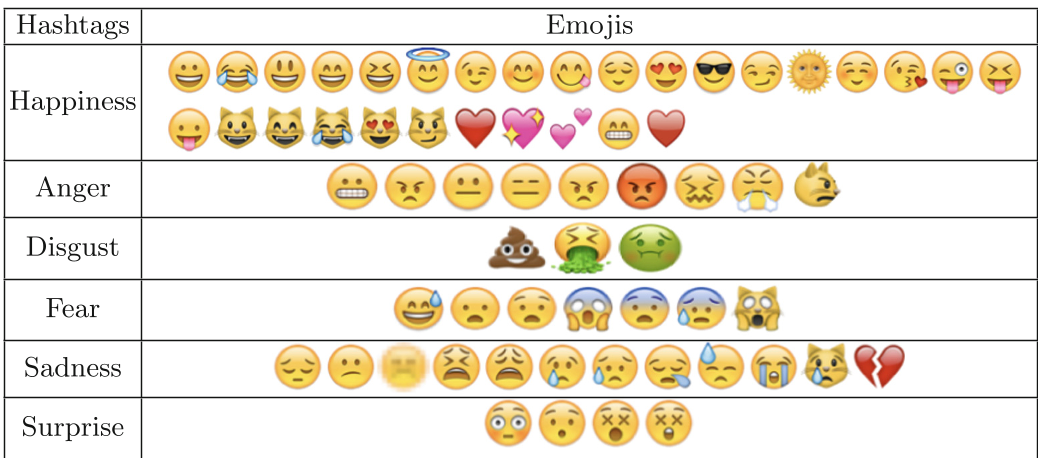 Figure 1: The mapping of 62 specific emojis to the 6 basic Ekman emotions.
Experiments & Results
The "Emotion Recognition" task (6 classes) was a success, but the "Emoji Prediction" task (62 classes) was a humbling exercise in complexity.
- The Happiness Bias: Nearly 68% of the dataset was "Happiness," leading to an F1-score of 0.866 for that class.
- The Complexity of Sadness: Emotions like "Fear" and "Surprise" had high precision but nearly zero recall, meaning the model was too "afraid" to predict them unless it was absolutely certain.
- The Inter-Emoji Challenge: Direct emoji prediction failed (F1 ~0.24) because many emojis are used interchangeably. Is there a semantic difference between 😂 and 🤣 in a tweet? To the classifier, the distinction is significant; to the user, it is often arbitrary.
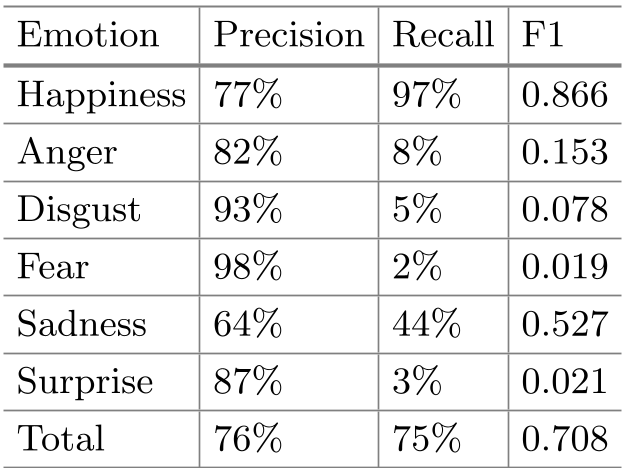 Table 1: Performance breakdown by emotion showing the massive influence of class imbalance.
Deep Insights: The Semantic Space of Emojis
By using word2vec to visualize emoji proximity, the authors discovered that happiness-related emojis cluster tightly together, while "negative" emotions like anger and sadness often overlap. This spatial analysis (via t-SNE) confirms the "valence" theory: humans (and models) distinguish between "good" and "bad" feelings much more easily than between specific nuances of negative emotions.
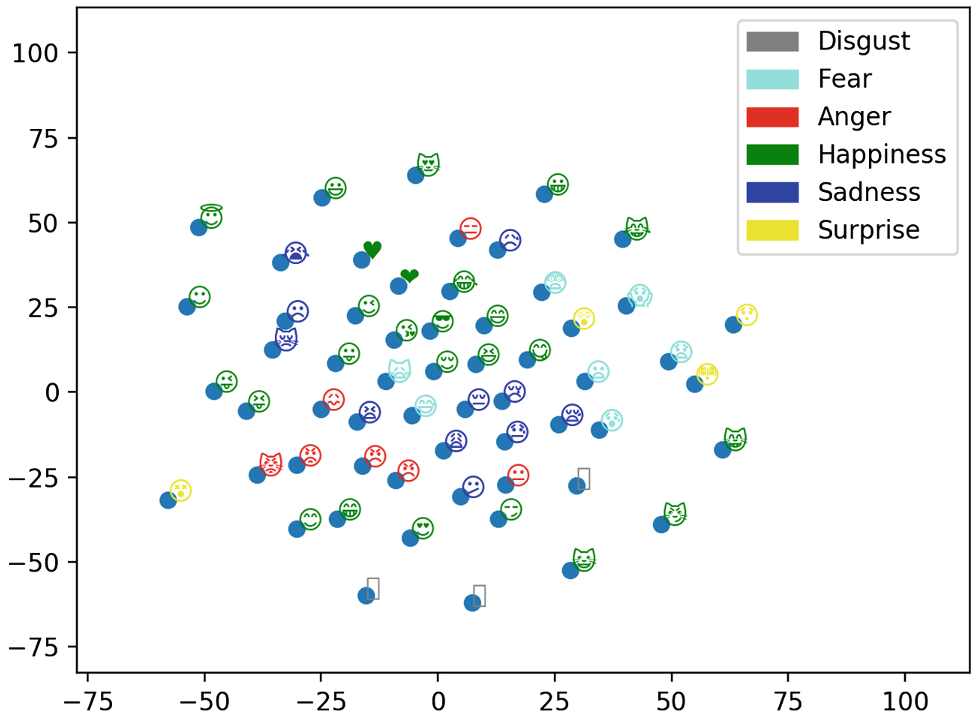 Figure 2: t-SNE visualization showing how emojis cluster by emotional context.
Critical Analysis & Future Outlook
Takeaway: This work provides a massive, silver-standard dataset for Portuguese NLP. It proves that while emojis are excellent proxies for broad emotional categories, they are too redundant for fine-grained prediction tasks using traditional ML.
Limitations:
- Imbalance: The dominance of "Happiness" reflects social media's "positivity bias" but hinders the detection of rarer emotions like "Disgust."
- Model Maturity: While Naive Bayes and SVM are solid, the field has moved toward Transformers (BERT/GPT). Applying these findings to a Portuguese-specific LLM (like BERTimbau) would likely yield significantly higher accuracy.
Conclusion: As we move toward more empathetic AI, leveraging the "natural labeling" inherent in our digital slang—emojis—remains one of the most promising paths for low-resource languages.