
RIP Emojis: Decoding the Digital Language of Grief on Twitter
Emojis and Words to Contextualize Mourning on Twitter
This paper investigates the role of emojis and text in "Social Media Mourning" (SMM) on Twitter. Using multi-stage data collection and BERT-based classification models, the authors analyze mourning behavior in English and Spanish, establishing a new gold standard for mourning sentiment detection with F1 scores reaching up to 97%.
TL;DR
How do we mourn in 280 characters? This research analyzes over 15,000 tweets to determine if emojis like 💔 or 🕊️ are enough to signal mourning. The verdict: Words are the primary anchors of grief, but emojis provide the emotional polish. While a combination of both yields the highest classification accuracy (up to 97% F1), emojis are too "polysemous" (multi-meaning) to stand alone as mourning indicators.
Background: The Rise of Social Media Mourning (SMM)
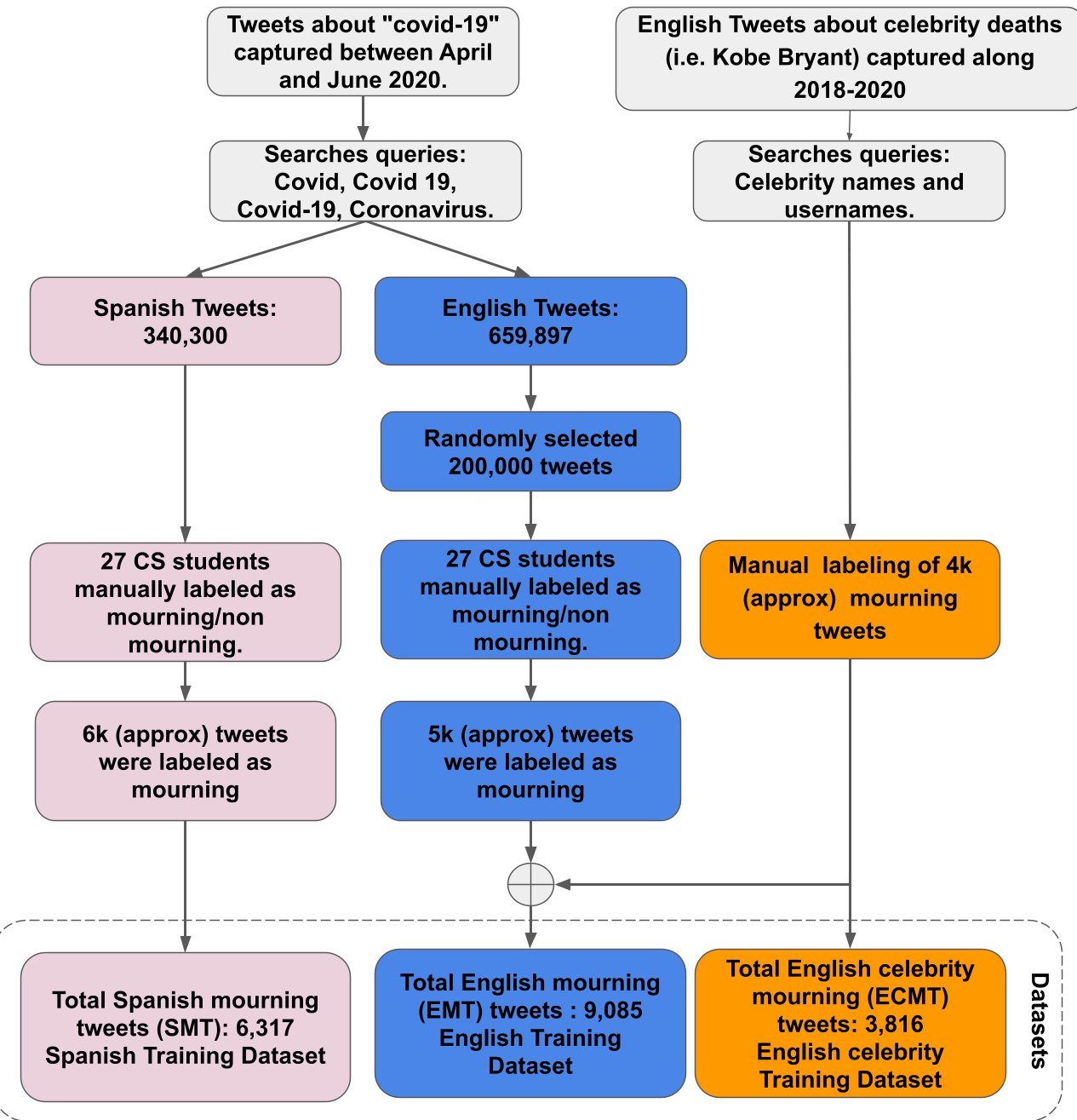
Mourning has moved from private altars to public timelines. Social Media Mourning (SMM) is now a standard cultural practice, yet identifying it computationally is difficult due to the nuance of grief. This paper marks a significant milestone by creating the first "Gold Standard" annotated dataset of mourning tweets in both English and Spanish, covering celebrity deaths and the COVID-19 pandemic.
The Core Challenge: Are Emojis Enough?
The authors set out to solve a fundamental question: Can an emoji alone contextualize mourning? They hypothesized two types of emojis:
- Emotional Emojis: 😭, 💔, 😔 (Direct expressions of sadness).
- Symbolic Emojis: ⚰️, 🕯️, 🕊️ (Representation of offline death symbols).
Interestingly, the study found that users rarely use symbolic emojis. Instead, they rely on high-arousal emotional emojis. However, these same emojis are used for breakups or "failing an exam," making them unreliable as solo indicators of death.
Methodology: BERT Meets Emojis
To tackle the classification task, the researchers used DistilBERT, a lightweight version of the BERT transformer. Since standard BERT isn't trained on emojis, the team performed a clever three-step adaptation:
- Vocabulary Extension: Added specific tokens for each emoji.
- Embedding Update: Initialized random embeddings for these new tokens.
- Fine-Tuning: Used Masked Language Modeling (MLM) on a large corpus of tweets to let the model "learn" the context of these emojis.
Key Findings: The Power of "RIP"
The analysis reveals a fascinating linguistic divide:
- English Simplicity: In English, digital mourning is dominated by a very limited vocabulary. The acronym "RIP" is the single most predictive feature. When "RIP" was removed from the models, accuracy dropped significantly.
- Spanish Diversity: Spanish speakers use a much broader range of "grief vocabulary" (e.g., dolor, pésame, duelo, pesar).
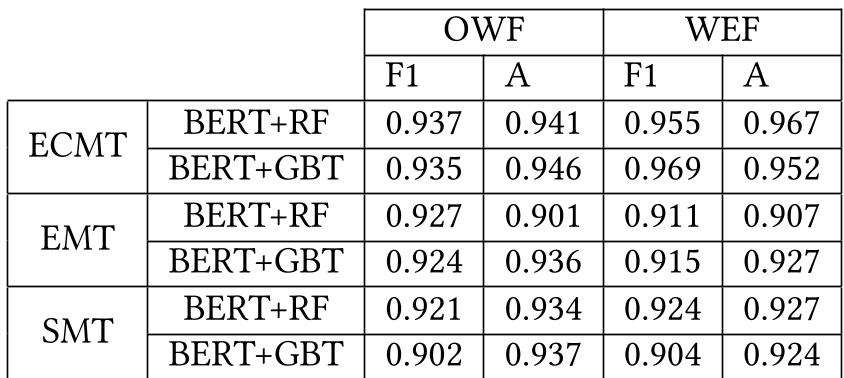
- The Emoji Impact: In the English Celebrity dataset (ECMT), adding emojis improved the F1 score by about 2.6%. However, in broader contexts like COVID-19, the improvement was less significant because emoji usage is more varied and less concentrated.
Performance Comparison
The table below shows that while "Only Words" (OWF) performs exceptionally well, the "Words & Emojis" (WEF) models consistently hit the highest marks.
Why Don't We Use "Death Symbols"?
One of the most intriguing "negative results" of this study was the absence of symbolic emojis (like ⚰️ or 🕯️) in the top features. This suggests a shift in mourning behavior: Online mourning is more about expressing personal emotional state (the internal) than ritualistic symbolism (the external). Furthermore, the absence of religious terminology (like "God" or "Angel") in the top features suggests that Twitter mourning is increasingly secular or simply more informal than traditional obituaries.
Critical Analysis & Future Outlook
Takeaway
For developers building safety or sentiment tools, the lesson is clear: Context is king. You cannot rely on a 💔 emoji to detect a sensitive event. You must look for linguistic anchors like "RIP" or "rest in peace."
Limitations
- Context Scarcity: Mourning tweets are "rare events" (only 15k found in 540k reviewed), making data imbalance a constant challenge.
- Platform Specificity: Twitter’s character limit may force users to use "RIP" and emojis as shorthand, which might not reflect behavior on long-form platforms like Facebook or personal blogs.
Conclusion
This work provides a critical foundation for understanding human emotion in the digital age. By proving that "RIP" and emotional emojis form the bedrock of digital grief, the authors have given us a roadmap for how machines can better recognize and respect human mourning in a noisy social media landscape.