
Emojitaliano: Engineering a Universal Visual Language from Crowdsourced Social Media
Emojitaliano: A Social and Crowdsourcing Experiment of the Creation of a Visual International Language
Emojitaliano is a crowdsourced linguistic project that establishes a standardized visual language based on the UNICODE emoji set, specifically developed through the translation of the Italian novel Pinocchio. Unlike previous "emoji art," it features a cohesive Italian-Emoji lexicon and a formal simplified grammar, integrated into the open-access @Emojitalianobot on Telegram.
TL;DR
Is it possible to turn a set of 3,000+ pictograms into a functioning international language? The Emojitaliano project says yes. By combining the classic Italian tale Pinocchio with modern crowdsourcing on Twitter and Telegram, researchers have moved beyond "emoji art" to create a structured "Emojilingua" featuring its own stable lexicon and simplified grammar.
Background: Beyond Decorative Icons
We often view emojis as digital "seasoning"—a way to add tone to a text message. However, the UNICODE set is essentially a massive, standardized repertoire of symbols. The researchers identified a gap: while projects like Emoji Dick (2010) attempted to translate literature into emojis, they lacked syntactic consistency. Without a grammar, these translations are merely puzzles; with Emojitaliano, they become readable text.
The Problem: The Ambiguity of the Sign
The core challenge in using emojis as a language is "interpretative drift." Does a 🍎 mean "apple," "health," "sin," or "New York"? Previous works were often "anglocentric" and lacked a systematic way to handle:
- Verb Tenses: How do you distinguish between "I went" and "I will go"?
- Abstract Concepts: How do you represent "Republic" or "Fault"?
- Syntax: How do you keep the reader from getting lost in a string of icons?
Methodology: The Emojitaliano Framework
The researchers used a "social and crowdsourcing experiment" via the #scritturebrevi community.
1. A Standardized Lexicon
When a single emoji wasn't enough, they created multi-emojis (compound signs).
- Carpenter’s shop = [House 🏠] + [Tools 🛠️]
- Talking Cricket = [Microphone 🎤] + [Trumpet 🎺]
- Fault = [Man 👨] + [Woman 👩] + [Apple 🍎] (Leveraging cultural archetypes).
2. The Analytical Grammar
To ensure the language was "universal," they adopted a strict SVO (Subject-Verb-Object) order and eliminated complex inflections (conjugations).
- Verb Markers: A specific symbol (like a diacritic mark) is placed on the left of an emoji to identify it as a verb.
- Tense Affixes: Past is indicated by an arrow pointing left (🔙), while future points right (🔜).
- Pluralization: Handled via reduplication (🍎🍎 = apples) or numerals.
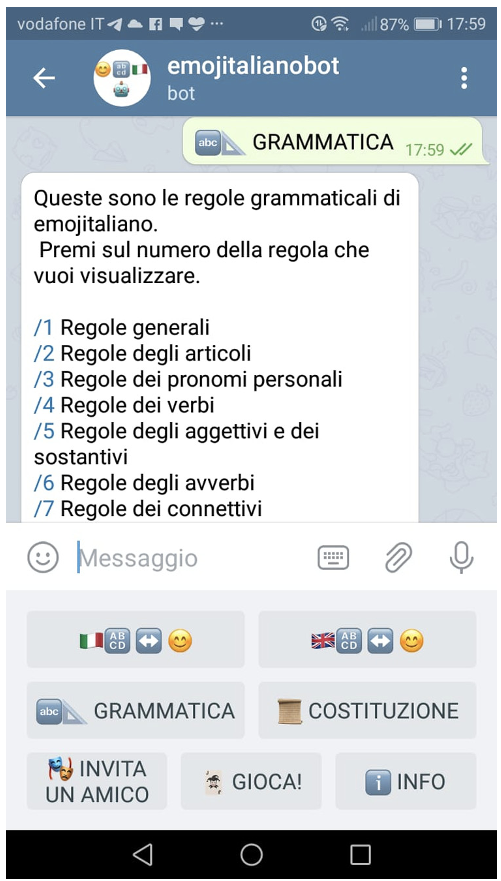 Figure: Snippet of the grammar rules used for personal pronouns and functional markers.
Experiments & Results: From Pinocchio to the Constitution
The method was stress-tested across different genres:
- Literature (Pinocchio): Translated 15 chapters, mapping 2,127 Italian words to stable emoji sets.
- Legal Texts (Italian Constitution): Proved that a visual language could handle abstract legal concepts like "Republic" and "Citizenship."
- Poetry (Leopard’s L'infinito): Tested the aesthetic and metaphorical potential of the code.
 Figure: Article 1 of the Italian Constitution translated into Emojitaliano.
To support users, the team developed @Emojitalianobot on Telegram. This bot acts as a bilingual dictionary (Italian/English to Emoji) and includes the full grammar and a gamified learning interface.
Critical Insight: A Human-Centric "Pivot" Language
The authors suggest that Emojitaliano could serve as a pivot language (a "lingua franca"). Traditionally, machine translation uses English as a hub. By using a visual, semi-universal code like Emojitaliano, we might enable a form of communication that bypasses the "anglocentric" filter of the modern internet.
Limitations & Future Work
- Cultural Specificity: As seen with the "apple" for "fault," some symbols rely on Western/Judeo-Christian imagery, which may not be universal.
- Complexity: While simplified, the grammar still requires learning (e.g., memorizing verb tenses).
- Next Steps: The team is working on a trilingual (Italian-English-Emoji) version of Pinocchio to bridge the gap between major natural languages.
Conclusion
Emojitaliano is more than a social media gimmick; it is a serious exploration of intersemiotic translation. It reminds us that as digital communication evolves, we are returning to ideographic roots—but this time, with the precision of modern linguistics.