
Beyond Monolingualism: Master Code-Switching Emotions with Joint Factor Graphs
Emotion Analysis in Code-Switching Text With Joint Factor Graph Model
This paper introduces a Joint Factor Graph Model (JFGM) tailored for emotion analysis in Chinese-English code-switching social media text. By integrating bilingual attribute functions and emotional correlation factors, the model achieves a state-of-the-art F1-measure of 0.693, significantly outperforming traditional monolingual classifiers.
TL;DR
In the melting pot of social media, emotions often "switch" between languages. This paper proposes a Joint Factor Graph Model (JFGM) that treats bilingual features and emotional correlations as a unified graph problem. By decoding the hidden relationships between Chinese and English words—and between different emotions like "Happiness" and "Sadness"—the authors push the F1-measure to 0.693, proving that context is truly multi-lingual.
Problem & Motivation: The "Hold 不住" Challenge
Social media users on platforms like Weibo frequently blend languages. A phrase like "hold 不住" (cannot take it) is a classic example of code-switching where the emotional weight isn't just in the English "hold" or the Chinese "不住," but in their unique combination.
The authors identify two fatal flaws in previous SOTA methods:
- Bilingual Blindness: Treating mixed text as a single-language string ignores the specific semantic nuances of the embedded language (English) versus the matrix language (Chinese).
- Emotion Isolation: Most models predict one emotion at a time. However, data shows that 14.2% of posts contain multiple, often related emotions (e.g., a mother feeling happy for her son but sad about his changing appearance).
Methodology: The Architecture of Connection
The core innovation lies in the Joint Factor Graph Model, which bridges the gap between raw text and semantic feeling through two specific functions:
1. Attribute Functions (Bilingual Insight)
The model extracts features from three sources: Chinese text, English text, and a translated layer. Using a Statistical Machine Translation (SMT) strategy, English words are mapped to Chinese to ensure the model captures the "bilingual bridge." These are fed into a bipartite graph structure.
2. Factor Functions (Emotional Correlation)
Instead of isolated labels, the model treats emotions as nodes in a graph. If "Happiness" and "Surprise" appear in the same post, the Factor Function models their relationship, essentially acting as a "soft constraint" during the learning process.
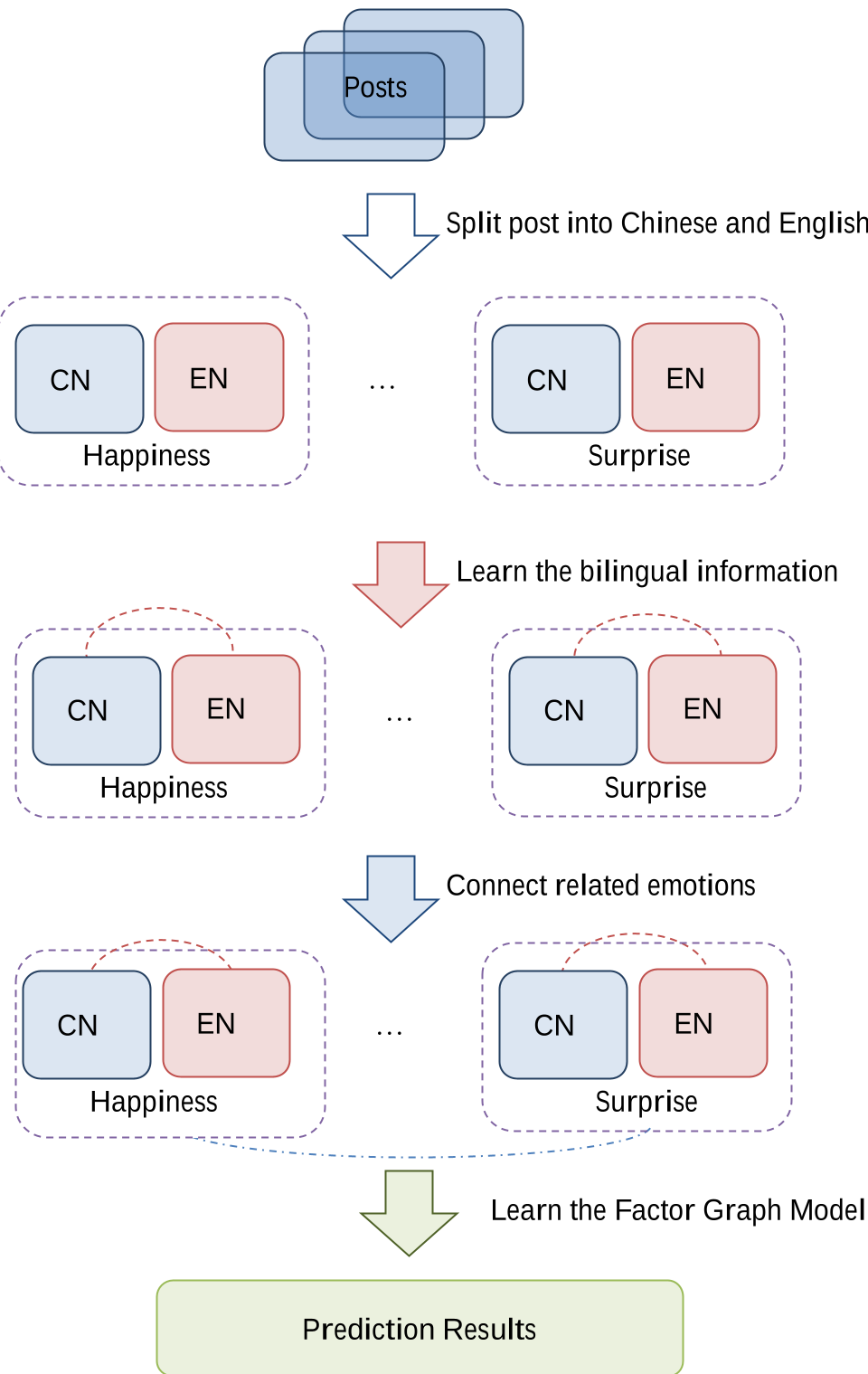 Fig 1: The factor graph model framework connecting bilingual attributes and emotional nodes.
Experiments & Results: Quantitative Breakthroughs
The authors tested their JFGM against several baselines on a dataset of 4,195 annotated Weibo posts.
- Baseline (ME): 0.653 F1
- Bilingual Only (ME-Bilingual): 0.672 F1
- Emotion Relation Only (FGM-Emotion): 0.690 F1
- JFGM (The Full Suite): 0.693 F1
The experiment reveals that modeling the relationships between emotions (e.g., how "Sadness" might trigger or follow "Anger") provides a bigger performance jump than just adding translation features.
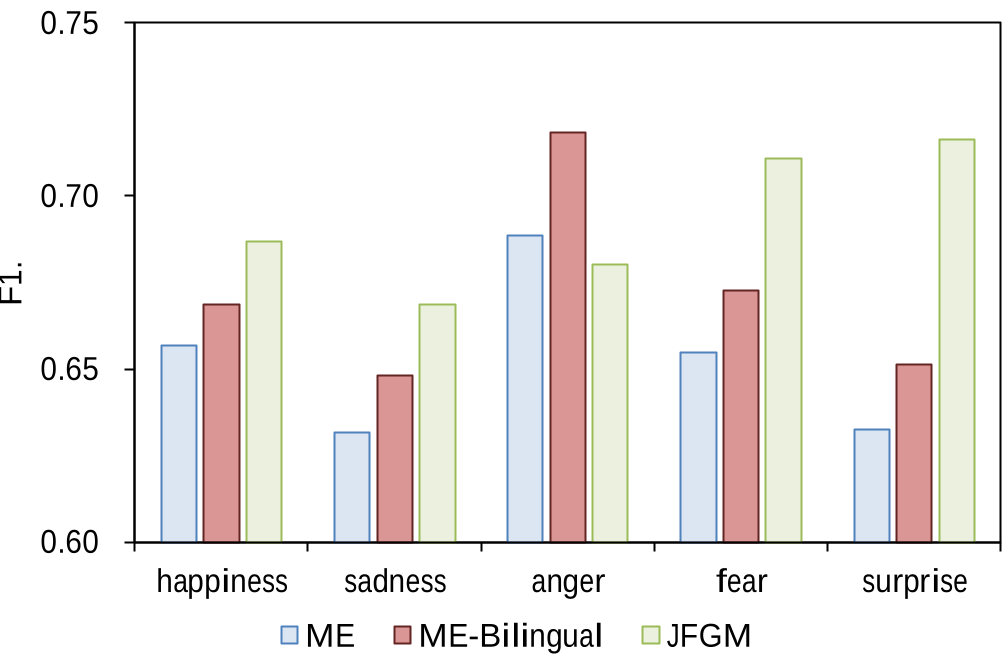 Fig 2: Comparison of F1-scores across different emotion categories.
Why it works: Case Studies
In posts like "感冒了一场,我真是 hold 不住" (Caught a cold, I really can't take it), traditional Maximum Entropy models failed to detect any emotion. The JFGM correctly identified Sadness because it captured the bilingual semantics of the "hold" + "不住" combination through its joint learning framework.
Critical Analysis & Conclusion
Takeaway
This research is a milestone in Code-Switching NLP because it refuses to "simplify" the problem by just translating everything into one language. Instead, it respects the structure of bilingual thought.
Limitations & Future Work
While the MT-based approach is effective, it relies on word-by-word translation, which might miss complex syntax. Future iterations could benefit from Cross-lingual Word Embeddings (like mBERT or LASER) to eliminate the need for an explicit translation step. Additionally, expanding the graph to include social ties (user-to-user relationships) could further refine emotion prediction accuracy.
Ultimately, this study proves that in the digital age, emotions are not just what we say, but how we navigate the bridge between the languages we speak.