
Sentiment-Aware Argument Mining: Decoding Logic Through Emotion and Rhetoric
4129_Emotion argumentation.
This paper introduces an Argument Mining framework that leverages linguistic features and emotional indicators to classify text into Premises and Conclusions. By integrating rhetorical patterns, POS-based tense analysis, and sentiment weights, the study achieves a significant F-Measure of 0.957 using a Naïve Bayes classifier.
TL;DR
This research presents a robust framework for Argument Mining, specifically the classification of "Premises" and "Conclusions." By combining classical linguistic features (Part-of-Speech, Tense) with Emotional Sense Weights, the authors demonstrate that a sentiment-informed Naïve Bayes model can achieve an F-Measure of 0.957, significantly outperforming standard structural approaches.
Problem & Motivation: The Missing Link in Logic
Argument mining is the task of automatically identifying the components of an argument. However, human reasoning isn't just a sequence of logical tokens; it is often wrapped in specific rhetorical strategies and emotional intensities. Prior works often treated arguments as neutral data points, failing to capture the "vibe" of a conclusion versus a premise.
The authors identified that certain emotional states—like Anger or Surprise—and specific rhetorical markers (e.g., "In conclusion" vs. "Furthermore") are strong predictors of a sentence's role in an argument.
Methodology: Fusing Linguistics with Affective Computing
The researchers built a feature engineering pipeline that looks at four distinct dimensions:
- Temporal & Structural Features: Using POS tags to identify Past vs. Future tenses (e.g., MD+VB for MD+VBN).
- Rhetorical Patterns: Categorizing words into Conclusion (e.g., "All in all"), Suppose (e.g., "Moreover"), and Oppose (e.g., "Nevertheless").
- Sentiment Weighting: Calculating emotion vectors for every sentence.
- Probabilistic Classification: Utilizing Naïve Bayes, SMO, and Decision Trees to map these features to labels.
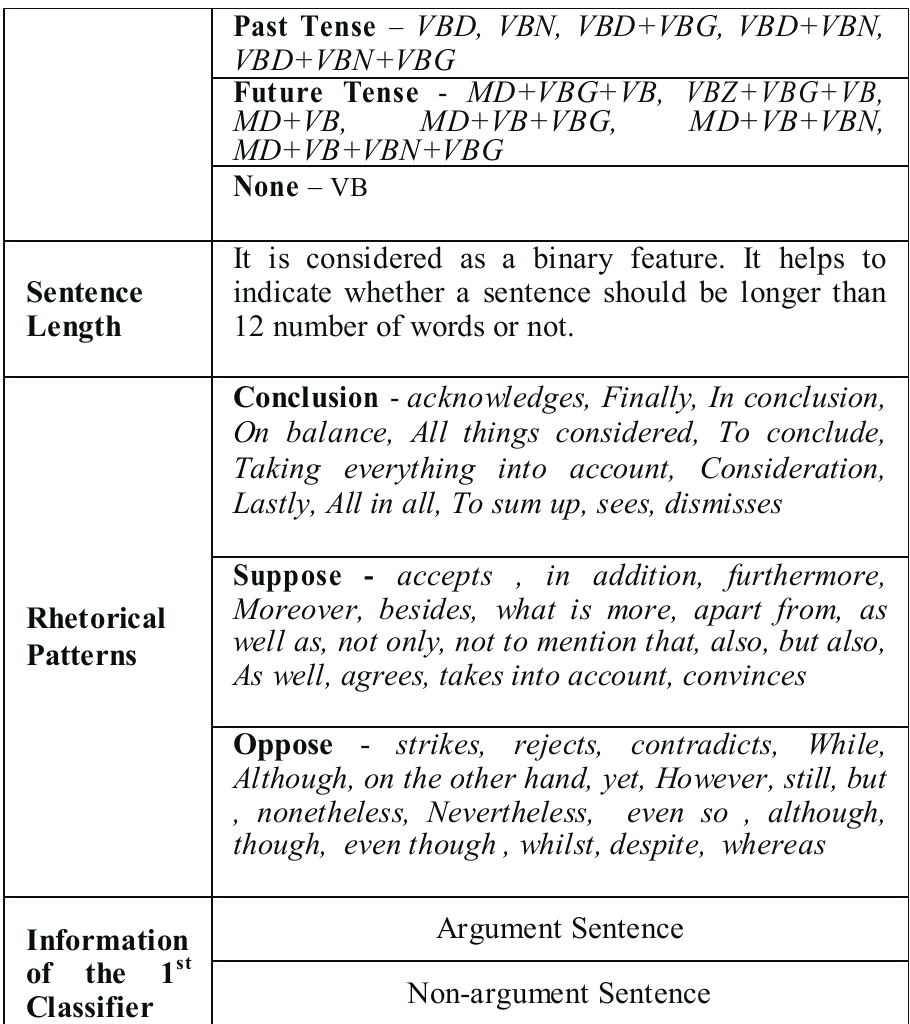
The core insight lies in the Sense Weight table, where different emotions are assigned specific values (e.g., Sadness at 0.1023) to quantify their contribution to the argumentative nature of the text.
Experiments: Naïve Bayes Takes the Lead
The study conducted rigorous testing across multiple classifiers. The experimental results were striking: Naïve Bayes proved to be the most resilient model for this specific feature set.
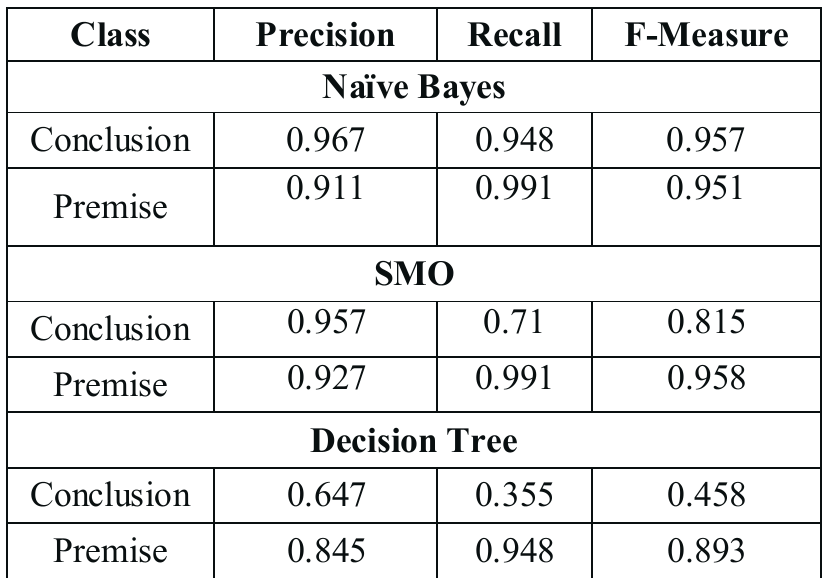
Performance Highlights:
- Precision (Conclusion): 0.967 (Naïve Bayes) vs. 0.647 (Decision Tree).
- Recall (Premise): 0.991 (Naïve Bayes), demonstrating an almost perfect ability to capture supporting evidence.
- Emotion Correlation: The system showed high accuracy in detecting "Neutral" sentences (89.30%), which is vital for filtering out non-argumentative noise.
Critical Analysis & Conclusion
The value of this work lies in its validation of rhetorical and emotional features as high-signal indicators for argumentative structure. By moving beyond simple N-grams to semantic "Sense Weights," the model gains a deeper understanding of how humans actually persuade.
Limitations & Future Work
While the precision is high, the reliance on manual rhetorical word lists might limit the model's adaptability to evolving internet slang or different languages. The next logical step would be to integrate these Sentiment Sense Weights into a Deep Learning architecture (like a Bi-LSTM or BERT) to see if the handcrafted features can enhance the latent representations of large language models.
Takeaway for Researchers
If you are building an argument mining system, don't just look at what is being said; look at the tense it's said in and the emotion it carries. Logic and emotion are two sides of the same coin in human discourse.