
TapSense: Decoding Human Emotion Through the Rhythm of Typing
Emotion-aware computing using smartphone
This paper introduces TapSense, a smartphone-based emotion detection system that leverages unobtrusive keystroke dynamics to infer user affective states. By utilizing a Random Forest-based personalized model, it achieves a high-level recognition of states like happiness, sadness, and stress without requiring specialized hardware.
TL;DR
Determining how a user feels usually requires intrusive cameras or expensive wearable sensors. TapSense changes the game by proving that the way we type on our smartphones—our speed, our errors, and our use of special characters—is a reliable window into our emotional state. By analyzing keystroke dynamics, this research achieves a 78% accuracy in detecting emotions like stress and happiness in a completely non-intrusive, energy-efficient manner.
The "Sampling Paradox" in Affective Computing
Smartphones are "digital mirrors," yet accurately capturing a user's emotion involves a difficult tradeoff:
- Resource Drain: Sampling CPU-intensive data like voice or video kills battery life.
- Privacy Intrusion: Users are rightfully hesitant to have their calls or messages constantly recorded.
- Complexity: Combining signals from GPS, App usage, and SMS creates a "black box" where it is hard to tell which signal actually matters.
The author's insight is elegant: Why not focus on the most common interaction? As we shift toward instant messaging, our typing patterns become a continuous, high-fidelity stream of behavioral data that reflects our cognitive and emotional load.
Methodology: The Architecture of TapSense
The researcher developed an Android prototype called TapSense. Instead of logging what you type (which would be a privacy nightmare), it logs how you type.
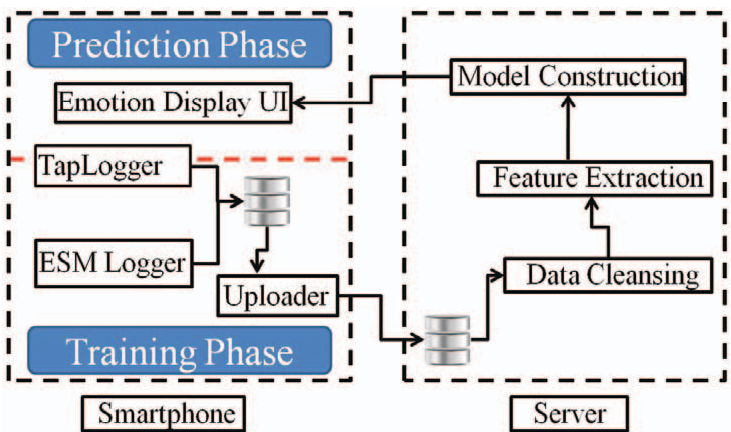
The system focuses on a specific set of Keystroke Features:
- Typing Speed & Duration: Do you type faster when stressed?
- Error Correction: A high frequency of backspaces or deletes can indicate frustration or lack of focus.
- Character Diversity: The use of special characters often correlates with emotional intensity.
- Contextual Metadata: The length of the session and the time elapsed since the last emotion report.
These features are fed into a Random Forest model. Why Random Forest? It handles the non-linear relationship between typing patterns and emotions effectively while remaining light enough to run on mobile hardware.
Experimental Results: Precision in the Wild
Unlike many studies done in controlled lab settings, this research conducted a 3-week uncontrolled study with 22 participants. This "in-the-wild" approach proves the system's robustness against the chaos of daily life.
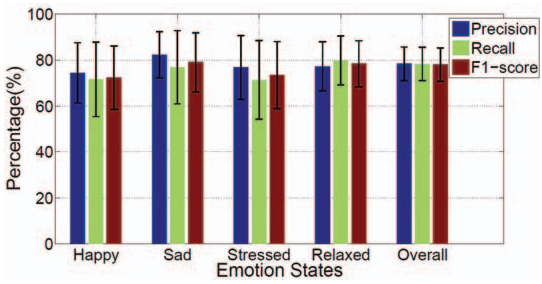
Key Performance Highlights:
- Overall Accuracy: An impressive 78% across four emotional states.
- State-Specific Precision: The model was remarkably consistent, maintaining 74% to 82% precision across Happy, Sad, Stressed, and Relaxed states.
- Superior Ground Truth: By using an intelligent experience sampling method, the researchers ensured that the labels provided by users were more accurate than traditional "fixed-interval" prompts.
Critical Analysis & Future Outlook
The beauty of this work lies in its simplicity and efficiency. By identifying typing as an "ideal" information source, it bypasses the need for the complex multi-sensor fusion that plagues other mobile sensing projects.
Limitations: While typing is frequent, it isn't constant. There may be long "silent" periods where the user isn't typing, making real-time continuous monitoring difficult during activities like watching a movie or driving.
The Future: The author envisions this as a bridge to Affective Learning. Imagine an educational app that detects your frustration via your frantic backspacing and automatically offers a hint or lowers the difficulty level. This moves us closer to a "Quantified Self" where our devices don't just track our steps, but truly understand our mental well-being.
Conclusion
TapSense demonstrates that high-accuracy emotion AI doesn't require a laboratory. By tapping into the existing "heartbeat" of our digital lives—the keyboard—we can build systems that are at once deeply personal, energy-efficient, and respectful of privacy.