
Unmasking the Digital Puppet Master: A Decade of Sybil Defense in Social Networks
SPECIAL SECTION ON EMOTION-AWARE MOBILE COMPUTING
This paper serves as a comprehensive survey of Sybil attack defense techniques in Online Social Networks (OSNs) from 2006 to 2016. It introduces a new taxonomy classifying defense schemes into graph-based, machine-learning-based, manual verification, and prevention approaches, highlighting state-of-the-art tools like SybilRank and SybilBelief.
TL;DR
The "Sybil Attack"—an adversary creating thousands of fake identities to manipulate trust—remains one of the most critical threats to the integrity of Online Social Networks (OSNs). This deep-dive survey (2006–2016) explores how researchers have transitioned from simple structural graph analysis to advanced machine learning and "Sybil Tolerance" schemes to protect platforms like Facebook, Twitter, and RenRen.
Problem & Motivation: The Illusion of Trust
Why is it so easy to disrupt a billion-user platform? The paper identifies three fatal flaws in OSN design:
- Openness at Zero Cost: Unlike opening a bank account, social media identities are "lightweight."
- Blind Trust: Users are 11% more likely to click a malicious link if it appears to come from a "friend."
- Algorithmic Vulnerability: Recommender systems and reputation scores are easily "gamed" by a swarm of fake accounts providing artificial engagement.
The technical challenge lies in the Assymmetry of Information: a fake account can perfectly mimic a trustworthy human's behavior, making binary classification nearly impossible for standard security filters.
Methodology: The Taxonomy of Defense
The authors propose a multi-dimensional taxonomy to categorize how we fight back.
1. Graph-Based Approaches (The Structural Shield)
These methods treat the social network as a mathematical graph . The core intuition is the Edge Bottleneck: while an attacker can create millions of Sybil nodes, they can only create a limited number of "trust links" (attack edges) with real, cautious humans.
- SybilGuard & SybilLimit: Use "Random Walks" across the graph. If two walks intersect, the nodes are likely in the same "honest" region.
- SybilRank: Ranks users based on their "trust power" landing probability. Honest nodes get more "heat" from trusted seeds than Sybils trapped behind a bottleneck.

2. Sybil Tolerance: Managing the Damage
Instead of trying to ban every bot (which is often a game of "whack-a-mole"), Sybil Tolerance systems like SumUp and Ostra use "Credit Networks." Every interaction costs a unit of credit. If an account behaves maliciously, its social bank account is drained, effectively silencing its influence without needing to delete the account.
3. Machine Learning: Analyzing the "Click"
The paper highlights the shift toward Clickstream Analysis. By looking at how a user moves through the site (the sequence and timing of clicks), models like Clickstream (Wang et al.) can distinguish the mechanical patterns of a bot from the erratic, emotional behavior of a human.
Performance Benchmarks: The Reality Check
The survey provides a rigorous comparison of modern tools. A standout mentioned is Integro, which significantly outperformed the structure-only SybilRank by incorporating "victim prediction"—calculating the likelihood that a real user is "naive" enough to accept a fake friend request.
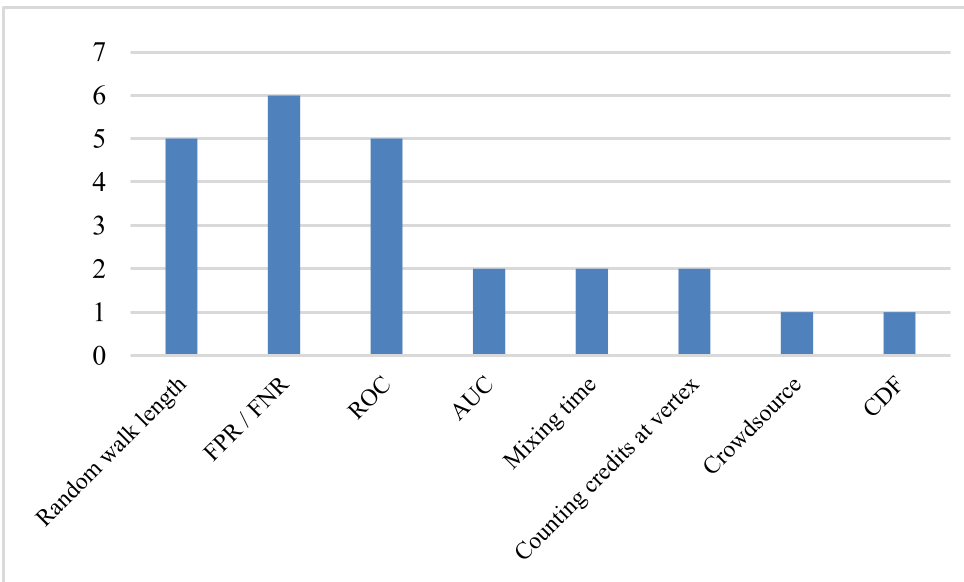
Key findings from the experimental data:
- Scalability remains the bottleneck: Many Bayesian models (SybilInfer) cannot scale past 30,000 nodes, whereas real networks have millions.
- The "Fast Mixing" Myth: Many graph algorithms assume social networks "mix" quickly. The authors argue this is a theoretical convenience that often fails in the fragmented reality of global OSNs.
Critical Insight: The Human Element
One of the paper's most fascinating sections discusses "Emotional Engineering." Sybil attackers don't just use code; they use psychology. By using attractive profile pictures or "attractive" language, they trigger oxytocin release in targets, bypassing the "edge bottleneck" through emotional manipulation.
Conclusion & The Future of Defense
The "arms race" is shifting. As Sybil operators buy human labor (social black markets) to maintain fake accounts, pure algorithmic detection is not enough. The survey concludes that the next generation of SOTA must be a hybrid:
- Structural + Content: Combining graph topology with NLP keyword analysis.
- Decentralized Intelligence: Moving away from central server verification to distributed trust models.
- User Feedback Integration: Leveraging negative feedback (rejected friend requests) as a weighted penalty in graph ranking.
For practitioners, the takeaway is clear: don't rely on a single defensive layer. The digital puppet master is always learning.