
Emotion-Aware Multimedia: Securing the Heart of Social Robotics
Emotion-Aware Multimedia Systems Security
This paper proposes a security framework for emotion-aware multimedia systems involving social robots, edge computing, and cloud layers. It introduces a polynomial-based access control policy and a collaborative identity authentication mechanism to protect sensitive emotional data and reduce computational overhead.
TL;DR
As social robots become our emotional caregivers, they handle our most private data—our feelings. This paper introduces a robust security framework that leverages Polynomial-based Access Control and Collaborative Edge Authentication to ensure that this data remains private while maintaining the low-latency response times essential for human-robot interaction.
Problem & Motivation: The Privacy of Feelings
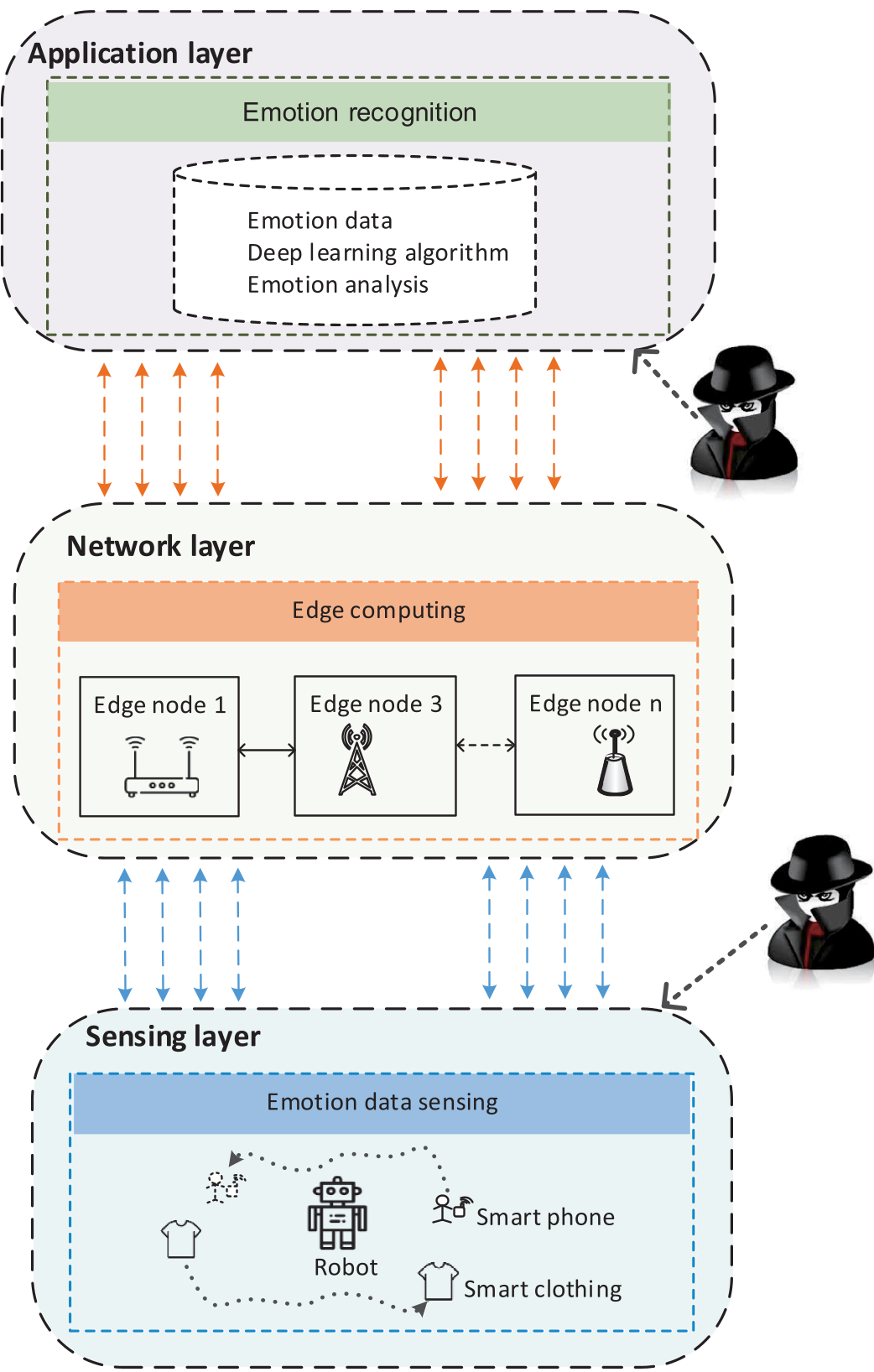
Traditional social robots focus on "what" we say, but next-gen systems analyze "how" we feel. This creates a massive data footprint involving physiological and psychological metrics. Current security paradigms fall short in two ways:
- Trust Assumptions: They often assume edge cloud nodes are fully trusted, which is dangerous in distributed, vulnerable environments.
- The Latency Penalty: Security protocols usually add seconds of delay, "killing" the natural flow of human-robot empathy.
The authors argue that a robot's inability to protect or quickly process emotional data isn't just a technical bug—it's a fundamental breach of user trust.
Methodology: Polishing Security at the Edge
1. Polynomial-Based Access Control
To remove the need for a trusted third party, the authors treat access permissions as roots of a polynomial. For a user with a set of permissions , a polynomial is constructed:
Verifying access simply requires the edge node to check if the provided permission is a root of the polynomial. This makes permission updates and multi-device management (where one user has multiple robots) seamless and mathematically elegant.
2. Collaborative Identity Authentication
In a world of mobile users, a robot or user might move between different edge cloud coverage areas. Instead of re-authenticating from scratch (which wastes CPU and time), the authors propose a Collaborative Mechanism. When one edge node verifies a signature, it generates an integrated signature and shares it with neighbors. Other nodes can then verify the result without re-processing the entire raw identity data.
Results: Faster, Leaner, Safer
The researchers tested their framework against traditional Access Control (TA) and single-node authentication.
- Efficiency: While traditional RSA-based or complex attribute-based encryption (ABE) schemes see a linear explosion in key size, this method keeps public and private keys at a near-constant, low level.
- Latency: The most striking result is in decryption. At 100 attributes, the proposed scheme is roughly 8x faster than traditional methods, finishing in less than a second.
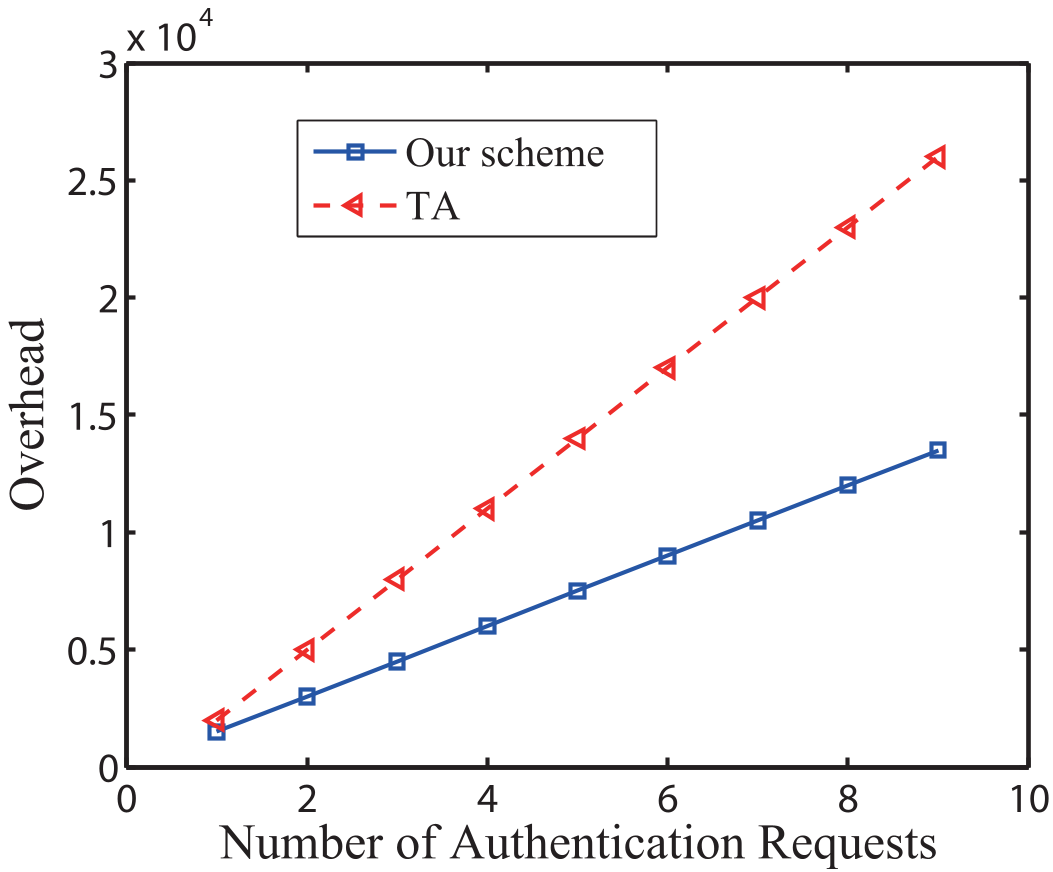
- Scalability: Computation and communication overhead remain manageable even as authentication requests scale, proving the system is ready for mass-market social robot deployments.
Critical Analysis & Conclusion
The true innovation of this work lies in recognizing that emotion is a biometric. By treating emotional states as part of the identity authentication process, the system becomes more personalized.
Limitations
While the collaborative authentication reduces overhead, it introduces a degree of "cascading trust" between edge nodes. If one node is compromised and validates a malicious signature, that "trust" could propagate. Future work should investigate "Zero-Trust" models within this collaborative framework.
Final Takeaway
This paper serves as a blueprint for the future of "Empathic IoT." By moving away from centralized, "trust-everyone" models to decentralized, mathematically-proven access control, we can finally interact with social robots without fearing for our privacy.