
Harmonizing with the Elements: How Weather-Driven Emotion Factors Revolutionize Music Recommendations
Emotion-Aware Music Recommendation
The paper introduces an emotion-aware music recommendation system that utilizes real-time weather information as a proxy for user mood. By analyzing K-pop "Mania Charts" alongside historical weather data, the authors developed Logistic Regression and Alternating Least Square (ALS) models to predict music preferences based on environmental factors.
TL;DR
Music preference isn't just about what you liked yesterday; it's about how you feel right now. This paper explores an "Emotion-Aware Music Recommendation System" that uses real-time weather data to infer user moods. By moving beyond simple popularity charts, the researchers demonstrated that models considering weather clusters can outperform standard baselines by over 20%, especially during high-stress weather events like summer monsoons.
Contextual Intelligence: The Missing Link in Personalization
Traditional streaming services (Spotify, Apple Music) rely heavily on keyword searches and collaborative filtering. While effective, these methods have a blind spot: they assume user preferences are relatively static. However, human emotion is a "latent factor"—it's always there, influencing our choices, but it's hard for a computer to see.
The authors argue that weather is one of the most consistent external drivers of mood. Instead of asking a user "How are you feeling?", the system looks out the window. If it's raining, the system recognizes a shift toward "loneliness" or "melancholy." If it's a romantic snowy day, the preference shifts again.
Methodology: Decoding the "Mania" in the Music
To build a clean dataset, the researchers made a strategic choice: they ignored the general Top 100 charts. Why? Because K-pop charts are often skewed by "fandom culture"—die-hard fans streaming a new Boy Band release 24/7 regardless of the weather.
Instead, they used the "Mania Chart", which tracks the top 2% of power users and excludes songs newer than one year. This "de-noises" the data, allowing the true correlation between weather and music to emerge.
The Engine Under the Hood:
- Weather Clustering: Using K-means clustering, the researchers grouped days into 8 distinct weather profiles based on temperature, humidity, and the Discomfort Index.
- Modeling: They compared Multi-class Logistic Regression (predicting the probability of a song appearing in the chart) and Alternating Least Squares (ALS) to decompose the relationship between weather clusters and songs into latent emotion factors.
- Hybridization: A final hybrid model combined these insights with a baseline of overall popularity.
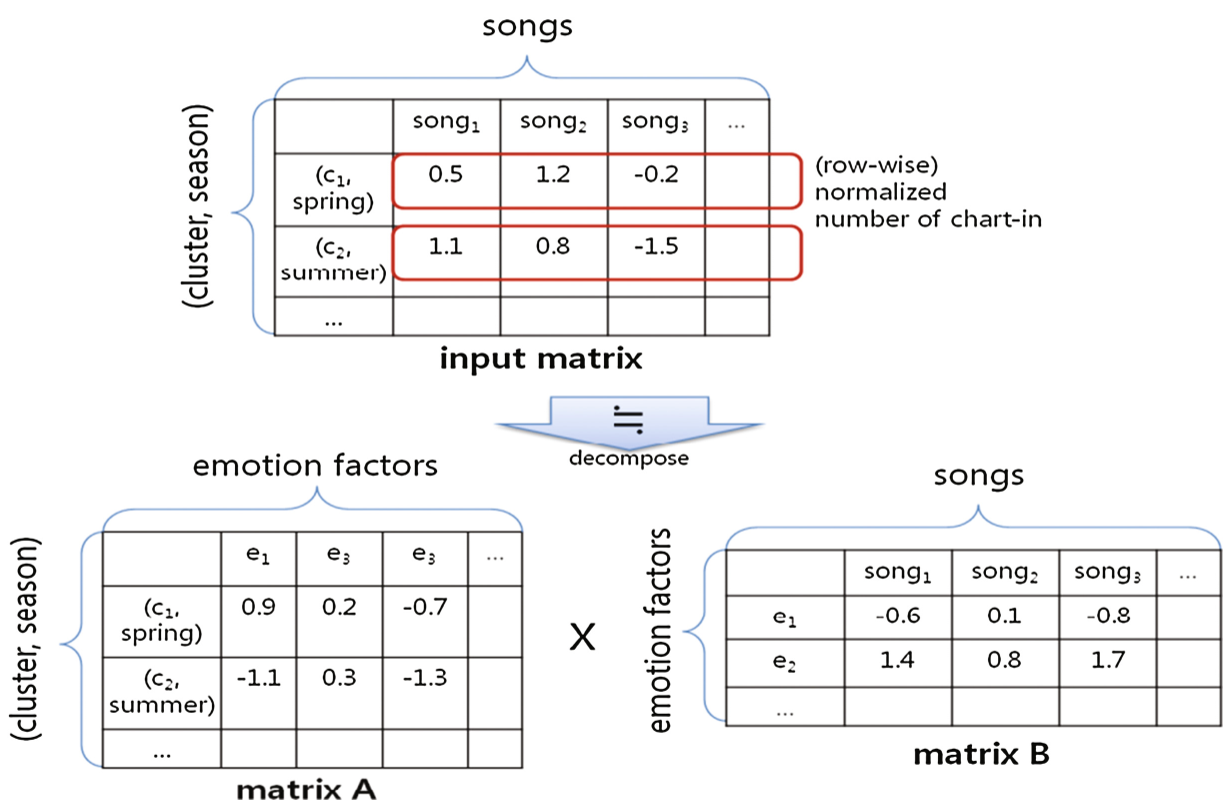 Figure: The ALS model decomposes the interaction between weather clusters/seasons and music into latent emotion factors.
Key Insights: When Does Weather Matter Most?
The study revealed a fascinating seasonal trend. In South Korea, the impact of weather on music choice peaks during the summer months (June, July, and August). During the monsoon and typhoon seasons, the high Discomfort Index acts as a powerful catalyst for emotional shifts, leading users to seek specific types of music to compensate for the "displeasure" of hot and humid weather.
Conversely, during winter (December to February), the "weather effect" is marginal. This suggests that while extreme heat or rain creates an emotional "pull," moderate cold might have a less uniform impact on our musical needs.
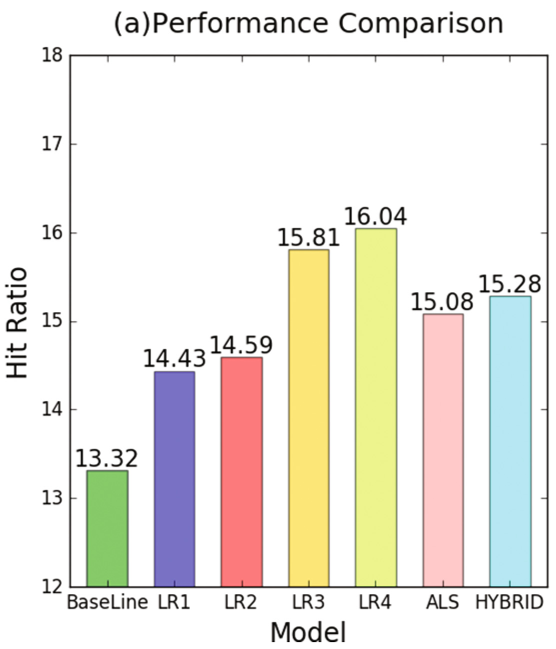 Figure: The performance boost of Logistic Regression (LR) and ALS models over the popularity Baseline.
Critical Analysis & Future Outlook
While the 20% improvement is significant, the paper acknowledges its limitations. Weather is an "implicit" capture of mood—it's a high-level proxy. The study serves as a foundation for even more granular systems that could integrate:
- Biometrics: Heartbeat and physiological stress levels.
- Social Context: Social media activity or recent location history.
- The Cold Start Problem: Predicting preferences for brand-new songs that don't have historical weather-alignment data remains a challenge.
Conclusion: This work marks a shift from "Recommendation based on History" to "Recommendation based on Context." By aligning digital services with the physical environment, we can create AI that feels more intuitive and "human."