
EMMA: Scaling Empathy Through Machine Learning and Passive Sensing
EMMA: An Emotion-Aware Wellbeing Chatbot
EMMA (EMotion-Aware mHealth Agent) is an emotionally intelligent chatbot designed to deliver personalized mental wellbeing micro-interventions. It utilizes passive smartphone sensor data (primarily GPS) to infer user mood and provides empathetic, context-aware support, achieving comparable user likability to ground-truth self-reporting systems.
TL;DR
EMMA (EMotion-Aware mHealth Agent) is a research project that bridges the gap between passive sensing and mental health intervention. By using smartphone location data and personalized ML models, EMMA predicts a user's mood and delivers "just-in-time" wellness activities—like deep breathing or calling a friend—using an empathetic, expressive tone. The study demonstrates that users find an automated, AI-driven bot just as likable as one that asks them how they feel, opening the door to low-burden mental health support.
Problem & Motivation: The Friction of Self-Reporting
Most current mental health apps suffer from the "Observer's Burden." To help you, they need to know how you feel, which usually involves nagging notifications asking you to rate your mood. This often leads to "app fatigue" and high dropout rates.
The researchers identified a dual challenge:
- Sensing: Can we know if a user is stressed or sad without asking?
- Delivery: Even if we know how they feel, how do we talk to them? A robotic "Please perform activity X" is far less effective than an empathetic "Feeling a bit down? Let's try something to brighten your day."
Methodology: From GPS to Emotion
EMMA's architecture is a pipeline that moves from raw data to affective dialogue.
1. The Sensing Engine
The system collects geolocation and activity data (movement thresholds > 10m). These raw data points are transformed into high-level features like:
- Distance from home/work: Markers of routine and social isolation.
- Location variance: Indicators of "agitation" (high variance) or "lethargy" (low variance).
- Baseline Personalization: Since one person’s "high energy" is another's "normal," the model subtracts individual averages to focus on variations in mood.
2. The Affective Loop
EMMA maps predicted emotions onto the Russell circumplex model of affect, which plots emotions on two axes: Valence (Negative to Positive) and Arousal (Low to High energy).
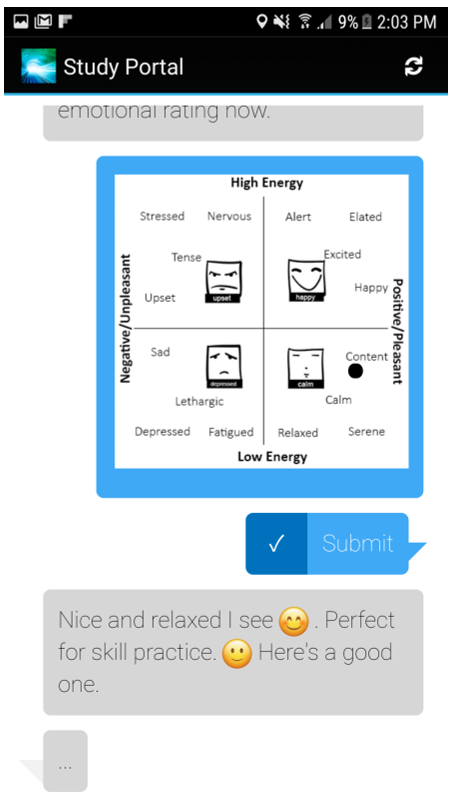
- TL (High Arousal, Negative Valence): "Feeling stressed? Take a breath."
- BR (Low Arousal, Positive Valence): "Feeling calm? Reflect on a happy memory."
Experiments & Results
The study involved a two-week experiment with 39 participants.
Personalized ML Performance
The researchers tested various models, finding that Personalized Regression significantly outperformed generic classification.

Key finding: Arousal is harder to predict than valence. While valence (whether a user is happy or sad) often correlates with routine stability, arousal (the intensity of the feeling) fluctuates more rapidly and requires more granular data.
User Likability: The "Invisible" AI
One of the most significant takeaways is that when the bot switched from manual input in Week 1 to ML-prediction in Week 2, there was no drop in user likability. This suggests that as long as the AI's "guesses" are reasonably accurate, users prefer the lack of friction over the precision of manual entry.
Critical Insight: Respecting the "Good Mood"
Perhaps the most counter-intuitive finding from the qualitative feedback was related to timing: Do not interrupt a good mood.
Participants reported that receiving a "wellness intervention" when they were already in a high-energy positive state (TR quadrant) was annoying and actually lowered their mood. They perceived the app as "prescriptive" or "controlling."
Design Guidelines for Future mHealth:
- Low Effort is High Impact: Short videos or quick stretches were preferred over complex tasks.
- Context is King: Asking a user to "walk to a colleague's office" while they are working remotely shows a lack of contextual intelligence that breaks trust.
- Opt-out Power: Users need to feel in control. An intelligent agent should suggest, not command.
Summary
EMMA proves that emotionally intelligent agents don't need to be perfect; they need to be empathetic and low-friction. By utilizing passive sensing, we can move towards a future where our devices support our mental wellbeing "behind the scenes," intervening only when needed and in a tone that feels human.
Future Work: Incorporating more diverse sensors (heart rate, screen dwell time) and using Reinforcement Learning to diversify content and avoid habituation will be the next frontier for EMMA.