
Beyond Numbers: Enhancing Reputation Guessing with Affective Intelligence
Towards emotion-based reputation guessing learning agents
The paper introduces an emotion-based reputation model for intelligent agents that leverages Ekman’s basic emotions and inductive machine learning to predict item reputation. By integrating affective features extracted from text reviews using the Synesketch tool, the proposed model achieves a significant improvement in utility over traditional numeric-only approaches.
TL;DR
Researchers have developed a new reputation model for intelligent agents that "reads between the lines" of textual reviews to extract human emotions. By moving beyond simple star ratings and incorporating Ekman’s basic emotions—like happiness, anger, and fear—into machine learning models, they achieved statistically significant improvements in predicting the true reputation of products and services.
Background: The Limits of Rationality
In the world of Multi-Agent Systems (MAS), "reputation" acts as a collective memory that protects the system from malicious actors. Historically, these systems have relied on Cognitive Trust—a purely rational calculation based on past success rates and numerical scores. However, human decision-making is rarely purely rational; it is deeply intertwined with emotions.
The authors argue that current reputation models miss a vital dimension: Affective Trust. When a user writes a review, the emotional intensity of their disappointment or joy provides a more nuanced signal of an item's quality than a flat 1-to-5 scale.
Methodology: Bridging Text and Emotion
The proposed model follows a systematic pipeline to transform "feelings" into "features":
- Text Processing: Large reviews are broken down into individual phrases to ensure better accuracy for emotion detection.
- Emotion Extraction: Using the Synesketch library, the model identifies the intensity of Ekman’s six basic emotions (Happiness, Sadness, Fear, Surprise, Anger, Disgust) and overall valence (positive/negative).
- Hybrid Learning: These emotional attributes are merged with traditional numeric data (like the number of hotel stars or total votes) to create a "Transformed Dataset."
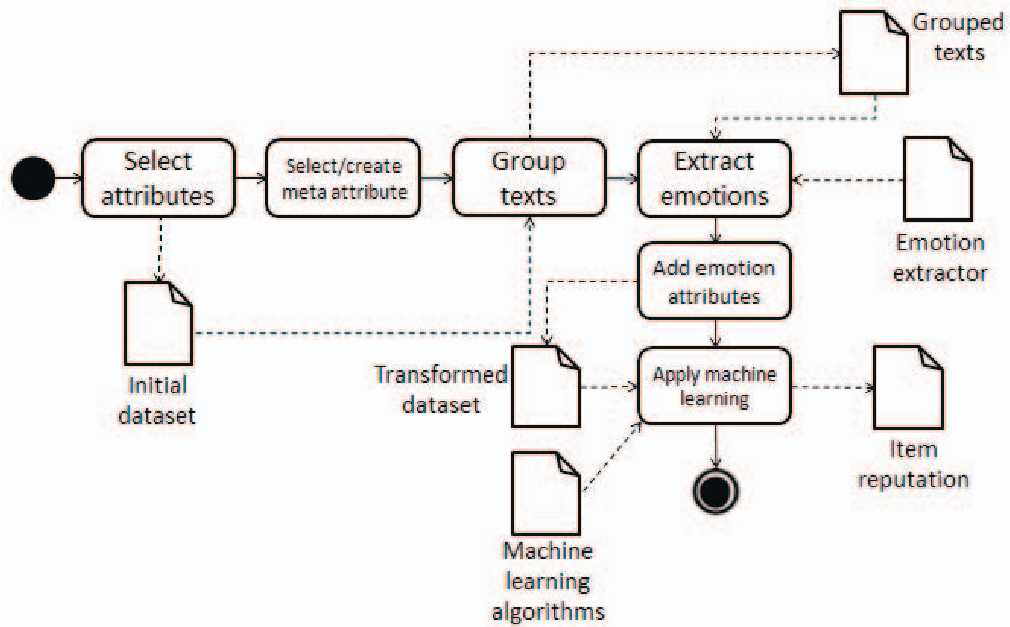 Figure 1: The workflow from raw review text to the final reputation prediction model.
Experiments: Real-World Evidence
The model was put to the test using two massive real-world datasets:
- Trip Advisor: 11,937 reviews of hotels.
- Good Reads: 48,345 reviews of books.
The researchers compared three scenarios:
- D1: Only numeric data (The status quo).
- D2: Only emotional data.
- D3: The Hybrid (Numeric + Emotional).
Key Findings
The hybrid approach (D3) consistently achieved the highest R² (Goodness-of-Fit) scores across multiple algorithms, including M5P Decision Trees and Linear Regression.
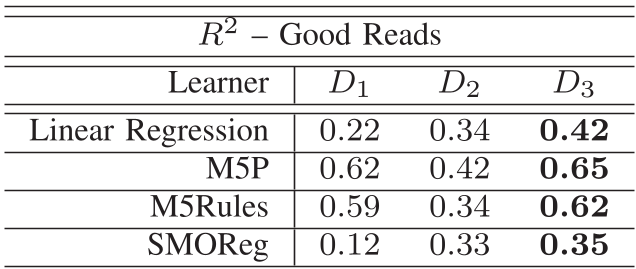 Table: Comparison of R² values in the Good Reads dataset, showing D3 as the clear winner.
The study reveals a fascinating insight through the M5P Decision Tree analysis. In the Good Reads dataset, "Positive emotions average weight" emerged as one of the most significant split nodes in the tree. This means that the emotional "vibe" of a book review is often a better predictor of its long-term reputation than the raw number of votes it receives.
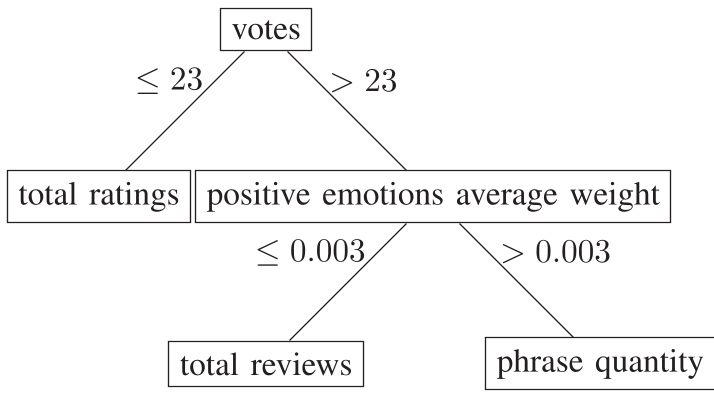 Figure 2: Contrast between models without emotions (a) and with emotions (b), highlighting how emotional weights become primary decision criteria.
Critical Insight: Why Does This Matter?
The core contribution of this work isn't just a slightly higher accuracy score; it's the validation that affective features provide a unique inductive bias that numeric models lack.
While numeric data tells us what someone thought, emotional data tells us how much it mattered to them. This "Affective Trust" acts as a security layer, helping intelligent agents distinguish between a mediocre product and a truly polarizing or disappointing one.
Conclusion and Future Outlook
This paper proves that for an AI to truly understand reputation, it must learn to "feel" the sentiment of its users. While the authors used the Ekman model, future iterations could utilize Appraisal Theory (OCC model) to balance positive and negative emotions more effectively.
As we move toward more autonomous e-commerce and evaluation systems, the integration of these "emotional bounds" will be essential for building agents that we can actually trust.