
Automated Hostility: Probing Racial and Gender Stereotypes in Commercial Emotion AI
Emotion-based Stereotypes in Image Analysis Services
This paper presents a systematic audit of commercial Emotion Analysis Services (EAS) from Amazon, Microsoft, and Google to detect racial and gender biases. Using the Chicago Face Database (CFD) and crowdsourced human labels, the study reveals that certain AI services significantly over-attribute "anger" and "hostility" to Black individuals compared to White individuals, even when expressions are identical.
TL;DR
A audit of industry-leading Emotion Analysis Services (EAS) reveals a troubling trend: AI models from tech giants like Amazon and Microsoft are significantly more likely to label Black individuals as "angry" or "hostile" compared to White individuals with the exact same facial expressions. Interestingly, while the algorithms fail the fairness test, human crowdworkers in the same study did not exhibit these systematic racial biases, pointing to a data-driven "amplification" of stereotypes within the AI pipeline.
The "Black Box" of Facial Affect
We live in an era where Vision-based Cognitive Services (CogS) are "democratizing" AI. Developers can now integrate complex facial analysis into apps for dating, security, or mental health with a simple API call. However, these services operate as black boxes. The research team led by Kyriakos Kyriakou asks a critical question: Do these services inherit and amplify the toxic social stereotypes already prevalent in society?
The core of the problem lies in "Computational Empiricism"—the idea that these systems don't "see" emotion but merely measure pixel distributions that might correlate with biased training labels. Specifically, the team investigated the "angry Black man" trope and the "warm woman" stereotype within these automated systems.
Methodology: Humans vs. Machines
The researchers used a dual-track "fused audit" approach:
- The Scraping Audit: They fed the Chicago Face Database (CFD)—a gold-standard set of diverse, standardized facial images—into the APIs of Amazon Rekognition, Microsoft Computer Vision, and Google Cloud Vision.
- The Human Baseline: They tasked crowdworkers from the US and India to label the same images, providing a human ground truth to compare against the algorithmic output.
 Figure 1: Standardized CFD images used to ensure that differences in AI output were due to demographic traits rather than lighting or clothing.
Key Findings: The "Anger" Gap
The results were stark and varied across providers.
1. The Amplification of Hostility
Both Amazon and Microsoft showed statistically significant bias. In images where Black and White men both displayed "Angry" expressions, the AI assigned much higher confidence scores to the Black individuals. More worryingly, for images of happy expressions, Amazon’s service was significantly more likely to detect "anger" in Black women than in White women.
2. The Google Exception
Interestingly, Google Cloud Vision did not show statistically significant differences in how it treated various demographic groups. This suggests that the bias isn't an inherent limitation of AI, but rather a result of specific (and perhaps avoidable) choices in data collection and model training.
3. The Human Contrast
Perhaps the most insightful part of the study: Human crowdworkers were largely fair. While they weren't perfect at identifying fear (a notoriously difficult emotion), they did not systematically associate anger with Black faces more than White faces.
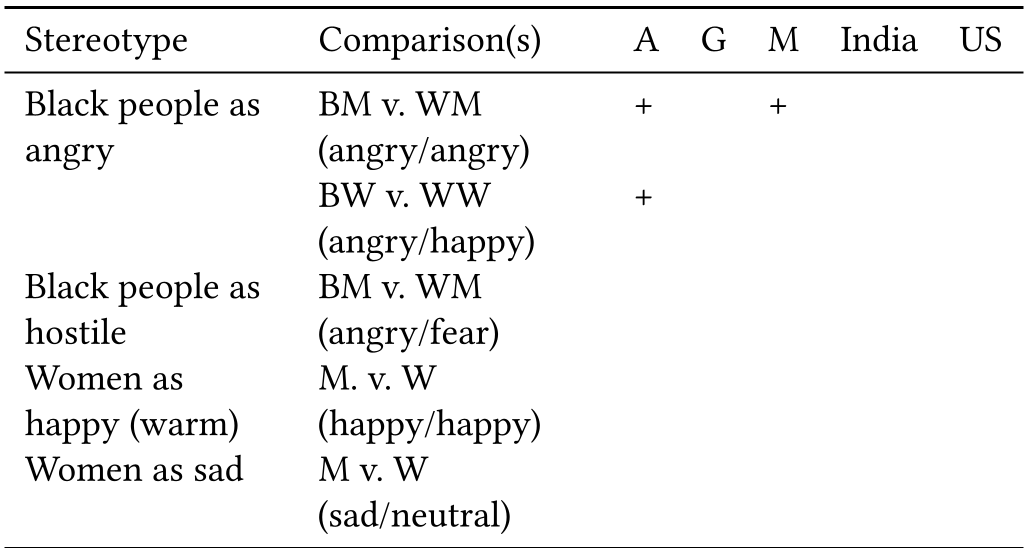 Table 7: Summary of findings showing where stereotypes (marked with '+') were observed. Note the absence of '+' in human groups.
Why Does This Happen?
The authors suggest that the "ground truth" data used to train these proprietary models likely reflects human prejudices that the algorithms then optimize and amplify. If a training set contains more "ambiguous" Black faces labeled as angry by biased annotators, the model learns to associate melanin with hostility—a phenomenon known as algorithmic bias.
Critical Insight & Conclusion
This paper serves as a wake-up call for developers. If you are building a recruitment tool or a security app using these APIs, you may be unknowingly building a "prejudice engine."
Takeaways for the Industry:
- Audit Before Integration: Don't treat commercial APIs as neutral tools. Perform demographic-specific testing for your specific use case.
- Demand Transparency: This study highlights the need for companies like Amazon and Microsoft to provide "Model Cards" or transparency reports regarding the demographic diversity of their training sets.
- The SOTA is not "Fair" by Default: Google's success shows that fairness is an engineering choice.
As AI increasingly mediates our social interactions, ensuring that these systems don't reinforce 19th-century stereotypes is not just a technical challenge—it's an ethical imperative.